Thursday, December 20, 2012

Memory and Tourism in Chile

A colleague called this to my attention. Clío and Mnemósine is an organization dedicated to "heritage tours."

The purpose of our project is to become one of Chile’s main promoters of heritage tours centered on Memory, Recent History, Cultural Heritage and Human Rights.  Moreover, it aims at becoming the primary provider of training in the matter, and a point of reference for research projects on Memory, Recent History, Cultural Heritage and Human Rights.
They are Chileans who want to make some of the most controversial and sensitive issues more accessible to foreigners. Without knowing anything about the organization itself, I like the general idea. There is a growing number of human rights-related museums in Santiago (e.g. see previous posts on my visits to the Memory Museum and Villa Grimaldi) but they are not really tied together. Getting some background, then visiting each in turn would provide valuable insights in Chile's political history.

Read more...

Wednesday, December 19, 2012

Erik Loomis

Erik Loomis is Assistant Professor of History at the University of Rhode Island and blogs at Lawyers, Guns, and Money. Now he is in hot water for tweeting, as his metaphor of "head on a stick" is being taken literally as a call for murder, prompting a visit from the police. This is not reasonable.

Crooked Timber has a good rundown. Here is Erik's own take. Especially if you've read Erik's posts over the years, consider joining me in writing an email to the administrators of his university in his support.

Read more...

Tuesday, December 18, 2012

CV Don'ts

Eszter Hargittai has a discussion of CVs at Inside Higher Ed. For those of you outside academia, a CV is different from a typical resume because it centers only on scholarly pursuits (e.g. no mention of any jobs not related to academia in some way). There is no statement of purpose or the like. Just the academic facts. Reading that post prompted me to add some don'ts. Especially for a job search, you need to remember that the CV is the single most important document because it is your career in an easily digested nutshell.

--Don't bury the key facts of where you received your degree and where you are now. They should be close to the top.

--Don't give a lengthy list of works "in preparation." "Under review" is fine because it signals activity and the ability to complete something, but "in preparation" gives the impression--to me at least--that you are compensating for a lack of accomplishments in hand. I have about 20 things in preparation in my head, but most will stay there.

--For a job search, don't forget to emphasize your accomplishments that fit the job description. If the job involves more teaching, then move up the teaching section. If the job requires someone to teach the politics of restaurants, then be sure to note that class you taught on The International Politics of the International House of Pancakes.

--If you are ABD, then don't forget to provide the expected date of completion. And remember that it looks really bad if a search committee calls your adviser and finds out it's wrong.

I'm sure there are more, but these came to mind immediately.

Read more...

Holiday in Honduras?

This story seems to be based on the statement of only one person. It argues that the very serious Honduras political crisis will take a backseat as all sides agree to stop doing anything over the holidays.

True or just the mocking of a U.S. media intent on perpetuating an image of sloth and siesta? A scan of the Honduran press says nothing about any such arrangement.


Read more...

Sunday, December 16, 2012

Populism and the Future

The Guardian makes a brief comparison between Chavismo and Peronism, arguing that even if Chavez dies now he will leave a long shadow.

True, but it is useful to remember that a movement's direction can be unpredictable. If you had told an Argentine in the 1950s that in 30-40 years Peronism would be the party of austerity and international capitalism, and that a Peronist would tie his country's economy very tightly to the U.S. dollar, they would not have believed you. It's also worth remembering that Juan Peron personally groomed Carlos Menem as an up and coming political leader. The Kirchners then brought the movement back more in line with its origins. Who knows what the next batch of Peronists will do?

Once the charismatic, outsized leader is gone, all bets are off. There will always be Chavismo, and its leader--or even competing leaders--will invoke Hugo Chavez and his revolutionary triumphs. But its precise nature will evolve and at times may not resemble today's Chavismo at all.


Read more...

Thursday, December 13, 2012

Finishing Your Dissertation

Megan MacKenzie at Duck of Minerva has a good post about finishing your dissertation, with a 10 step process. You can really boil down all such advice posts down to write, write, write. I set myself a daily word goal and became fairly reclusive. You can work out whatever incentive structure you want, but keep writing even if you think the writing is not so good. I had also read a long time before about Ernest Hemingway's advice--perhaps apocryphal -to leave an idea for the next day when writing. Whether or not he really gave that advice, I liked that because I found it much easier to quickly get going.

Did I mention keep writing?

Read more...

Wednesday, December 12, 2012

Talking About Immigration Reform

Despite all the talk that the Republican Party "must" embrace immigration reform, even supporters seem concerned about being too supportive. John McCain, for example, has long been an advocate for reform, though of course he had to pretend otherwise to win the presidential nomination in 2008. And now he is afraid even to admit he's talking about reform.


Politico is reporting that a group of eight United States senators, including Arizona's John McCain and Jeff Flake, is discussing immigration reform. 
Flake's office would not confirm the report and McCain's office did not return calls.


I think it's great they're talking. It is sad, though, that nativist pressure is strong enough to make the whole thing furtive.

Read more...

Tuesday, December 11, 2012

CMS and Autism: Does Anyone Care?

Picture this scene. The Dean of Students at a top CMS school, Irwin Elementary, openly mocks a 10 year old autistic child by calling him a two year old in the hallway. The Dean of Students then gets angry, indeed very vocally angry with the parents, at the child's response to the insult, and conveniently omits what he said to provoke it. Later the principal admits in writing it happened, but dismisses it as unimportant.

Just happened last week to my son. And no one in CMS cares.


Read more...

Parsing the Venezuelan Constitution

David Smilde and Hugo Pérez Hernaíz comment on the Hugo Chávez transition issue. Here's one thing that struck me:


It seems likely that Chávez’s fourth surgery is risky enough that he is not sure he will be able to assume his fourth term on January 10. And Article 233 also says that if a president-elect were to die, resign or be declared physically or mentally incapacitated before being sworn in, it is not the Vice President but the President of the National Assembly that becomes acting president. Currently that is Diosdado Cabello. 
What is more, the Constitution does not specify what would happen if the president-elect is alive, has not resigned nor been officially declared incapacitated, but is not able to be sworn in. Presumably in such a case it would also be the President of the National Assembly who would assume the presidency, since cabinet positions such as the Vice Presidency do not automatically carry-over from one term to the next but must be reconfirmed.


This, of course, is why Chávez felt the need to name Nicolás Maduro as successor with a dedazo. Chávez is afraid he may die before January 10, which would make Cabello the interim president. However, it seems to me that if Chávez is in terrible shape but has not been ruled incapacitated, then he can be sworn in if the Supreme Court is amenable. From Article 231 of the constitution:

Artículo 231. El candidato elegido o candidata elegida tomará posesión del cargo de Presidente o Presidenta de la República el diez de enero del primer año de su período constitucional, mediante juramento ante la Asamblea Nacional. Si por cualquier motivo sobrevenido el Presidente o Presidenta de la República no pudiese tomar posesión ante la Asamblea Nacional, lo hará ante el Tribunal Supremo de Justicia.

Morbid, to be sure. But if the judges come to a hospital room--perhaps even in a foreign country?--the constitution is being followed. Get sworn in, then step down, and Maduro is interim president.

Read more...

Sunday, December 09, 2012

Chavez and cancer

Hugo Chavez says his cancer--still undefined--has returned and so once again he will go to Cuba.

He was absolutely masterful in making himself appear sufficiently healthy during the campaign that the cancer ceased to be a factor for the presidential election. He made a major effort to make just enough public appearances, deny rumors and, above all, avoid secret trips to Cuba. Henrique Capriles framed himself as youthful but ultimately that didn't matter. Chavez was vigorous enough to take the issue off the table.

But he held on and won the election, and so the question is no longer whether the opposition can take electoral advantage of the situation, but rather just how a potential chavista transition would look for the next six years. That's a lot of political breathing room.

When the government refuses to tell the truth, then rumors will fly even more than usual. At this point, there is no reason at all to believe any public declaration denying Chavez's health problems.


Read more...

Friday, December 07, 2012

People Who Should Not Have Signs

From Rob Neyer's Twitter feed. I had no idea Nashville had erected a sign to William Walker, who ranks very high on the list of the most arrogant and stupid Americans trying to screw up Latin America.


And the state of Tennessee calls him an "idealist." Oy.

Read more...

North Carolina Immigration Policy

Very nice to read this report from the North Carolina House Select Committee on the State's Role in Immigration Policy. What it indicates is that the state legislature is not going to pursue punitive policies a la Arizona and other states. It emphasizes over and over that a wide range of stakeholders will need to provide input, and urges the federal government to enact reform.

Finally, the Committee recommends a renewed focus on economic development potential and opportunities to increase North Carolina's regional competitiveness through pragmatic approaches to immigration in this State.

Good. This doesn't preclude an individual member from introducing a wacky piece of legislation, but the leadership wants pragmatism aimed at promoting economic development. That means avoiding legislation that either deprives businesses from getting workers or burdening them unduly with regulations.

Also nice to read this from House Speaker Thom Tillis:

“It’s a very emotional issue on both sides, and we’ve got to try and hold that rhetoric off and look at things that benefit the economy, treat people respectfully, and in some cases, address some symptoms now whose problem is really rooted in federal policy. I just think we need to be very careful with it,” Tillis said.

Let's hope the leadership retains that attitude.

Read more...

Thursday, December 06, 2012

Michael Lewis' The Blind Side

I am late to it, but just read Michael Lewis' The Blind Side, the story about how Michael Oher went from homeless to NFL left tackle through the intervention of rich people in Memphis. It's an unusual and intriguing story--Lewis makes the evolution of the left tackle really interesting--but ultimately the book didn't uplift me much, and Lewis didn't intend it to. It's a reminder that sports plays an absurd role in our lives. Oher is essentially a large piece of meat, viewed primarily in financial terms, as is the case with all his teammates at Ole Miss. Almost no one cares about them at all. They get sucked from the ghetto to entertain rich white people, and then go back to the ghetto once their playing eligibility ends. Absent his amazing size, strength, and speed, Oher would've gone nowhere. Lewis talks to men in the housing projects who once were phenoms, and now are drug dealers.

Therefore it's also a story about the strong racial divide that still exists in Tennessee, Mississippi, and elsewhere. Football brings the two together in ways that reinforce de facto segregation. So the "feel good" story is depressing. It's a reminder of how many lives are still being wasted.

Read more...

Wednesday, December 05, 2012

Ranking and Placement in Political Science

So how does ranking of your Political Science program affect job placement? Today this topic seems to be the definition of viral. My dean emailed me the Chronicle of Higher Education article first thing this morning. A similar article appeared in Inside Higher Ed (without a paywall), and suddenly I see responses in Twitter, Facebook, and blogs. Responding hours later makes me very late to the party.

The money quote:

The median institutional ranking of institutions in the study is 11, which Mr. Oprisko said implies that 11 institutions contributed half of the political scientists who filled tenured or tenure-track positions at research-intensive universities in the United States. That means that graduates of the more than 100 other political-science programs competed for the remaining 50 percent of job openings.

I'm still chewing on this a bit. It implies that "job openings" only appear in those particular institutions being studied, which obviously isn't true--there are lots of good jobs outside the purview of the study. But still, this is a pretty serious concentration.

The bottom line is that it is hard to argue with the idea that candidates in lower ranked schools find it more difficult to get a job, especially a job without a really heavy teaching load. All things being equal, someone with a more prestigious Ph.D. is viewed--rightly or wrongly--as being less risky in terms of getting tenure. This isn't fair, but it's true. If you advising people who want a Ph.D., or are thinking of one yourself, you need to acknowledge this reality.

See also:

--The Monkey Cage

--Mike Munger

--James Joyner

Read more...

Going paperless

The Chronicle's ProfHacker blog has a lot on going paperless in some form or another. I started trying to do that more this semester. As I mentioned before the semester began, I used iAnnotate to grade papers in my U.S.-Latin American Relations course. I really liked how it worked--easy to use a stylus or type to write on the term paper, plus voice comments--but it does not mesh well with Moodle, which is the online course platform that UNC Charlotte uses. I generally like Moodle, but if the students turn their paper in through Turnitin, there seems to be no way for me to upload their graded paper back as a PDF. Ultimately I had to email the papers to each student individually, which is doable but a pain. I am hoping to figure out something better.

My next step is to take attendance without paper. I do so most days not only to keep track of attendance but also to keep connecting names to faces in the class.

Read more...

Tuesday, December 04, 2012

Chile and the Pact of Bogotá

Following up on yesterday's post about Chile and Peru, recent controversies surrounding the International Court of Justice stem from the Pact of Bogotá, which requires signatories to resolve their differences peacefully, with the ICJ as a potential ultimate arbiter.

A key question is what types of disputes one state can require another to mediate. It can become a reductio ad absurdum, where states could demand changes to all boundaries, going back centuries, so that virtually anything can be contested. In the case of Bolivia and Chile, the boundaries have been well set with a series of treaties.

Here is the text of the pact. For the Bolivia-Chile dispute, Article 6 is important:

ARTICLE VI. The aforesaid procedures, furthermore, may not be applied to matters already settled by arrangement between the parties, or by arbitral award or by decision of an international court, or which are governed by agreements or treaties in force on the date of the conclusion of the present Treaty.

In 2011, Chile noted its concern about Bolivia's reservations with the treaty, which are as follows.

The Delegation of Bolivia makes a reservation with regard to Article VI, in as much as it considers that pacific procedures may also be applied to controversies arising from matters settled by arrangement between the Parties, when the said arrangement affects the vital interests of a state.
And further:


To file an objection to the reservation made by the Plurinational State of Bolivia with regard
to Article VI of said American Treaty on Pacific Settlement, “Pact of Bogotá,” and declares that, in accordance with the principles of international law, this objection precludes the entry into force of that Treaty between the Republic of Chile and the Plurinational State of Bolivia.

Unless I am missing something, what this means it that Chile will not enter into negotiation or mediation unless it is voluntary.

Read more...

Monday, December 03, 2012

The Chile-Peru Show

The Chile-Peru show at The Hague begins today. An interesting tidbit.

Bolivia has also said it will send a delegation to the court and plans a lawsuit to try to reclaim its ocean access from Chile.

So if Chile loses, Bolivia will file a lawsuit quickly, and the delegation may well already have a copy on hand. The problem is that the ICJ requires the participation of both governments, and I cannot imagine a scenario whereby the Chileans would agree. They are participating now primarily because they are convinced they will win.


Read more...

Sunday, December 02, 2012

Autism at CMS Part 2

Very big news on the autism front is that the term "Asperger's" will no longer be used. A new term for autistic kids like mine who have behaviorial problems will be Disruptive Mood Dysregulation Disorder, a mouthful boiled down to the acronym DMDD.

Hopefully this will help officials at Charlotte Mecklenburg Schools understand autism better. At this point all we hear from the school system is that meltdowns are the child's choice, and we are told repeatedly just to talk to our son so he will understand he's making bad choices. Despite the fact that meltdowns are extraordinarily common in kids with high functioning autism--so common they now are part of a special label--CMS officials insist that they are not characteristic of how they understand autism. Update: reading more closely, the article doesn't explicitly link autism and meltdowns but rather just mentions them together. So we'll have to wait and see.

The problem is that CMS makes virtually no effort as an institution to understand autism. Teachers and EC teachers alike tell us how little training they have, and we know there are no programs--absolutely none in a huge school system--for kids with high functioning autism. I will not hold my breath, but with luck the DSM-5 shift will force CMS to acknowledge certain facts. Aside from a few committed individuals in some schools, there is incredible resistance to acceptance.


Read more...

Friday, November 30, 2012

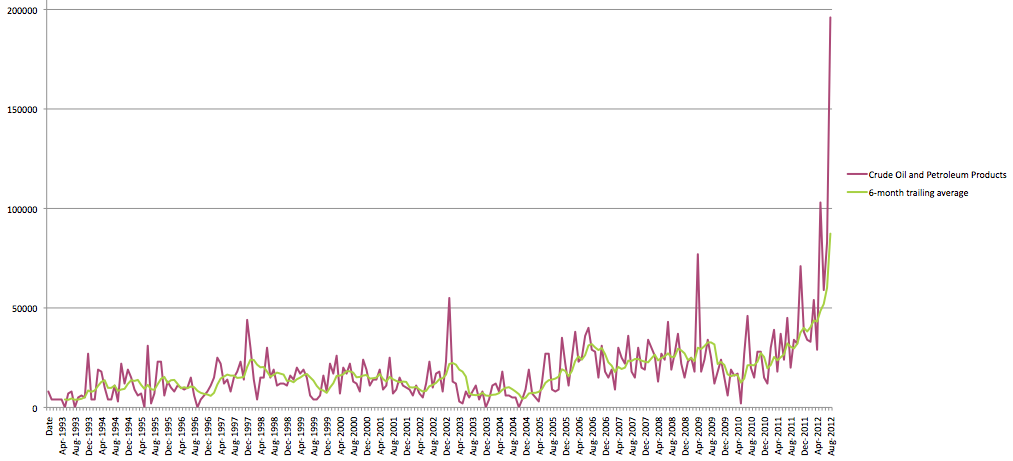
U.S. Fuel Exports to Venezuela

Steven Bodzin has a great post (following up on a previous one) about how much fuel Venezuela is importing from the United States. I am nabbing one of his charts, so please give him credit if you use it:


Really fascinating. The MSM gets it sometimes, but not often enough. Instead, we get the drum beat of "threat" based on the fact that the U.S. also imports from Venezuela (a few years ago Dick Lugar even had a big investigation). Hugo Chávez himself eggs this on, with periodic empty threats of shutting off the flow of oil.

The point is that there is way, way more going on than virtually anyone in the United States gives credit for. After almost 14 years of "revolution," Venezuela is more economically dependent on the United States than ever.

Read more...

Thursday, November 29, 2012

Latin America links

--The Pew Hispanic Center on the future growth of the Latino electorate.

--David Smilde on Venezuela getting on the UN Human Rights Council.

--Tim's El Salvador Blog on Salvadoran Ni-Nis.

--COHA on Kerry, Rice, and Latin America.

--Yoani Sánchez on what she worries about.

--Colin Snider on human rights trials in Argentina.

--And as a bonus, Mike Munger on publishing and him perishing.

Read more...

  © Blogger templates The Professional Template by Ourblogtemplates.com 2008

Back to TOP