Friday, August 26, 2016

Venezuela Can't Even Do Oil Anymore

Venezuela is an oil-rich country. However, it is currently unable to adequately extract oil, refine oil, or now even pay for imported oil.

Risk-averse suppliers are refusing to discharge cargoes to cash-strapped PDVSA without being paid first, unusual in an industry in which buyers normally have 30 to 60 days to pay after delivery. Others have stopped dealing with PDVSA entirely as it resorts to bartering its own oil in swap deals, according to traders and a company source who was not authorized to speak publicly.

The "good" news is that domestic demand for fuel is down, largely because the economy is such in bad shape. This is all happening in the context of decreasing reserves.

Finally, this is happening in the context of an opposition march scheduled for September 1, which is Thursday of next week.

At least there's Pokemon Go.

Read more...

Thursday, August 25, 2016

Patrick Iber's Neither Peace Nor Freedom

Patrick Iber's Neither Peace Nor Freedom: The Cultural Cold War in Latin America (2015) examines the intellectual struggle the U.S. and the Soviet Union waged in Cold War Latin America. More importantly, it examines how the results were unpredictable. Many people associated with the organizations did not share the views of the funders, which found them difficult to control--local interests sometimes trumped the funders. It's a very good read.

The two big players were the Soviet-funded World Peace Council (WPC) and the CIA-funded Congress for Cultural Freedom (CCF). These were, as Iber, points out, imperial projects. The people in the front organizations, however, did not feel that way. They felt, only occasionally correctly, that they were struggling on behalf of peace and liberty.

Yet all this did not mean they were "working for" the U.S. and the USSR. They were publishing and talking in ways they believed, which happened in some manner to overlap with these powerful countries. Yet sometimes they didn't overlap. This is the point that I think needs to be remembered the most. People are not necessarily just puppets, and during the Cold War many Latin Americans were trying to figure out how to get the money necessary to reach a wider audience. At the same time, if someone exposes your funding to be CIA or the Kremlin, then your credibility gets hit. That started to happen at the end of the 1960s for the CCF.

Oddly enough, the adamantly anti-Communist CCF helped encourage the Cuban revolution (with money from the CIA!) because it was anti-Batista, then of course grew disenchanted with it. Especially after the revolution, the CCF and WPC touched directly or indirectly a seemingly endless spiderweb of political and cultural organizations. In the midst of all this, the Cuban government launched its own cultural war (through the Casa de las Américas).

The cultural war in Cold War Latin America was a messy business, indeed so complicated ideologically that it led to the decline of intellectuals' influence in Latin America. Iber's book is a reminder not to assume that anyone ultimately gets what they want.

Read more...

Can the FARC Win Elections?

The announcement of the finalized deal between the Colombian government and the FARC is incredibly important and historic. There is so much to sort out here, but what immediately came to my mind was a question: can the FARC attract any voters?

One of the more controversial parts of the deal are some guaranteed seats in the legislature:

Santos said Wednesday that the rebels will be granted a limited number of seats in Congress through 2018, where they will not have voting rights but can speak on matters pertaining to the implementation of the peace accords. They will be assured a minimum of five seats in Colombia's Senate and five seats in its lower house for two legislative terms starting in 2018. But then they will have to win at the ballot box, Santos said. His opponents have already savaged this concession as an outrageous giveaway to the rebels.

This makes people like me cringe because of the Chilean example (where retired military commanders got appointed senate seats) but at least they are clearly temporary and non-voting.

The more I thought about it, though, the more I liked it. Unlike, say, the FMLN, the FARC has virtually no domestic support. By now, very few Colombians support their ideology. As a result, they have an uphill battle to win voters. I could therefore imagine a scenario where elections were held where the FARC won about very few seats (or none!) which in turn could blow things up (figuratively if not literally). Now the FARC can ease into democratic governance but without unearned power. It will have a chance to engage in debate and win future voters.

Read more...

Wednesday, August 24, 2016

Hillary Clinton Is Like Fidel Castro (In Terms of False Illness)

The Washington Post has a story about all the diseases Hillary Clinton has been accused of having/hiding. I immediately thought of Fidel Castro, who has been rumored near death many times. He gave a speech in 1986 joking about U.S. rumors of his death. Back in 2007, the Miami Herald had one of the best headlines ever: "Vague Comments Made About Fidel Castro's Health."

Then, of course, he eventually did get sick, but U.S. intelligence still couldn't figure it out. He had terminal cancer a decade ago, and Parkinson's a year before that. We have to assume that someday he will actually die, at which point the U.S. government can say, "See, I told you so!"

Read more...

Tuesday, August 23, 2016

Venezuela Desperate For Higher Oil Prices

The Venezuelan government is desperate for OPEC to cut production. Its oil minister is making the rounds to find supporters.

Venezuela expects oil price of $70 per barrel as ideal to help the global financial situation, the country’s president Nicolas Maduro said last week as he tries hard to shore up support to boost oil prices, which have plunged by more than 60 per cent since 2014.

If you're wondering, oil is now about $48 a barrel.

This sort of trip is common for Venezuela. Nicolás Maduro went to Saudi Arabia in early 2015. And, of course, when OPEC did not push for higher prices Maduro blamed the United States.

Read more...

Monday, August 22, 2016

Peña Nieto's "Style Errors"

It seems Mexican President Enrique Peña Nieto plagiarized sizeable chunks of his law thesis. His spokesman said there were "style errors." Don't you love euphemisms? In my class, such "style errors" would have very serious consequences.

It's another self-inflicted wound for a president with a 29% approval rating. Maybe he should Google a good "mea culpa" speech and copy it. As Patrick Iber noted on Twitter:


This is indeed a perfect post for the beginning of the semester. In classes I've used the New York Times' wonderful breakdown of Senator John Walsh's plagiarized Master's thesis as well. That, incidentally, compelled him to resign so at least there's some sense of accountability.

Read more...

Saturday, August 20, 2016

Karl Ove Knausgaard's My Struggle Book 2

As I read Karl Ove Knausgaard's My Struggle, Book 2 (here is my review of book one), I kept thinking about how keeping things to ourselves is what holds civilization together. If we all said or wrote in the manner he has done, we'd all end up hating each other. Honesty is in fact not always the best policy. In large doses (like the 3,000+ pages he has written) it's even disconcerting

More so than in Book 1, Knausgaard writes in unsparing detail about the people closest to him, especially his wife Linda. It is hard to imagine a relationship holding together after such a public rendering of its most intimate and intense moments, dealing even with mental illness. We don't show these parts of ourselves to the world, and more importantly we don't expose those that we love. But Knausgaard needs to write, and so he does.

Yet the book is so fascinating precisely for these reasons. Periodically I saw myself in the narrative, sometimes laughing out loud (such as descriptions of dealing with very young children in public) but even when I couldn't really relate, I enjoyed the very deeply thought out way he describes his own feelings and actions.

It ends with him starting on book one (none of them are chronological). I'm now going to order book three. We'll see how far I go with all these.

Read more...

Friday, August 19, 2016

Iran's Weak Ties to Latin America

The funny thing about the supposed Iranian influence in Latin America is that for at least the last ten years, every so often Iran feels the need to send a government official to launch a "new chapter" in relations with the region. It is doing so now.

Countries that have influence don't need to relaunch. They just launch once and then go from there. Also, countries that have influence don't need to blame Israel for the fact that all their launches fail.

Iran has been growing increasingly close to Latin America in recent years, but has accused Israel and other countries of undermining its emerging relationship with the region. “Certain regional states have also joined the Zionist regime and display a wrong image of Iran in line with Iranophobia plots,” said Takht-e-Ravanchi to Iran’s Fars news agency.

Not surprisingly, Telesur reports this uncritically without noting not just the anti-Semitism but also how ridiculous the argument is. Iran's image comes from Iran's own actions, including past terrorist attacks in Latin America.

Read more...

Thursday, August 18, 2016

Venezuela Timing and the Opposition

Gabriel Hetland has an article in The Nation about Venezuela, which is a good read for several reasons. He is sympathetic to the ideals of Chavismo but clear-eyed with regard to the ways in which the government has shot itself in the foot.

Further, he has an intriguing argument:

Officially, the opposition is adamantly opposed to delaying the referendum beyond January 10. There is speculation, however, that many opposition leaders actually prefer this scenario because the next several years are likely to be exceedingly difficult no matter who is in office. If the Maduro government stays in power it will pay the price. The opposition would thus be well positioned to win the 2019 presidential election.

I'm not a fan of the passive voice with regard to this sort of thing because there is no sense at all of who is making such a speculation and who the "many" opposition leaders actually are. I see the logic here, but I am left with the question: the opposition is already well positioned to win an election, so why would it want to wait and win later when things are actually worse?

Read more...

Wednesday, August 17, 2016

The Complicated Colombian Peace Process

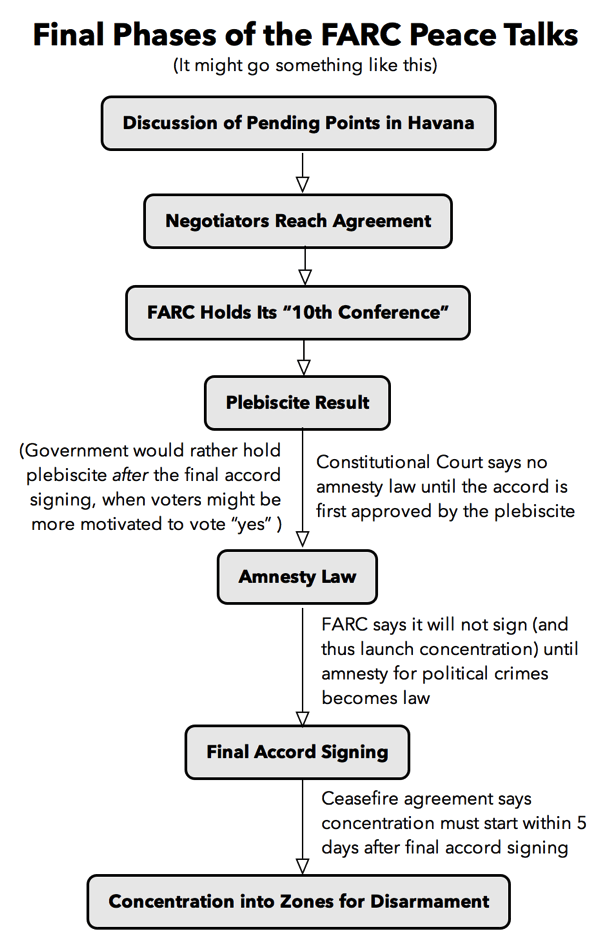
Adam Isacson tweeted about a new post up at the Washington Office on Latin America's Colombia Peace site explaining the complicated referendum process for the peace deal. Here's the flow chart they put together:


And that doesn't even get at the legal and political complexities involved.

It's a great post. One part that I found particularly interesting is that over time polls show a decreasing willingness to vote "yes." One problem is that Juan Manuel Santos' popularity has dropped, in no small part because of the drop in commodity prices. It would be tragic if the vagaries of the global economy--combined with the historic Latin American economic dependency problem--played a decisive role.

Read more...

Cuba's Concern About Immigration

I'm quoted in this story about Cuba's dislike of the Cuban Adjustment Act. My argument is that as Venezuela disintegrates, thus making oil scarcer, Cuba cannot afford more brain drain, like losing doctors. In general, there has been an uptick of Cuban emigration, precisely as people consider the end of the immigration law.

At this point, opponents to the law include both the Cuban government and hardcore anti-Castro members of Congress, who correctly believe that Cubans are gaming the system because they're not actually facing persecution, but rather are going back and forth. It'll end, it's just a matter of when.

Read more...

Tuesday, August 16, 2016

Chile's Sagging Pension System

Here's a good column in the Los Angeles Times about the privatized Chilean pension system, which is facing huge protests despite being held up for years as the model for the world.

As my friend and co-author Silvia Borzutzky has written about for years, the fees in the system (through AFPs, or Pension Fund Administrators in English) are astronomical, so the return to individuals is very low in comparative terms. Supporters of the system simply blame Chileans for not knowing enough (I am not making that up).

But what to do? Michelle Bachelet is proposing changes, but she's an extremely unpopular president and there will be legislative resistance. For the time being, it's hard to see changes being made.

Read more...

Monday, August 15, 2016

Hezbollah Still Not a Major Threat in Latin America

Mike LaSusa has a good post at LobeLog on how the Hezbollah threat in Latin America is overblown.

To be sure, Latin American authorities must remain vigilant about terrorist threats. But they also must keep those threats in perspective and allocate their limited resources accordingly. Overblown claims like Levitt’s encourage countries to engage in the kind of security theater that leaves fundamental problems unaddressed and ultimately puts citizens at greater risk.

I've been repeating that basic point for a long time now with regard to U.S. policy.  Last year I wrote:

We need extremely high standards of evidence. Otherwise we do "stupid stuff." There are a lot of ill-informed but trigger-happy members of Congress and it would be a major mistake to let them dictate policy.

For years, we've seen a pattern of using weak sources to encourage a hawkish response. For many reasons, it's a bad idea.

Read more...

Venezuela: At Least We're Not Syria

Rafael Ramirez, Venezuela's Ambassador to the United Nations, rejected Ban Ki-moon's assertion that there is a humanitarian crisis in Venezuela.

"Hay que tener sentido de las proporciones, en el país tenemos nuestros problemas, pero no hay una crisis como en el caso de los desplazados en el Medio Oriente."

In other words, "proportion" means that Venezuelan officials no longer even try to compare themselves to other Latin American countries. They compare themselves to Syria and come out looking pretty good in comparison. But that works only if you compare yourself to Syria.

Read more...

Friday, August 12, 2016

Latin America Not Good at Refining Oil

Interesting story on how Latin American oil refinery plans haven't worked out, which is helping the U.S.

From Brazil's Petroleo Brasileiro to Mexico's Petroleos Mexicanos, state oil companies have failed to complete nine projects worth at least $36.4 billion that would have supplied 1.2 million barrels of gasoline and diesel daily. U.S. refiners have stepped up to help fill the gap, with exports almost doubling in the past six years, according to the U.S. Energy Information Administration.

It doesn't even mention Venezuela, which has had all kinds of refinery problems.

None of these countries is too eager to talk about it either.

In response to a request for comment, Petrobras said decisions on the construction of new refineries will be announced as part of its next five-year investment plan. It didn't disclose when that announcement will be made. Ecuador's ministry of strategic sectors, which is in charge of the project to build the new Pacifico refinery, didn't return calls and e-mails seeking comment. Valero, Marathon and PBF declined to comment....Pemex declined to comment on plans for future or existing refineries.

The inability to use oil revenue to build necessary infrastructure has been a frustrating constant in Latin American economic history.

Read more...

Wednesday, August 10, 2016

Tom Long's Latin America Confronts the United States

I read Tom Long's Latin America Confronts the United States: Asymmetry and Influence (2015) which is worth your time (and which I hope gets a paperback edition). His argument is that Latin American foreign policy initiatives have received too little attention, and that they've been strikingly successful in setting the political agenda and achieving policy goals. He uses detailed case studies Operation Pan American, the Panama Canal treaties, NAFTA, and Plan Colombia.

There are several things that set the book apart.

First, it is based on some excellent fieldwork, with extensive archival research and interviews with key participants. So beyond the analysis itself, it's an interesting read.

Second, it is a book about policy makers. In the case of Panama, for example, it's even about an individual (Omar Torrijos) overcoming concerns about Cold War security, which is typically seen as an almost overwhelming structural constraint.

Third, coordinated Latin American lobbying matters. This is a variable that Michael Grow uses in his book U.S. Presidents and Latin American Interventions and which deserves much more attention than it gets. Knowing how to deal with U.S. political institutions (especially Congress) and the public is so important.

Fourth, it takes on a lot of existing literature (including my own). Long argues that he is part of an "internationalist" school of thought, versus "establishment" or "revisionist" schools. Both of the latter tend to downplay Latin American agency, albeit for different reasons. That's true, but I think there's actually a lot more potential than Long even gives himself credit for, especially in theoretical terms.

More specifically, one point I would've liked to read more about was the critical obstacle Latin American policy makers found in each case. For each, I found the following, in an obviously simplified manner:

1. OPA: overcoming US resistance to providing large amounts of aid
2. Panama Canal: overcoming US concerns about security
3. NAFTA: overcoming US caution about an FTA with a developing country
4. Plan Colombia: overcoming US suspicions of Colombia

These are all different, so what strategies mattered most? Some of these are economic, and some are political. This stuff could get modeled on some way that could provide a new strand of literature but also potentially contribute to theories of foreign policy more specifically.

Read more...

Kissinger Didn't Understand South America

The Argentina Declassification Project has been getting some attention for the bits on Henry Kissinger. As anyone with a passing interest in Cold War Latin America knows, Kissinger was a big fan of the Argentine dictatorship, and the Dirty War did not bother him a whit. So the fact that he continued to praise the dictators shouldn't surprise us.

What I found more interesting about the documents is how nicely and accurately Robert Pastor skewered Kissinger. Pastor was a Latin America expert whereas Kissinger knew very little.


Pastor expands on that:


So it's not just indifferent to human rights abuses. It's a lack of understanding about how South American governments relate to each other, which then made him believe such indifference was necessary. Court authoritarian Argentina in order to avoid South American dictatorships come together? This is not a reasonable argument, for the reasons Pastor lays out.

Read more...

Tuesday, August 09, 2016

Venezuela's Impending Clash

I suggested that maybe the Venezuelan government would simply hold the referendum one day after the deadline to require a new election. Turns out that might literally be true.

National Elections Council President Tibisay Lucena said Tuesday that critics of the socialist administration will likely be authorized in late October to try to collect signatures from 20 percent of voters needed to force a recall. 
Elections officials would then have 90 days to confirm the signatures and schedule any vote. That means the vote might happen in January or February.

Naturally, the government is so very sorry about the delay.

Meanwhile, the opposition is calling for a protest on September 1. All the frustrations will come out, from the empty shelves to the refusal to hold a referendum in a timely manner, and the increasingly militarized government will have to deal with it. It will be a miracle if it remains peaceful.

This is really a problem as the police face protestors. As David Smilde noted, Nicolás Maduro is surrounding himself with military officers:

The logic of cultivating a loyal core among security officials extends beyond those who are on some sort of US blacklist. The recent designation of Defense Minister Gen. Vladimir Padrino López as the head of the “Grand Supply Mission” that will take control of Venezuela’s entire food supply system, effectively makes him and the military direct stake holders in the government’s weakest flank: food scarcities. If there is mass social unrest because of shortages, it will not be aimed at a government who then needs to hope the military defends it, it will be aimed at the military itself.

Protests like these, then, may be seen as existential threats. Military officers now control both the police (through the Minister of the Interior) and food distribution.

Read more...

Bernie Bungles Brazil

Bernie Sanders has just released a letter condemning Dilma Rousseff's removal from power. The timing is odd, almost calculated to have the least possible impact. If you mention it during the campaign, you get headlines. If you mention it right before the Olympics, as many of his colleagues did, then you get some attention on the cusp of the games.

What he chose, though, is a time when he no longer has the national and international stature as a serious candidate, and in the United States people are focused more on the excitement of the games. In short, who will pay attention besides people like me?

Read more...

Monday, August 08, 2016

Michelle Bachelet's Downward Slide

Michelle Bachelet's approval has dropped to 19%, as she faces problems from just about every angle (most recently it is protests about pensions). The general response has been to continue pressuring her to shuffle her cabinet. It's funny how that sort of action is viewed as potentially effective, when in fact part of the problem is that her entire coalition is falling apart.

It's also funny how the political response is to go back to the past.

The two names that emerged in the poll as most likely to be president after elections due in 2017 are both veteran ex-presidents who have already begun 'soft' campaigning - Lagos and center-right Sebastian Pinera. 
But when asked to choose between the two, most people said they would prefer not to vote (40 percent). The 78-year-old Lagos received 28 percent support, and 66-year-old Pinera 26 percent.

It's exactly like Hillary Clinton trying to position herself as the agent of change. People are not buying it and would prefer to sit it out in disgust.

Read more...

Sunday, August 07, 2016

Biden and Bachelet Talk Colombia

Vice President Joe Biden had a phone conversation Chilean President Michelle Bachelet. They also had a meeting back in April. What really struck me was that in both conversations, Biden brought up the Colombian peace negotiations.

August:

The Vice President welcomed Chile's continuing commitment to the Colombian peace process and the two leaders pledged to deepen their collaboration as the peace process reaches its conclusion, in concert with their Colombian partners. The Vice President also highlighted the robust support of the U.S. Congress for the implementation of a Colombian peace deal. 

April:

The Vice President praised Chile's constructive role in addressing a number of regional challenges in the Americas, including its support for the development of the Northern Triangle countries of Central America and its vital role as a facilitator of the Colombian peace process. 

Remember that the Democratic platform this year somehow mentions Colombia while entirely ignoring the peace process. Kudos to Biden for making sure to emphasize it and acknowledging Chile's role.

Read more...

Friday, August 05, 2016

Venezuelans Seek Asylum in the US

Via the Pew Research Center:

Venezuela is now among the top nations of origin for asylum applicants to the U.S., accounting for 10,221 applications filed between October 2015 and June 2016 – up from 3,810 filed during the same time period the year before.

My first reaction was to question how likely it was that asylum would be granted. I've testified in asylum cases and "well-founded fear of persecution" is a high bar. It's not just about country conditions, no matter how awful they might be. But because the U.S. immigration courts are so horribly clogged, we just don't know--the article notes that some Venezuela cases have been sitting since 2011.

Regardless, right now more Venezuelans are seeking asylum than any other country except China and Mexico. The signs of political and economic collapse are just everywhere.

Read more...

Thursday, August 04, 2016

Cuban Argument Against Cuban Adjustment Act

Granma has an article on Cuban migrants that ends with a call for revoking the Cuban Adjustment Act:

La política de Pies secos-Pies mojados vigente desde 1995 establece que aquellos que to­quen suelo estadounidense tienen derecho a quedarse, a diferencia de quienes son interceptados. Destacan además que si llegan a Estados Unidos por un tercer país vía terrestre —como pretenden hacer los que se encuentran en estos momentos en Turbo—, basta con que vayan al puesto fronterizo y demuestren que provienen de la Isla para acogerse a ese mecanismo. 
Otra de las formas con la que EE.UU. promueve la migración ilegal es el programa de Parole para Profe­sionales Médicos Cubanos, creado durante la administración de George W. Bush. En este caso se estimula que los galenos abandonen las mi­siones médicas en los países donde laboran. 
Ambas iniciativas, que pueden ser cambiadas por el presidente de Estados Unidos, tienen su trasfondo en la Ley de Ajuste cubano de 1966 que concede una vía expedita para la residencia a los ciudadanos cubanos que la pidan. Nacida en los tiempos de la Guerra Fría, su objetivo sigue siendo desestabilizar el país.

This is all accurate, though of course it neatly sidesteps the question of why so many Cubans are trying to leave.

More importantly, it is a reminder that the days of the Cuban Adjustment Act's days are numbered. The negotiations are assuredly going on now. It has to be entirely secret, however, or there will be a flood of people trying to leave Cuba before it happens. It's even harder in the current U.S. political climate because Congress needs to be involved.

Read more...

Wednesday, August 03, 2016

Petrocaribe and Venezuelan Hunger

Petrocaribe was going to be a way for Venezuela to lead a bloc of left-leaning countries in solidarity. It would end dependence on the United States. As Hugo Chávez put it back in 2007:

"We have begun to create a new geopolitics of oil that is not at the service of the interests of imperialism and big capitalists," Mr Chavez said in his speech.

Ironically, it strengthened dependence on oil prices and Americans (among others) buying oil. As oil prices unraveled, so did the agreement. Now it has reached a new low, where Jamaica is going to pay off its debts with food and other necessities because Venezuelans are going hungry and hospitals need supplies.

In a statement to the state news agency, Jamaica Information Service, government minister Ruel Reid said: "This decision is taken primarily to give support in the form of medicine, food and fertiliser".

To be fair, part of the Petrocaribe concept was to allow countries to pay back as they could, including with food or whatever else. But that was supposed to be determined by their need, not the dire need of the Venezuelan people themselves.

This is perhaps the final nail in the coffin of Venezuelan foreign policy, which was based on merging ideology and oil money. Once the oil money started to dwindle, so did external interest in the ideology.

Read more...

Tuesday, August 02, 2016

Karl Ove Knausgaard's My Struggle Book 1

Karl Ove Knausgaard's My Struggle, Book 1 is one of the most intriguing books I've read in a long time. It is often compared to Marcel Proust, as it is the first of six autobiographical "novels." He details his life, bouncing around chronologically, in a way that kept me reading even when the particular topic was mundane (and some, like his father's death, are not mundane at all). He is an excellent writer, and has a knack for simultaneously remembering, explaining (in one part, he acknowledges the "meta" aspect of that sort of introspection) and putting it all into almost a spiritual context.

Of course, for such writing to work it has to be honest, and he doesn't spare anyone, including himself, and he is often filled with shame and doubt. Many people now hate him for his brutal truth (which seems to be the reason he left Norway for Sweden). Even in what we typically consider an age of narcissism, with selfies everywhere, we're still faking it--we don't much want people seeing us naked, so to speak.

It's the sort of book that makes you feel more aware of how you're dealing with any particular situation. I've already ordered book two.

Read more...

Venezuela Recall Moves Along

We all should know by now the importance of timing for a possible recall referendum in Venezuela. If it happens before January 10, 2017 there will be a new election. The government, knowing a loss is quite likely, is stalling as much as possible. But it also knows that completely shutting down the recall effort could lead to serious consequences, so it has let the opposition through the first hurdle, which is certifying 1% of voter signatures in each state. It took three months to make that decision.

The next step is to get 20% of voter signatures (about 4 million) and it is widely reported that must happen within three days (that is not in the constitution--I haven't actually seen the relevant law). The opposition has traditionally been fractured, but I have to assume they've been planning that effort for months--it will take a ton of organization.

The government is stuck. It does not want this to go forward quickly, and is undermining it in a number of different ways (such as lawsuits). But it also cannot just say it won't happen, especially since the international community has set its mind on having a vote. The most likely scenario is allowing a vote on January 11 (yes, I could even see it being that brazen) which, if lost, would still keep Chavismo in power a little longer.

Read more...

Saturday, July 30, 2016

Imbalance of Power Venezuela

If the Supreme Court says you cannot swear in legislators, and you do so anyway while saying you will not obey the Supreme Court, then you're getting pretty close to civil war. That's the case in Venezuela, where the three legislators who would give the opposition a 2/3 majority were denied by the court, which didn't have any plans for resolving the issue.

The executive branch does not recognize the legislative branch. The judicial branch tries to block the legislative branch, and the legislative branch ignores the judicial branch and mocks the executive branch.

In Latin American presidential systems, extreme conflict between branches of government have been solved by coups and/or fighting. Something has to give. If the opposition passes legislation, so what? It doesn't exist if it isn't enforced the executive branch. Ultimately, this comes down to power, and the military represents the ultimate power of the state (yes, police can also be important but in Venezuela and elsewhere it's been the army).

The other solution is a referendum, which is monitored and where everyone agrees to accept the outcome. The question is whether, after so many years of talking about how many elections Hugo Chávez won, the government will even accept voting.

Read more...

Friday, July 29, 2016

George Kennan in Venezuela

Thanks to Joshua Goodman via Twitter for mentioning the diaries of George Kennan, which in 1950 have this mention of Venezuela and its addiction to oil as he traveled to Caracas.

Here was a tropical country in the subsoil of which reposed great quantities of a liquid essential to the present stage of industrialization in the U.S. Americans were extracting this liquid and hauling it away. The local population had not moved a finger to create this wealth, would have been incapable of developing it, and did not require for its own needs the thousandth part of what was apparently there. However, for the privilege of being able to enter and extract this liquid, our firms were paying hundreds of millions of dollars annually into the coffers of the Venezuelan Government, a sort of ransom to the theory of state sovereignty and the principle of non-intervention which we had consented to adopt. The traffic could bear it. Prices of oil permitted it. The companies could pay this tribute and still make money... 
There was plenty of oil under the ground. Perhaps this could go on for a long time. There were signs that the competitive position of high priced Venezuelan oil was falling off, but important iron deposits had been found, and new capital was already pouring in for their development. Still, one could not avoid the conviction that some day, some how, there would inevitably be a terrible awakening: a day when the morphine of oil company or steel company royalties and taxes would no longer enter the system of Venezuelan economy, when the country would be thrown back on its own resources, and when someone would have the unpleasant task of dealing with a terribly disoriented and intellectually debilitated population. It would behoove us to think about that day, and to anticipate it... 
Incidentally, all of nature in Venezuela was a bilious yellow-brown.

This was, as Lars Schoultz notes*, a trip Kennan took after resigning his position as State Department Counselor and then getting invited to give a talk to U.S. ambassadors in Rio. He took the opportunity to travel around Latin America and pretty much hated everything.

Then Kennan wrote a long memo for the Secretary of State just a few weeks after he returned. Here is one key insight:

It seems to me unlikely that there could be any other region of the earth in which nature and human behavior could have combined to produce a more unhappy and hopeless background for the conduct of human life than in Latin America.

Not much need to go further than that. Communism is a big problem and Latin Americans are worthless.

Now, back to Venezuela. There is a "terrible awakening" in Venezuela now, but it's not really what Kennan was getting at. Venezuelans are perfectly capable of producing their own oil. The problem is not lack of intellectual capital, but rather the PDVSA corruption that spread so thickly over the years of Chavismo.

See his Beneath the United States, pp. 330-331.

Read more...

Thursday, July 28, 2016

Does the Democratic Platform Matter for Latin America?

As I've been writing about the Democratic and Republican platforms (see a Spanish version here) I was asked about how much President Obama had adhered to the platforms written during his election campaigns.

I knew that in 2008 he had talked about opening up to Cuba, which he then later accomplished. But I hadn't realized the 2008 platform said almost the exact opposite.

And we must build ties to the people of Cuba and help advance their liberty by allowing unlimited family visits and remittances to the island, while presenting the Cuban regime with a clear choice: if it takes significant steps toward democracy, beginning with the unconditional release of all political prisoners, we will be prepared to take steps to begin normalizing relations.

Of course, normalization started without preconditions. The rest of the 2008 platform is really hawkish, all about war, toughness, and WMDs, as Democrats felt the need to avoid getting labeled as soft. The Latin America part is entirely platitudes, similar to 2016. Venezuela does not even get mentioned. Obama himself was pretty far ahead of (and more progressive than) the party.

In 2012, the platform writers forgot about 2008 and just talked about how Obama had done some bold things for Cuba.

Under President Obama, we have undertaken the most significant efforts in decades to engage the Cuban people. We have focused on the importance of the family ties between Cuban Americans and their relatives still living under oppression. Because of steps the President has taken, it is now possible for Cuban Americans to visit and support their families in Cuba, and to send remittances that reduce the Cuban people’s dependence on the Cuban state. We have taken additional steps to bolster Cuban civil society, expanding purposeful exchanges that bolster independent religious groups on the island and enhancing the free flow of information to, from, and among the Cuban people. Going forward we will continue to support the Cuban people’s desire to freely determine their own future. 

In Venezuela, Democrats would "promote" democracy, with no details. That also is the same as now.

So did the platforms matter? They're mostly useful for the tone they set. In 2008, the party began to distance itself from the Cuba policy orthodoxy--indeed, the 2004 Democratic platform was still talking about regime change in Cuba. Obama moved much faster than the Democratic Party itself, but they were moving in the same direction.

The 2016 platform reflects the division within the Democratic Party, especially with regard to free trade. Although Hillary Clinton has been strongly pro-free trade for many years, if elected her policies will have to take the division into consideration as she tries to get things passed in Congress.

Read more...

Wednesday, July 27, 2016

Venezuela Will Force Workers Into Agriculture

The Venezuelan Ministry of Labor* has declared that workers can be reassigned on a temporary basis to do agricultural work. Here is the exact wording from the government's Gaceta Oficial 40.950 from July 22, 2016.

Resolución mediante la cual se establece un régimen laboral transitorio de carácter obligatorio y estratégico para todas las entidades de trabajo del país públicas, privadas, de propiedad social y mixtas, que contribuya con el reimpulso productivo del sector agroalimentario, estableciendo mecanismo de inserción temporal de trabajadores y trabajadoras en aquellas entidades objeto de medidas especiales implementadas para fortalecer su producción.

This is a) not a joke; b) a terrible idea; c) undemocratic; and d) a sign of terrible desperation. It should remind everyone of the infamous (and failed) 1970 sugar harvest in Cuba. It distorted the economy and made Cubans worse off.

Venezuela cannot feed itself, and food shortages are severe. The long-term solution is to work toward weaning itself off oil exports and develop stronger domestic industries. Neither Hugo Chávez nor Nicolás Maduro worked with that longer term in mind, however, and now Maduro is more fixed than ever on the short term to avoid more protests and perhaps even possible ouster from within.

Yet not only is it hard to see this measure doing any good with regard to production, it is guaranteed to make people mad, which will the make the situation worse.

I can't find any mention of this on the government's official news site. It's hard to spin as positive.

* by which I mean the Ministry of Popular Power for the Social Process of Work, but that's both confusing and long.

Read more...

Monday, July 25, 2016

Latin America in the Democratic Platform

At Latin America Goes Global I give my take on how Latin America fits into the Democratic Party's platform. The basic takeaway is that it is underwhelming but at least isn't paranoid. So there's that.

I wrote about the Republican platform here.

Read more...

Sunday, July 24, 2016

Go To Tijuana

Last year my wife and I walked across the San Diego-Tijuana border to have a nice dinner for our anniversary. This year we met friends and walked across with our kids during the day. We took a taxi to the Centro Cultural Tijuana, which was cool. You get a different view of Californian (and US-Mexican more generally) history.


In this era of xenophobia, it's worth of it for that alone.

But then we just walked, found some good food, and checked things out. Yes, it is touristy, but Mexico needs tourists and a reminder that Tijuana is a place to take your family. People could not have been nicer. If you visit San Diego, then just park at the border and walk across. If you take the new Pedwest pedestrian crossing coming back, it's really quick.

Read more...

Saturday, July 23, 2016

Mutual Compensation With Cuba

The U.S. and Cuba are about to hold their second meeting on "mutual compensation." The Cuban version, as you might guess, only provides one side.

The Cuban delegation explained the basis of their claims, particularly, the demands of the Cubans to the US government for human and economic damages, acknowledged by the Cuban courts.

Ah, if Cuban courts acknowledge it, then 'nuff said! But the U.S. side, with all the properties seized by the Cuban government in the aftermath of the revolution, is the truly difficult one. There are a lot of Cuban Americans who maintain deep feelings for what was taken from them (one such story came out in a Charlotte Talks show I was just on).and they will be vocal about it.

Read more...

Friday, July 22, 2016

Russell Crandall's The Salvador Option

I read Russell Crandall's The Salvador Option: The United States and El Salvador, 1977-1992 (2016) and it is worth your time. The book is an exhaustive (500 pages plus 100+ more of endnotes) analysis of U.S. policy toward El Salvador, using declassified documents in addition to the massive literature on the topic. The guiding question--contained in the title--centers on how El Salvador is held up (especially by the U.S. military) as a counterinsurgency and state-building model (not unlike Plan Colombia).

This is "thick description," like a number of other very good books in the past few years on U.S. policy (like Morley and McGillion's book on U.S. policy toward Chile, but also books by Brian Loveman, Lars Schoultz, Bill LeoGrande, and others). One important point is that the Reagan administration was not monolithic at any time and evolved, especially when George Shultz replaced Alexander Haig, and when Jeane Kirkpatrick left the administration, not to mention when different ambassadors were in San Salvador.

Crandall dives into the context in detail. So we simultaneously have to come to terms with the fact that the U.S. wanted a moderate (José Napoleón Duarte) in office rather than Roberto D'Aubuisson, and used money to make it happen undemocratically; that it held fast to Duarte even as the army's extrajudicial killings went on; that the army and oligarchy were violent and inflexible; that the FMLN used vicious tactics of its own and did everything it could to disrupt elections; that the Salvadoran army was inept in the field no matter what kind of training it received; that the Cold War dominated the motivations of virtually everyone; that Cuba and Nicaragua were major players as well; that Washington had no serious plan for changing the conditions that generated armed conflict in the first place (despite knowing quite well what those conditions were and paying lip service to land reform); that for years no one could even agree on what "negotiations" should mean; that U.S. policy in El Salvador was often ad hoc; and that the money flowing in made the U.S. Ambassador into a proconsul.

The result was carnage that went on and on until both sides were worn out, and the Cold War was over so Washington didn't care so much anymore. Everyone sought to take credit for the peace agreement (though no one wants to take credit for the bloody aftermath we see now).

Crandall's goal is to lay it all out, sparing no one and trying simply to understand motivations, causes, and effects, which is not easy. The civil war has hardened into caricature for many people depending on their ideological orientation. He does not try to show how his analysis might fit into existing IR theory, which I think would be a fascinating exercise. For example, Kathryn Sikkink's work on "green lights" would be interesting, where the actions of the Salvadoran army and civilian elites might be guided by their belief of what Ronald Reagan wanted to happen in the country.

And what of that original guiding question? The main answer as I see it from Crandall is that the "Salvador Option" makes little sense when taken out of its own specific context, besides the conclusion that inserting yourself into civil war carries heavy ethical and practical implications that are rarely taken into consideration. Sadly, that is a point that gets forgotten by too many policy makers.

Read more...

The Donald and The Hugo

As time goes on, the similarities between Donald Trump and Hugo Chávez become more and more apparent. His speech cemented that. As I watched, I could not get it out of my mind.

1. He talks endlessly about how he is a savior. He could easily sit once a week on a "Hello, President" show, solving people's problems and humiliating his cabinet in public. "I am your voice" and "I am your champion."

2. He argues that government is the only institution capable of solving problems created by capitalism. And the state is him.

3. He says he will spend enormous amounts of money to help the common person, without talking about where that money will come from.

4. There is no other person capable of leading that government-oriented spending program than him.

5. He talks about unity while demonizing the opposition. That opposition, he says, is controlled by evil capitalists.

6. You blame foreigners for a lot of your problems.

Venezuelans underestimated Chávez from the beginning, and could not believe it when he won.

Read more...

Thursday, July 21, 2016

Republicans and Trump in Latin America

I have a post up at Latin America Goes Global on how Latin America fits into the Republican platform.

What we might reasonably expect from a Republican victory, then, is an inchoate potpourri for Latin America. The party faithful will want to remain firmly rooted in the anti-communist past, but a President Trump would happily ignore those Cold Warriors when he didn’t like the deal. Which raises a key question: what deal exactly is the U.S. voter getting for Latin America?

So go over there and check it out.

Read more...

Cuban Communist Party in Democracy

Last month I linked to a Monkey Cage blog post by James Loxton, a lecturer at the University of Sydney, on authoritarian successor parties. He also has a post up at the LSE's Democratic Audit blog pondering the future role of the Cuban Communist Party.

Most relevant for Cuba, ASPs have been especially successful in the post-communist world and Latin America, exceeding in these regions the (already high) global average. 
In the post-communist world, ASPs have been prominent actors in 16 of 19 new democracies (84 percent), and returned to power in 14 of them (74 percent). In Latin America, ASPs have been prominent actors in 11 of 15 new democracies (73 percent), and returned to power in 9 of them (60 percent). 
As a communist regime in a Latin American country, this bodes well for the Communist Party of Cuba. Perhaps unsurprisingly, the Latin American country whose former authoritarian regime most resembled Cuba’s—Nicaragua—produced a strong ASP that was elected back into office in 2006.

He also gets at the point that the nature of the transition matters a lot. If the regime falls apart, the brand will be badly tarnished. For the Nicaraguan case to be truly instructive, it would need to accept elections. One could easily argue that if Daniel Ortega had held out and refused elections, he might be in power now. Even if you lose the initial election, you're still a player and your brand is intact.

It's very hard to see this type of transition happening while Raúl or Fidel are alive, but after that it's wide open.

Read more...

Wednesday, July 20, 2016

Was Armed Insurrection Worth It in Latin America?

Jim Wyss and Glenn Garvin wrote a very good article in the Miami Herald that has background on guerrilla insurgencies in Latin America and asks the question, "Were they worth it?" The thrust of the question is whether those insurrections were necessary to achieve any meaningful reform in the long run. The question reminds me of a provocative academic article Victor Figueroa Clark wrote not long ago about how the Chilean armed opposition played a role in changing US policy and hastened the democratic transition.

The authors correctly have a quote about how some countries did not have armed rebels and reforms still happened. It would be fascinating to analyze why, and to think of the counterfactuals. In Colombia, one could even argue that the growth of the FARC served as an obstacle to reform. The government was ignoring the countryside, but by the 1980s could do nothing there but fight anyway. There was no chance the FARC would defeat the government, so 50 years of civil war has been entirely disastrous.

What would've happened in El Salvador had the FMLN not brought disparate rebel groups together? Just never-ending oppression or gradual reform? Is the current situation, after so many thousands dead from all sides, better? Very tough but fascinating questions.

Read more...

Tuesday, July 19, 2016

Latin America in the Republican Platform

The RNC has been quite a spectacle, and given the tenor of the presidential campaign we shouldn't be surprised at the alarmism of the Republican platform. It actually has multiple references to Latin America, including an entire section. Here is a chunk:

We express our solidarity with all the peoples of the Western Hemisphere. Their aspirations for economic betterment and political liberty have deserved better from our government than its policies of the last eight years. The current Administration has abandoned America’s friends and rewarded its enemies. A Republican president will never embrace a Marxist dictator, in Venezuela or anywhere else. The current chief executive has allowed that country to become a narcoterrorist state, an Iranian outpost threatening Central America, and a safe haven for the agents of Hezbollah. Now, with their country ruined by socialism and on the verge of chaos, the Venezuelan people are fighting to restore their democracy and regain their rights. When they triumph, as they surely will, the United States will stand ready to help them restore their country to the family of the Americas. 
We affirm our friendship and admiration for the people of Colombia and call on the Republican Congress to express its solidarity with their decades-long fight against the terrorist FARC. Their sacrifice and suffering must not be betrayed by the accession to power of murderers and drug lords. 
We want to welcome the people of Cuba back into our hemispheric family — after their corrupt rulers are forced from power and brought to account for their crimes against humanity. We stand with the Women in White and all the victims of the loathsome regime that clings to power in Havana. We do not say this lightly: They have been betrayed by those who are currently in control of U.S. foreign policy. The current Administration’s “opening to Cuba” was a shameful accommodation to the demands of its tyrants. It will only strengthen their military dictatorship. We call on the Congress to uphold current U.S. law which sets conditions for the lifting of sanctions on the island: Legalization of political parties, an independent media, and free and fair internationally-supervised elections. We call for a dedicated platform for the transmission of Radio and TV Martí and for the promotion of internet access and circumvention technology as tools to strength Cuba’s pro-democracy movement. We support the work of the Commission for Assistance to a Free Cuba and affirm the principles of the Cuban Adjustment Act of 1966, recognizing the rights of Cubans fleeing Communism. 

In short: we oppose dialogue, negotiation, and common sense. Interestingly, though, given Trump's comments he would ignore the entire Cuba section. I don't think he cares enough about Colombia to try and block its own decision to end the civil war.

Overall, this is a Cold War document. The references refer overwhelmingly either to Cold War disputes or re-labeling of current disputes (Venezuela) as essentially Cold War.

And, of course, the Mexico wall.

Our highest priority, therefore, must be to secure our borders and all ports of entry and to enforce our immigration laws.  
That is why we support building a wall along our southern border and protecting all ports of entry. The border wall must cover the entirety of the southern border and must be sufficient to stop both vehicular and pedestrian traffic. 

Anyone writing "the entirety of the southern border" is not familiar with the southern border, or the border economy, but of course the wall idea didn't make sense in the first place. Interestingly, the document shies away from saying who will pay for this wall.

The other thing that struck me was how the platform is like many Latin American constitutions, such as the Venezuelan. In such documents, you throw in a lot of ideology and ideas that can't be fulfilled, going on for pages and pages (50+ for the platform). This is ironic for a group that purports to love the U.S. constitution, which has lasted so long in no small part because it is so short and based on consensus.

Read more...

Monday, July 18, 2016

Freedom to Travel to Cuba Act

Republican resistance to Cuba travel is unraveling. Already you can travel to Cuba under one of 12 broad categories, and all restrictions will end before long with the Freedom to Travel to Cuba Act (introduced soon after President Obama announced the new policy). The name of the bill itself is very instructive, as this boils down to the basic fact that the U.S. government currently restricts the liberty of Americans to travel where they'd like without having to convince bureaucrats that it's OK.

The text of the bill itself is extremely short, to the point, and focused on liberty.

On or after the date of the enactment of this Act, and subject to section 3— 
(1) the President may not prohibit or otherwise regulate, directly or indirectly, travel to or from Cuba by United States citizens or legal residents, or any of the transactions incident to such travel, including banking transactions; and 
(2) any regulation in effect on such date of enactment that prohibits or otherwise regulates travel to or from Cuba by United States citizens or legal residents, or any of the transactions incident to such travel, including banking transactions, shall cease to have any force or effect.


Then there's the argument that U.S. dollars are keeping Cuba going, which of course ignores the fact that Cuba has kept going in the past with hardly any money at all. Increasingly, though, this is a moot point. It's just going to happen.

Flake told The Hill momentum is building among Republicans who want to lift the Cuba travel restrictions. 
“Believe me, we’ve got more than 60 votes,” Flake told The Hill, adding that he's spoken with Sen.Mike Crapo (R-Idaho) and Sen. Bill Nelson (D-Fla.), and believes they will sign onto the measure in the near future. 
A House measure similar to Flake’s led by Rep. Mark Sanford (R-S.C.) has 130 co-sponsors, including nearly two-dozen Republicans.

We're left with just the hardcore opponents, who increasingly don't even represent the views of their own constituents. They've driven policy for many years, but losing their grip.

Read more...

Sunday, July 17, 2016

Coupish in Venezuela

At Latin America Goes Global, Javier Corrales and Franz von Bergen make the case that what we're seeing in Venezuela is a new kind of coup:

Venezuelan President Nicolás Maduro shocked his country this week when he announced that he was giving exceptional powers to his Defense Minister Vladimir Padrino López. Maduro made Padrino Lopez a sort of food czar, giving him all responsibilities for overseeing food distribution in a country with critical levels of food shortages. More important, Maduro declared that all his ministers will now need to report to the general. 
A civilian president making a military man the head of his own government is a remarkable event. Almost every analyst in Venezuela has interpreted Maduro’s decision as the clearest sign that a dangerously weak government, rapidly losing control of the situation, has taken desperate measures to survive. 
But there’s another possible interpretation: that this was a semi-coup by the military against a rudderless, ineffective and discredited Maduro government.

If you're a regular reader of this blog, you know that I resist applying concepts like "coup" to everything we see. This one could be more accurate, though we'd have to think of something better than "semi-coup." If this was forced on Maduro, then the military has decided to control much more without being condemned for taking over the entire country. Doing so would probably force even very reluctant Latin American governments to take a stand. For now, those governments can continue pretending that somehow this will all work out.

This is all bad. Democracies don't involve reporting to a general.

Read more...

Friday, July 15, 2016

Cuba Getting Nervous About Venezuela

It seems that the crumbling of Venezuela's socialist model is accelerating the crumbling of the Cuban economy. Last week we learned that Venezuela is cutting oil exports. Raúl Castro sacked his economic minister and is talking about, well, capitalism.


Last week, Cuban President Raul Castro warned that citizens would have to improve management of their finances and spend less money. Murillo has been replaced with Ricardo Cabrisas Ruiz, a veteran Cuban politician who was previously overseeing the country's recent debt restructuring. 
Murillo will now help lead market reforms in efforts to manage Cuba's economy. A Cuban government statement said Murillo will focus his efforts on tasks related to "updating the Cuban economic and social model."

It's essentially a new, though more mild, Special Period coming up. Cuba will once again become financially independent, which will be painful. But it will also become more market-oriented because Cuba simply doesn't have the resources to support socialism.

Read more...

Thursday, July 14, 2016

Russia and Latin American Militaries

This is a head scratcher. The United States military has been deeply connected to Latin America for over a century. Throughout the Cold War the U.S. trained Latin American militaries, and after the Cold War helped them shape new missions. Thousands of Latin American soldiers come to U.S. military schools. The interaction is constant and ongoing.

Yet the U.S. thinks the Russians can badmouth us and mess it all up.

Tidd said Southcom was also exploring ways to share cutting-edge research with partner-nations, new technologies and experimental technologies. 
Meanwhile, he said Russia was making some "significant investments" in trying to discredit the U.S. in the region, such as broadcasting propaganda on RT and other television networks to "tell stories that are patently false."  

Really? I am not sure what the stories are, but are the U.S. military-military relationships so superficial that the Russians can so easily mess them up?

Read more...

Billy Lynn's Long Halftime Walk

The standard "thank you for your service" for the military is a fascinating issue (which Kevin Power's also dealt with in The Yellow Birds) and Ben Fountain's Billy Lynn's Long Halftime Walk (2012) is a great fictional examination. It tells the story of soldiers (dubbed "Bravo Squad) in Iraq who saved fellow soldiers in a heroic mission, which happened to be filmed by Fox News and thus beamed back to the United States.

They were given two days to return to the U.S., both to see their families but then also to attend a Dallas Cowboys football game, where they would be feted and honored. The novel focuses largely on that day, with keen and really funny satire. The soldiers feel like props as they struggle to understand the motivations of the people fawning over them while mouthing platitudes about "ninaleven" and terrRsm." Ultimately the soldiers don't care too much about being thanked and want everyone to leave them alone. War actually feels more real to them.

Like the others, Billy is trying to come to grips with the death of one of their buddies, with his own religious beliefs, his future, and his personal relationships but Americans don't care much about that.

No matter their age or station in life, Billy can't help but regard his fellow Americans as children. They are bold and proud and certain in the way of clever children blessed with too much self-esteem, and no amount of lecturing will enlighten them as to the state of pure sin toward which war inclines (45-46).

Throughout, they have a producer trying to put together a film deal, which then connects to the red-blooded patriotic owner of the Cowboys owner (fictional) who talks about how much he loves them yet lowballs them all the same.

There's a lot to chew on in this book, and the writing is excellent. Fountain captures so well the spirit of the times, the desire for 9/11 revenge, and the disconnect between the average American and the war in Iraq.

Read more...

Wednesday, July 13, 2016

Brexit Impact on Latin America

The good(ish) news: Moody's says Brexit will have a minimal impact on Latin America. The main problem would be if Brexit caused more downward pressure on commodity prices, along with just general global uncertainty. FWIW, Andres Oppenheimer uses mostly the same logic to say the impact will be quite bad.

The bad news: the reason is that Latin America doesn't trade much with either Great Britain or the European Union. In other words, trade remains less diversified than it should be. These days Latin America is much more affected by China.

Read more...

Monday, July 11, 2016

$2.00 A Day: Living on Almost Nothing in America

Kathryn J. Edin and H/ Luke Shaefer's $2.00 A Day: Living on Almost Nothing in America (2015) is an excellent examination of "welfare" and the working poor. The authors combine different methods (including in-depth interviews) to provide a compelling, measured, and very readable picture of people who are literally surviving on the equivalent of $2.00 a day. They examine everything from every angle, always thinking about how people might reasonably argue against them. So you get both analysis (with 20 pages of endnotes, which never disrupt the flow of the narrative) and the stories of people struggling on almost nothing.

There are so many lessons to pull out of it. Three stood out for me in particular. First, contrary to popular opinion it is incredibly hard to keep a job when you're very poor. Already you face serious problems of transportation, clothing, and other basics (dental care, for example, as some lost teeth when they were children and cannot afford to replace them). But in recent years the nature of low-wage work has changed and become highly contingent. Your hours are unpredictable, so you can be employed yet unable to pay your bills. If you complain about bad hours, you're fired. Done. The low-wage service economy has no mercy. People want to work but it's an uphill battle.

Second, a cash-less welfare system forces people to make choices they don't want to make. If I need a new outfit from Salvation Army to go for job interviews but have no cash, I may have to barter my SNAP card. I can't get a job in raggedy clothes, so I have to break the law in order to get a job. The authors note how the current welfare system goes against many of our basic values. Providing such benefits is one of the policy prescriptions, and they have some interesting ways of conceiving it.

Third, and most importantly, President Clinton's 1996 welfare reform was a disaster for the very poor. It was intended to promote work but provides no safety net. It also provides no public service jobs for those who cannot get private sector jobs. The reform makes it very, very hard for people who want to work to actually do so. Creating those jobs represents one of the main recommendations of the book. Recipients want to work and contribute, and we need a system that facilitates it.

Read more...

Friday, July 08, 2016

Bad Oil News For Venezuela Is Bad Oil News For Cuba

As Venezuela becomes increasingly unable to produce enough oil for its own needs, it is cutting exports to Cuba.

Cuba, long reliant on Venezuela as its top energy supplier, has received some 53,500 barrels per day (bpd) of crude from PDVSA this year, a 40 decline from the first half of 2015, according to the company's data.

Cuba remembers how the Soviets had economic problems that made oil suddenly scarce. It's not at that point yet, only because the opposition has yet to take power. As soon as that happens, exports will plummet to virtually nothing (or perhaps actually nothing). With the U.S. opening up to Cuba, it'll be a lot harder these days to use ideology to explain shortages.

Read more...

Wednesday, July 06, 2016

No One Defends Maduro

I've asked whether anyone will come to Nicolás Maduro's defense. An article in Counterpunch suggests no. The analysis asks whether Hugo Chávez would've done different, and the basic answer is that reliance on oil wasn't working, and that everything else is the fault of the United States. I figure this will become the main argument for Maduto's failures--yeah, maybe he could've done some things better, but the United States got in the way.

None of these opinion pieces ever mention Maduro's actual policy decisions, thus completely robbing Venezuela of any agency. As such, Maduro hardly even has the power to make decisions because the United States is omnipotent.

Read more...

Sunday, July 03, 2016

Voting Shifts in Latin America

Chris Kraul at the Los Angeles Times has a very nice visual about the shift of left and right governments over time in Latin America, going back to 1980. What you're really seeing is the development of democratic rule in the region. Too many people have a tendency to see elections as the "death of the left/right" in some way, without taking the larger context in mind. As I've written over and over, Latin American voters are more pragmatic than we give them credit for, and will continue seeking solutions to the problems they face. If the left can't do it, they'll look to the right, and vice versa.

Read more...

Saturday, July 02, 2016

Doing "Something" in Venezuela

One constant of all calls for the U.S. to "do more" in Latin America is that they get really, really vague when it comes to specifics. Here is one from a Venezuelan American group in the United States. The argument is that the United States needs to "exert pressure" and "turn the screws on regional powers" to make them agree 100% with Luis Almagro.

Let's set aside how counterproductive such an approach would be, which is a given. Let's wonder instead about how screw turning (or what LBJ called "nut pinching") would actually work in practice. By definition, it involves punishment or the threat of punishment.

He does not say what regional powers he's referring to, but I assume Brazil is one. Brazil is in crisis and its president can't exactly lecture Venezuela on democratic principles so what punishment are we thinking of? I can't actually think of a good one. Argentina? I guess the U.S. could punish Mauricio Macri's government somehow, though he's intent on an Argentine getting that UN General Secretary position. Who else? Maybe we could punish Mexico because of course that wouldn't rebound on the United States at all.

So here's what I want from these op-eds. I want them to specify the exact ways the U.S. can threaten Latin America, and the likelihood of those threats bearing fruit.

Update: coincidentally, Moisés Naím and Francisco Toro have an op-ed in today's Washington Post, asking why the international community hasn't "run out of patience." I assume patience refers to the OAS, but they don't say.

Read more...

Friday, July 01, 2016

Venezuela Makes China Nervous

It's well known how much China has been spending in the developing world in recent years. But it's getting burned badly in Venezuela, which is leading it to rethink its free-spending ways elsewhere.

"What we learned from the Venezuelan case is that China should be more cautious and sophisticated about its overseas lending and investment," said Xue Li, director of international strategy at the state-run Chinese Academy of Social Sciences's Institute of World Economics and Politics. "Compared to Latin America, Africa holds greater strategic significance for China and there'd be more at stake if things go wrong."

Now, remember that in Latin America, China has been seen as a positive force because unlike the United States it does not attach economic strings to its loans. Well, Venezuela has screwed that up too.

Facing such pressures, China has begun to demand greater financial transparency and responsibility from recipient nations, said Lin Boqiang, the director of Xiamen University's energy economics research center and an adviser to the National Energy Administration of China. The message is that China's shouldn't squander the world's largest stockpile of foreign reserves.

The party, it seems, may be ending because of Hugo Chávez and Nicolás Maduro.

Read more...

  © Blogger templates The Professional Template by Ourblogtemplates.com 2008

Back to TOP