Monday, March 18, 2013

Videla Calls for Coup

Staying classy until the very end, former dictator and frequent jailbird Jorge Videla has called for the Argentine military to rise up and overthrow the government.

This is someone who overthrew the government, ordered the use of extraordinarily repressive means to maintain political control, helped with the theft of babies, oversaw the unraveling of the Argentine economy, and contributed to the almost total de-legitimization (and de-funding) of the Argentina military. Despite that, I guess he figures his opinion matters within the ranks.

It is also a reminder that the age-old habit of calling the military to cut resolve political conflict is very hard to stamp out. However, it is also reasonable to assume that this particular convicted criminal's views aren't widely shared. Or at least we can only hope.

Read more...

Sunday, March 17, 2013

Seed of Chávez

Nicolás Maduro just started a Twitter account (@NicolasMaduro), where he describes himself as a (the?) "son of Chávez." The obvious and intended comparison is Jesus Christ, but there are other--and much less pleasant--possible comparisons.

For example, is Maduro like the seed of Chucky? Not so pleasant.

Or maybe the son of Sam? Equally unpleasant.

A more optimistic comparison would be Sanford and Son, because you know Lamont would run things better than Fred.

Maduro seems intent on criticizing heretics. For the country, he'd be better off trying the Lamont model.

Or even better, don't say you're the son of a dead president for political gain.


Read more...

Feedly

Like so many other people, I was annoyed when I learned that Google Reader was disappearing in July. I'm actually not a devotee per se, but I just don't want to spend time searching for and switching to something different. I decided on Feedly, primarily because it allows you to quickly and seamlessly move all your Google Reader feeds.

So far, it is working really well and I don't miss Google Reader. It is very easy to organize and access all your feeds, and on an iPad it has very intuitive features. My only complaint is that it seems to take too many steps to copy a link--I wish you could quickly open it in Safari. Maybe I am just missing something. Update: I WAS missing something. There is a circle icon at the top right of the page that immediately opens the blog post (or whatever it is) in Safari.

Another issue is that for years I've been sharing blog posts I like, which then show up on my blog, and Feedly does not have the same feature. However, increasingly Twitter is serving that purpose for me, and since my tweets also show up on my blog, sharing is actually just duplication.

In short, you can give it a test drive with minimal waste of time and effort. Just do so before July 1.


Read more...

Saturday, March 16, 2013

Conspiracy Theories in Venezuela

Hugo Pérez Hernáiz and David Smilde both for Chavistas and the opposition. They end with this:

What is lost by both sides when they resort to conspiracy theories is politics: the forthright recognition of differing views and interests, negotiation with foes, and the attempt to convince voters on the issues.


Sound familiar? It's just like the United States, where it predominates with the right. Instead of grappling with complex policy issues, just say Barack Obama is a Kenyan Communist trying to establish a dictatorship (with lots of "what the media doesn't want you to know" sorts of statements). I mean, we even coined a new term, "birthers," that refers to crazy people. I expect some similar word to pop up in Venezuela for those who believe that Hugo Chávez's cancer was cooked up in a CIA lab.


Read more...

Thursday, March 14, 2013

A New Papa in Town

I won't belabor the many accounts of the new pope's actions (or inactions) during the Dirty War in Argentina. The New York Times has the basic overview.

In the absence of hard evidence showing complicity, this won't matter much. Of course, I don't mean the accusations don't matter, or that the victims don't matter. But it is hard to see this affecting his new role. Latin Americans are excited about having a pope--even the late Hugo Chávez apparently!--and that's what the average person is thinking about. He's one of us. He rides the subway.

I imagine reporters and researchers are heading to Buenos Aires right now, looking to dig. If they find something concrete, it'll make serious waves. If they don't, then this will likely fade to the background, never going away but at the same time not hovering over him. Even Cristina Fernández de Kirchner was more irked by his social conservatism than by his past. And even she congratulated him.

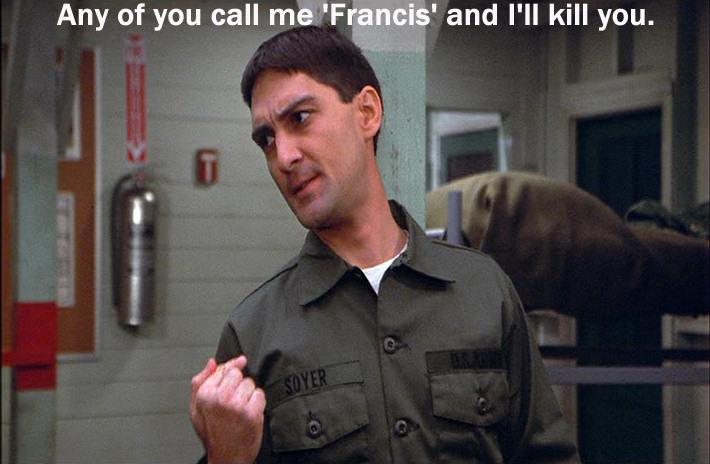
And remember, if you call him Francis, he'll kill ya.


Read more...

Wednesday, March 13, 2013

Intelligence on Venezuela

Via Just the Facts, here is the Senate Select Committee on Intelligence's "Worldwide Threat Assessment of the U.S. Intelligence Community. For Latin America there is mention of Iran but not in too sensational a way. Iran is not mentioned with regard to Venezuela, which in fact gets pretty bland treatment.


Venezuelan President Hugo Chavez’s death on 5 March has triggered preparations for a new election in which we expect Vice President Nicolas Maduro to compete against Miranda Governor and former presidential candidate Henrique Capriles Radonski. Venezuelan Foreign Minister Elias Jaua announced that Maduro will take over as interim president and that an election will be held within 30 days. Maduro is a long-time Chavez loyalist and will almost certainly continue Chavez’s socialist policies.  
The Venezuelan Government will be up against the consequences of an increasingly deteriorating business environment and growing macroeconomic imbalances. Debt obligations will consume a growing share of Venezuela’s oil revenues, even if oil prices remain high. Lingering citizen concerns that Caracas will face in the next year also include personal safety, which has been threatened by a rising tide of
violent crime.


This could have been culled from recent media reports in less than five minutes. However, bland and obvious is far better than paranoid and deranged.

Read more...

Monday, March 11, 2013

Ken Follett's Fall of Giants

I read Ken Follett's brick of a book, Fall of Giants. It's the first part of a huge trilogy about the 20th century, and focuses on World War I. I enjoyed it. It's a soap opera with really intelligent commentary on the class divides that were rigid but changed as a result of the war.

You've got the Welsh miners and the Welsh earl (married to Russian nobility), members of the German elite, the lower strata of Russian society, American political elites, British radicals, and others in a sprawling story. They intersect in ways that strain credulity--too many people see each other coincidentally, even on a French battlefield--but it works.

It's a beach book with a backbone. Someone with no historical knowledge would at least get a sense of the ridiculous and sad chain of events that led to the war, the reasons it went on so long, and then get a taste of the consequences.

Read more...

Support for Democracy in Venezuela

The Latin American Public Opinion Project has some data on support for democracy in Venezuela. The upshot is that it is high, and in fact even higher than in the United States.


We have to be careful about how we interpret this. It does not necessarily say that Venezuelans believe the country is being governed democratically. I expect many, particularly in the opposition, would say they believe in democracy, but not the way Hugo Chávez has managed it. On the other hand, it is undeniable that many Venezuelans do believe the country is being governed democratically.

Either way, the overall level of support is important as Venezuela moves into unknown political territory. At the very least, leaders on both sides will feel more domestic pressure to find democratic solutions to political disputes. With luck the United States will recognize this and resist calls for intervention. Beyond generic calls for all sides, the U.S. should stay out.

Read more...

Losing Double in Venezuela

After a brief hesitation, Henrique Capriles has agreed to be the opposition candidate for the April 14 president election. Lots of combat-oriented rhetoric is flying all over, with "fight," "war," etc. Twitter is positively aflame with it.

Capriles will almost certainly lose, which would put him in the very unusual position of losing two presidential elections in six months. There is, however, plenty of precedent for perennial losers eventually coming back. Salvador Allende first ran for president in 1952 and won only just over 5 percent of the vote, and didn't end up winning until 1970. In the United States, Richard Nixon is of course the most famous/infamous case, as he lost both the 1960 presidential election and then the 1962 California gubernatorial election, finally coming back in 1968.

At least for now, Capriles is what the opposition has to offer, so he's come out blasting to overcome the support for Chavismo and the sympathy for the candidate Hugo Chávez publicly chose. Via Steven Taylor, here's a visual of that from Colombia's El Tiempo:


Read more...

Sunday, March 10, 2013

Panama Canal

I saw the Panama Canal yesterday. So impressive. The lock doors are still original.


What also hit home was how big the canal zone is. It was much easier to internalize how resentful Panamanians were about being excluded from this huge chunk of prime Panamanian real estate. There was just an enormous American bubble. The canal museum in the old part of town hammered home the problems with the 1903 treaty.

Read more...

Friday, March 08, 2013

Panama Construction

I am in Panama City for the annual SECOLAS conference. What immediately strikes me is the construction. Of course, the canal is being widened, but a new metro is being built, the old part of town (Casco Viejo) has tons of work being done on it, and there are high rises going up. There is work being done all over the place

My first thought was debt, which may well be the result. Somone has to be paying for all this.


Read more...

Wednesday, March 06, 2013

Venezuelan Opposition Unity

Jennifer Cyr has a post up at The Monkey Cage about Venezuela. I disagree on one point:

With Chávez around, these parties had achieved an organizational and institutional unity that might have been sufficient to topple him at the polling booth. Now it is likely that ideological differences, personal ambitions, and unsavory links with the past will become manifest, chipping away at the unity that had made Capriles an attractive alternative for many Venezuelans.

I agree that the opposition is united primarily against rather than for anything in particular. But the fact is that opposition groups have a strong incentive to remain united as long as they are out of power--it took them years to achieve it, and I don't see it disappearing that quickly. Whether or not the president is Chávez is immaterial. In fact, you could argue there is even more incentive without him because he seemed so invincible whereas Nicolás Maduro will be viewed as beatable in an election.

Contrary to her argument, I think Maduro will have a much bigger challenge with coalition unity over the longer term than Henrique Capriles will, precisely because he is president. Maduro will enjoy a honeymoon period, but he hasa to hold together his own disparate factions. Chavismo is not a bloc.


Read more...

Tuesday, March 05, 2013

Hugo Chávez died

Rumors of someone's death must eventually be true. I'm not sure the last time a president's death mattered so much for the politics of a Latin American country (maybe Juan Perón?). According to the Venezuelan constitution, there will be an election in 30 days. That election will pit Henrique Capriles against Nicolás Maduro, and Maduro will have the very clear advantage.

Chavismo is no bloc, however, and so assuming he wins Maduro will have to work hard to keep the coalition together. He will use foreign enemies as a foil as much as possible to generate unity, but will face internal political competition in a way that Chávez did not. I have a piece coming out in Americas Quarterly shortly arguing that ALBA will likely become less relevant as a result. Maduro will keep the close ties to Cuba, but he will also need to use resources for domestic constituencies more than Chávez did.

Read more...

Government's Take on Chávez

The Venezuelan government announced that Hugo Chávez is not doing well. Go to the state media site and you get even more:


El Gobierno Bolivariano continúa acompañando a los hijos y demás familiares del Comandante Presidente en esta batalla plena de amor y espiritualidad y llama a todo nuestro pueblo a mantenerse en pie de lucha, incólume ante la guerra psicológica desplegada por laboratorios extranjeros con altavoces en la derecha corrupta venezolana, que busca generar escenarios de violencia como pretexto para una intervención extranjera en la patria de Bolívar. 
Asimismo, el Gobierno Bolivariano repudia la actitud farisea de aquellos enemigos históricos de Hugo Chávez, que siempre le han prodigado odio, insultos y desprecios, y ahora tratan de utilizar su situación de salud como excusa para desestabilizar a la República Bolivariana de Venezuela.


I'm not sure what "psychological war" the government is referring to, unless they mean the rumor-fest that itself was caused by the government's refusal to give any facts about Chávez's condition. There's no "foreign laboratory" in that regard. And beyond a tiny minority of people like Roger Noriega, I don't see any appetite in the United States for "foreign intervention."

Read more...

Monday, March 04, 2013

Latin American Political Scientists

Flavia Freidenberg and Andrés Malamud, "Politólogos on the Run: Contrasting Paths to Internationalization of Southern Cone Political Scientists." Latin American Politics & Society 55, 1 (Spring 2013): 1-21.

Abstract (full text is gated).


Political scientists from the Southern Cone have enriched the discipline with pioneering work. Many of them went into exile for political reasons, and thus produced part of their work abroad. Although Latin American political science has professionalized since the 1980s, many scholars still emigrate for study and employment. Argentines most numerously seek academic careers abroad, while Brazil has many more domestic doctorates and returns home after doctoral studies abroad. Uruguayans emigrate in proportionally high numbers and tend to settle in Latin American countries, while the number of Chileans and Paraguayans abroad is minimal. These contrasting patterns are explained by reference to factors such as the availability of high-quality doctoral courses, financing for postgraduate studies, and the absorptive capacity of national academic markets. Paradoxically, the size and performance of the diasporas may increase rather than reduce the visibility and impact of national political science communities.


This is the sort of thing that deserves more attention, since political science (like many other disciplines) has long been dominated by the United States (and to a lesser extent Europe) but there is more and more cross-pollination. As the authors note, however, they chose their cases on the dependent variable--people who left--and so there is a lot left to explain. The vast majority of respondents are also Argentine, which leaves open the question about why people didn't leave other countries.

I think of the Chilean case, where there are plenty of well known political scientists who received their Ph.D. abroad and then returned to become professors at various universities in Chile.

Overall, this type of study can fruitfully connect to the broader question of how much higher education is valued in each country. To what degree do governments value "brain gain"?

Read more...

Sunday, March 03, 2013

Baseball Uh-Huh

Below is a sure sign of spring:


Forget that it snowed a bit in the morning. By afternoon we got to see UNC Charlotte beat Youngstown State. One of the local curiosities is a guy who paces the concourse, often with baseball mitt all ready for a foul ball, calling out to the field and ending every sentence with a loud "UH-HUH!" So if the opposing pitcher throws a ball in the dirt, it's "Dirtball! UH-HUH!" or if an opposing batter watches a strike, it's "That's called taking a strike, UH-HUH! UH-HUH!" He even has signs, 10 or so in different scripts, all of which say "Uh-Huh." Later in the game he put on a "Uh-Huh" shirt and cap.


We've seen him at Kannapolis Intimidators games too. It's just odd enough not to be annoying. He's obviously a very friendly guy, periodically chatting with people. I don't know whether he finishes every sentence with "Uh-Huh."

Update: Here's a video of the Uh-Huh guy from two years ago:


Read more...

Friday, March 01, 2013

More on Election Boycotts

I wrote a short piece at Foreign Policy on the ineffectiveness of election boycotts in Latin America. The basic idea is that they can very easily result in things you don't want.

Read more...

Wednesday, February 27, 2013

Boycotting Elections

The Egyptian opposition says it will boycott the upcoming parliamentary elections. This is so ripe for comparative analysis with Latin America, where similar boycotts have taken place in all kinds of contexts. At least anecdotally, my first thought is that the boycott will not have the effect the opposition wants, which is to delegitimize the regime. Instead, the most likely outcome is that the Islamists will consolidate their power and have more free rein to pass what they want.

In that regard, there are a lot of similarities to Venezuela in 2005, when the opposition pulled out of legislative elections based on similar dislike of the government and distrust of how the election would be handled. The result, though, was a huge win for Hugo Chávez. I also think of the Nicaraguan opposition boycotting the 1984 presidential election.

Read more...

Tuesday, February 26, 2013

Cuba and Terrorism

This is pretty much the definition of moving goal posts. José Cárdenas argues that Cuba is no longer supporting terrorism but that it should remain on the list of state sponsors of terrorism anyway. Oddly enough, he uses the example of North Korea to say that you must make a significant stride to get off the list. I am still puzzling over how to apply the North Korean case to Cuba.

Read more...

Santos Disapproval

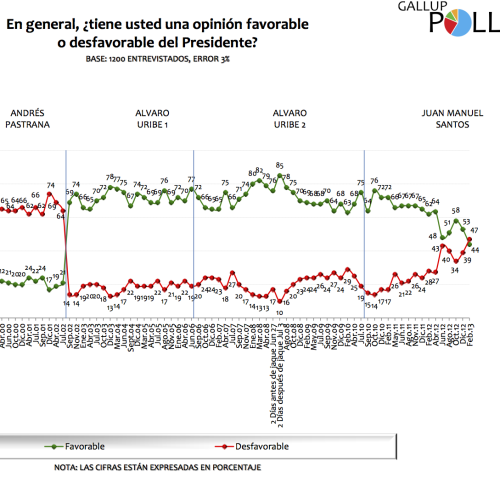
I am stealing this image from Adam Isacson's blog.


Not so nice news for Juan Manuel Santos, clearly, though at least he's not in Andrés Pastrana-land quite yet. What's so unusual in this case is that Santos' most vocal opposition is actually to his right. Alvaro Uribe has kept up a relentless negative drumbeat on Twitter, arguing that Santos is soft on Hugo Chávez and stupid about the FARC. I can't recall any former president being so vocally derisive.

Read more...

  © Blogger templates The Professional Template by Ourblogtemplates.com 2008

Back to TOP