Friday, March 07, 2014

Dirk Hayhurst's Bigger Than the Game

I bought Dirk Hayhurst's new book, Bigger Than the Game, as soon as it came out because I knew I'd like it. This is the third book in a baseball trilogy and the previous two were fascinating and funny.

This one is no different, but it's actually much less about playing baseball than about dealing with baseball. It starts with the self-inflicted shoulder injury (lifting too much weight) he got in the offseason after 2009 and how he dealt with injury during the entire 2010 season. That included depression, using pills to make himself sleep and get numbed, having people know about his first book, a run-in with an arrogant teammate who did not like him writing and talking to the media, and rehab (with a cameo by wrestler Triple H).

Baseball is a conservative game in many ways--players have their codes, things are done this particular way, and you must not rock the boat. The mere idea of letting people see inside scares baseball players, and seeing inside is what Hayhurst does. He goes off about the player who kept confronting him (different reviews speculate differently, but he may just be an amalgam) as well as a few others, in large because he's not respecting the game and instead is trying to be bigger than baseball, which is a sin.

In some way all of his books are about his efforts to figure himself out. You get the impression that he was finally getting there at the end of this one. He thought hard about what baseball means and how he should fit into it. He learned how not to care about others' perception of his role in it. Like many other entertainers--such professional wrestlers--the fans see you as a commodity and not as a person. Players buy into the image, which feeds their self-image and self-worth.

Everyday dumbasses get on the internet and debate your worth like you're a fucking commodity. But instead of trying to say we're not a commodity, we just want to be the most valuable commodity possible. Everyone wants to be the hyped, processed, nostalgia-injected product instead of being an actual fucking person (p. 125).


The player who didn't like him hated the fact that Hayhurst might puncture the bubble they live in and value so highly--just chatting too often with the team's own media person (who in many ways helps nurture the image!) was crossing the line. As he points out, though, this is already slowly changing. Glacially yes, but social media is here now and not going away. Way too few baseball players write real books but reality is spilling out in bits and pieces.

And like the rest of the books, it's funny and self deprecating. As he said to his book agent:

"My style is being honest about failing in a game that everyone thinks you're a winner in simply by playing" (p. 232).

I'm guilty of that feeling, and like how Hayhurst has made me think more broadly. If you're a baseball fan, you should check out all three.

Read more...

Thursday, March 06, 2014

Maduro Goes After Panama

Nicolás Maduro's verbal attack on Panama and announcement that diplomatic and economic ties were frozen got a response from Ricardo Martinelli--this part is hard to argue with:

Rechazamos como inaceptables las ofensas proferidas por el presidente Nicolás Maduro en contra de nuestro país y su más alta autoridad. El lenguaje soez utilizado es impropio del Presidente de un hermano país.

What Martinelli had done was suggest that the OAS discuss the Venezuelan crisis and bring the two sides together in sort of dialogue. Even that made Maduro blow up. That extraordinarily exaggerated response resulted from his stated belief that Panama was plotting against him.

It's hard to interpret this as anything but straightforward paranoia. If it's a conscious strategy, then I don't see it resonating with his domestic audience (who cares about Panama?) or serving any real purpose. I guess we can set it alongside the wide variety of other conspiracy theories Maduro has claimed since the protests began.

So will trade with Panama truly be frozen? I wonder. A quick Google search suggests that the U.S. is Panama's biggest source of oil, but I don't know how Venezuelan oil fits in. Hugo Chávez did something similar with Colombia in 2009, which lasted a while and then went away after Alvaro Uribe left office. That was a particular kind of personal animus that isn't really the case with Panama.

Read more...

Wednesday, March 05, 2014

Venezuela Student Manifesto

David Smilde has a post about the Venezuelan student manifesto, and makes a very good point.

I have a lot of sympathy with the students’ emphasis on individual liberties. However in political terms the statement reveals how little progress the opposition base has made in understanding what it will take to grow their coalition. The last fifteen years have shown that if Venezuelans have to chose between liberty and equality the latter will usually win out. Thus the art of politics in a context characterized by large scale poverty is in proposing solutions to inequality that at the same time preserve liberty.

The five points in the manifesto say nothing about poverty or inequality, which are precisely what launched Hugo Chávez to the presidency in the first place. All the ranting about "régimen castro-comunista" totally ignores that critical fact.

Political reality should dictate that no matter what your ideological inclination, you need to incorporate the preferences of the majority into your messages. Otherwise you are doomed to failure. It is bizarre that after so many years the opposition seems to remain blind about that. Leopoldo López seems to believe that pressure will force out the Maduro government and through elections bring to power something more middle/upper class that will focus largely on dismantling chavismo. If there is even a shred of evidence to support that, I have yet to see it.

Read more...

Tuesday, March 04, 2014

Thinking About Venezuela Sanctions

It appears the idea of targeted sanctions is gaining momentum:

President Barack Obama’s administration is considering imposing sanctions on Venezuelan officials culpable in that nation’s repression and who travel to and hold bank accounts in the United States, U.S. Rep. Debbie Wasserman Schultz said Monday. 
“There should be sanctions on individuals. ... The administration is looking at those,” said Wasserman Schultz, the Democratic National Committee chairwoman, citing an unnamed “high-level” state department official she spoke with earlier in the morning.


Read more here: http://www.miamiherald.com/2014/03/03/3971520/wasserman-schultz-obama-looking.html#storylink=cpy

I had mentioned before that this would be tempting. They are low cost because they do not disrupt oil or anything else, and President Obama can nod to Cuban-Americans and Venezuelan-Americans in Florida that he's tough. That is particularly appealing as Republicans rail on him for being soft on Russia.

I'm quoted in this Washington Post story, arguing that for now Nicolás Maduro is still in a solid position. What would targeted sanctions do? If you pinch just the right people, maybe his internal position weakens.

With regard to chavistas in general, there is the question of whether sanctions provides new ammunition for the empire argument and thereby strengthens Maduro's position domestically. However, if they are well targeted then they actually won't affect more than a very small number of people, which takes a lot of the steam out of that line. Does the average chavista care that much whether some of the political elites can't access their money? It's not impossible but hard to imagine caring too much.

At least at this point, if there is no dialogue then there is a really good chance we'll see such sanctions. It's just a solid domestic political move for Obama.

Read more...

Monday, March 03, 2014

Venezuela and Florida Presidential Politics

Once you start mixing Venezuela with Florida presidential politics, logic starts flying out the window. From the Miami Herald:

For Republicans, who have watched the once-reliable Cuban-American GOP vote lean more Democratic, Venezuela provides a fresh way to remind voters about the failures of a socialist-totalitarian state. And Havana’s role in the unrest in Caracas and San Cristóbal provides a new counter to those who want to lift the embargo against Cuba.

Read more here: http://www.miamiherald.com/2014/03/02/3969446/marc-caputo-venezuela-joins-cuba.html#.UxPmwc0et30.twitter#storylink=cpy

The fact that the embargo helped keep Fidel and Raúl Castro in power long enough to have anything to do with Venezuela in 2014 goes unmentioned. Worse, we see politicians stumbling over themselves to talk about "getting tough" with Venezuela in the exact same ways we've talked about getting tough with Cuba. That getting tough with Cuba gave more power and legitimacy to the Castro goes unmentioned.

Scott was far more strident in attacking Obama at the Friday event.
The governor excoriated the president for not pushing sanctions. Scott pointed out he raised the sanctions issue Monday at a governors meeting with Obama.


Read more here: http://www.miamiherald.com/2014/03/02/3969446/marc-caputo-venezuela-joins-cuba.html#.UxPmwc0et30.twitter#storylink=cpy

We can only hope these do not refer to the same type of blanket unilateral sanctions levied against Cuba, which of course don't work even though you can point to them as an example of how good you are at getting tough.

Unfortunately, this is inevitable. The Cuban American vote is not in lockstep with the Republican Party anymore and Venezuela provides a way to give new life to the party in Florida by also bringing Venezuelan-Americans into the fold. They want red meat and so they will likely get it.

So Venezuelans are getting their introduction to the odd contraption we call the Electoral College. The only reason this relatively small group of Venezuelan- and Cuban-Americans matter is that the state of Florida has 29 electoral votes, which is 10.7% of the total needed to win election to the presidency of the United States. If the Venezuelan protests matter to politically active and wealthy Floridians, then it has to matter to presidential candidates as well.

Read more...

Sunday, March 02, 2014

Congress Resolving Venezuela

Here is the text of the proposed Senate resolution about Venezuela. Its thrust is to "urge" the president to use targeted sanctions against individuals deemed to be contributing to repression. Given its authors, I'm a bit surprised it is not more strongly worded and/or harsh in sanctions.

Looking back, I saw there was a resolution from 2013, which passed. The basic wording was similar but without the sanctions. Go back to 2007 and you find something similar and co-sponsored by Senator Obama.

And then, of course, there is this House Resolution giving the president authority, even up to war, to pursue claims by U.S. citizens against the Venezuelan government. Oh wait, that one is 1872.

Just since Hugo Chávez was first elected, there have been a lot of resolutions--I don't know how many were passed. Eyeballing them through govtrack, I figured most would come from Florida or Bob Menéndez but they are spread out (even Rick Santorum got into the act). One commonality is ideology, couched in terms of caring for the Venezuelan people. Their goal is to do something against chavistas which will then somehow make things better.

I'll be curious to see whether the targeted sanctions strategy gets legs, as it is a new component--for the most part the resolutions call for reports, dialogue, etc. As a political strategy, it sidesteps the question of how effective unilateral sanctions per se are--Cuba makes that problematic--and provides considerable flexibility. I have no idea whether President Obama will bite, but it could be tempting as a way to show he is doing "something."


Read more...

Saturday, March 01, 2014

15 Annoying Things About the Venezuela Crisis

I'm actually having a very pleasant day, but annoying things about the Venezuelan crisis have been stuck in my head for a while. In no order at all:

1. that Maduro obsessively uses the word "fascist" in a meaningless way

2. that the opposition thinks the majority of Venezuelans are with it

3. that after 15 or so years, the opposition still has no idea how to lead its way out of a paper bag

4. that Maduro claims the opposition is to blame for the state of the economy

5. that the Venezuelan government claims that incredibly bland statements from Juan Manuel Santos, John Kerry, and others should be taken as a sign of meddling

6. that Eva Golinger and Roger Noriega are almost perfect mirrors of each other

7. that anyone believes sanctions would make the situation improve

8. that Leopoldo López is still in prison

9. that anyone continues to cite Chile in 1973 and other distant Cold War crises as comparisons to Venezuela 2014

10. that the opposition uses the word "dictatorship" while simultaneously marching publicly every day against the government

11. that Maduro keeps saying he wants peace while simultaneously ranting and raving about the opposition

12. that people think the media is sweeping Venezuela under the rug

13. that Venezuela keeps expelling U.S. diplomats until nobody's left but the night shift or something

14. that the Agencia Venezolana de Noticias takes itself seriously

15. that English-language media cannot stop writing that Venezuela is "bracing" for protests (just Google Venezuela braces)


Read more...

Friday, February 28, 2014

U.S. and Latin American Relations writing (part 4)

Three weeks since my last confession. Two weeks ago we had three consecutive snow days, which was heavenly for textbook editing. As I was looking at the chapters, I realized I hadn't laid them out correctly, so now it is clearer with titles as well. Unfortunately I have not written any more of the new chapter.

But at least for now I feel pretty good about progress.

Progress (Deadline: August 1, 2014)

Chapter 1 (Theory) - Revised but not polished
Chapter 2 (Historical) - edited with red pen but not revised
Chapter 3 (Rise of US Hegemony) - edited with red pen but not revised
Chapter 4 (Intervention/Good Neighbor) - edited with red pen but not revised
Chapter 5 (Early Cold War) - edited with red pen but not revised
Chapter 6 (Cuba Revolution)- edited with red pen but not revised
Chapter 7 (Communist Threat) - in the process of reading/commenting
Chapter 8 (Challenge to US Hegemony)- writing (3 pages)
Chapter 9 (Political Economy)- not started
Chapter 10 (Immigration) not started
Chapter 11 (Human Rights) - not started
Chapter 12 (Drug Trafficking) - not started

Read more...

Maduro and the Protests

I'm quoted in this Wall Street Journal article. In many ways an extension of my thoughts yesterday about how Nicolás Maduro is hoping that things peter out. The holidays are part of that--can you keep protesting at a time of traditional celebration? How much will that annoy the rest of the population?


Read more...

Thursday, February 27, 2014

Gallup Survey of Venezuela

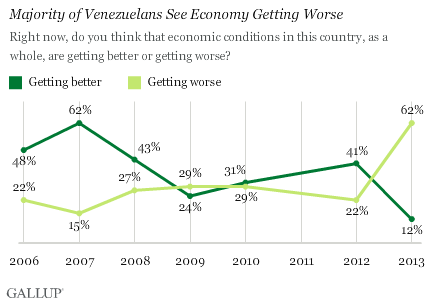
Here is the first of a two part Gallup study of Venezuela. What it shows is an increasing sense that the economy is getting worse and that in general Venezuelans feel they are becoming worse off. This suggests that the protests stem in large part from these feelings.

This is interesting, though it's important to keep two things in mind. First, even under Hugo Chávez these indicators bounced around. So, for example, on the economy:


After 2007 confidence took a nosedive but the government didn't fall apart. That spike at the end, though, is pretty dramatic, suggesting a correlation with Chávez's death and Maduro taking over. It'll be critical to see whether the trend continues or there is more bouncing.

Second, they say nothing about political preferences. The opposition seems to believe that dissatisfaction with the economy translates into support for the opposition, or at least for Maduro's departure. But that's not obvious at all. It's up to Maduro to implement policies that reduce crime and inflation, etc., which would stabilize the situation considerably.

These numbers, though, are indicative of the fact that even if the protests peter out in the next few weeks, the underlying causes for them must be addressed or political conflict will return. If the dissatisfaction continues, then his internal position will weaken. It's hard to see the opposition winning, but easier to see an internal push for a new president if conditions worsen.

Read more...

Maduro and the Military

Reading about WWI is a potent reminder of how even logical assumptions can go terribly awry. Germany could affirm a secret agreement with Austria-Hungary because it wasn't in Russia wasn't likely to go to war. There were very solid, yet ultimately erroneous, reasons for believing so.

This is relevant when thinking about the Venezuelan military. A question that keeps popping up is whether Nicolás Maduro maintains its support. Without cracking the black box of the military, which is impossible for anyone outside the institution, you can only go by outward appearances and logical assumptions, knowing full well they are correct only until they are wrong.

But here's what we know, or at least what I claim we know:

1. The military publicly affirmed its adherence to the government, and has not made any public sign to the contrary.

2. The military is chavista and therefore is very unlikely to impose regime change if there is any chance of the opposition taking over.

3. If the military overthrew Maduro and installed another chavista, the protests would get far, far worse as the opposition smelled political blood. The military knows this and therefore it is not a likely outcome.

4. The protests have continued but it's hard to argue they've gained momentum, which leaves the military less likely to get nervous.

Things can change, and these assumptions are not permanently applicable. If there are months of protests, they will change. If Maduro intensifies repression, they will change. But for now that's how I see it.


Read more...

Wednesday, February 26, 2014

News Coverage of Venezuela

There's an article in the Washington Post about news coverage of Venezuela. I've read numerous complaints, most prominently from Caracas Chronicles, about the lack of coverage, which I don't buy. As the article points out, there was more coverage of Ukraine but there are reasonable reasons (so to speak) for that, and it's not simply that we ignore Latin America.

More importantly, though, is digging into what "coverage" or "attention" means. The article spends time examining what stories are "above the fold," referring to the news that you see on the front of a newspaper when it is face up on a news stand. That is what signals importance. Or did. Long ago. Now it's largely irrelevant. Who cares what's on the front when you get your news online or elsewhere? And if you go online, there is a flood of stuff on Venezuela from every source imaginable. I've been contacted by several reporters, as have numerous other people who study Latin American politics. Last week I was at the gym and on CNN there was Wolf Blitzer talking about Venezuela. If Wolf is on the case, then by definition you're mainstream. At this point you would need to be actively avoiding news not to know there is something up in Venezuela.

Now, all of this is anecdotal. To make a convincing case you would need to examine coverage across all media, accounting for where people get their news (print newspapers, for example, don't inform many people these days so should not be weighted very heavily so don't focus too much about what's "above the fold"). Then you have to decide what constitutes "reasonable" coverage, ranging from no stories to total saturation. I think this would show that Venezuela is not being swept under the media rug.


Read more...

Tuesday, February 25, 2014

Various Faces of Nicolás Maduro

Over the last few weeks, Nicolás Maduro's statements and actions have seemed to have a certain schizophrenic quality to them, going in different and sometimes contradictory directions. It seems, too, that I've read a considerable amount of commentary sympathetic to the government versus the opposition, and none of it defends Maduro himself. He seems to have no plans and no strategies, which are replaced by saying whatever pops into his head. It's like he's playing good cop and bad cop simultaneously.

We saw that immediately as he slapped Leopoldo López into jail on flimsy charges, with Maduro personally saying he must answer for his "unawareness of the constitution" and saying he would put all fascists in jail. Meanwhile, Maduro spoke of "justice." This played directly into the opposition's hands.

Another example is the amazing array of insults he hurls at the opposition, all the while saying he just wants dialogue. In every other sentence he makes certain everyone knows that he will make no concessions and feels nothing but contempt for the opposition. If you weren't already numbed to the word "fascist" then you must be now, as it is overused to the point of absurdity. He plays eagerly (and understandably) to an internal audience, but seems oblivious to the fact that doing so closes off other opportunities.

Even as he unleashes insults at them, he laments the opposition's insults against him and the government.

Maduro also announced Venezuela would name a new ambassador to the United States, shortly after expelling three officials and giving a continuous barrage of accusations against the U.S. If you don't tone down the language, then the gesture is useless. What is it intended to achieve?

Lurching from one stance to the next and back again is counter-productive. Having López in jail is a boon to the opposition and no one is quite clear whether Maduro wants dialogue, or what it would be about.

The opposition is not much better. Henrique Capriles indicated he would engage in dialogue, then backed off. Leopoldo López seems to have few or no redeeming qualities, and apparently seeks to rival Hugo Chávez for megalomania. The government and opposition blunder along together.


Read more...

Monday, February 24, 2014

Insults and Dialogue in Venezuela

I'm quoted in this Bloomberg story about the upcoming dialogue between Henrique Capriles and Nicolás Maduro. It really echoes my thoughts from yesterday's blog post.

Basically, I don't think all the insults necessarily preclude dialogue. These are seasoned politicians in an extremely polarized context. Each knows the other must play to a domestic constituency. It won't be a comfortable conversation, but it can at least happen.

What I don't get is what the dialogue will be about. If it is just a sign of good will, then that's positive (Boz notes some specifics in comments in that last post). But my quote is about how it will not be easy to back off the lines in the sand that each side has drawn: "la salida" on one side, and a deepening of the revolution on the other. At some point you have to either address that directly, or dialogue descends back into monologue. Monologue is what we've got now, and it serves mostly to exacerbate the divisions.


Read more...

Sunday, February 23, 2014

Dialogue in Venezuela

Henrique Capriles agreed to talk to Nicolás Maduro on Monday. The way to do this, it seems, is to have an implicit agreement that each has the right to continue publicly hammering on the other. Neither can afford to look soft.

But it's still very unclear what the goal will be. Currently, the opposition's stance is all about Maduro's departure, which obviously is nonnegotiable. Maduro is all abou revolution, which is also nonnegotiable. "Dialogue" implies concession because otherwise you have only predictable monologue, which is what we've already got.

Don't get me wrong. Talking is good, certainly far better than the chest thumping we've been seeing. But following up on my post yesterday about the fork in the Venezuelan road, there are only two visions in Venezuela at the moment, and they're very hard to reconcile. I don't really see a "third way" that bridges the gap.

Insisting only on departure or only on revolution will likely create more violence. So what other options are there, and who can articulate them? With any luck, the meeting between Maduro and Capriles can somehow get them out of the rhetrical straitjackets they're in and point in that direction.


Read more...

Saturday, February 22, 2014

Taking the Fork in Venezuelan Road

In The Nation, George Ciccariello-Maher offers up an interesting view of the protests in Venezuela with a sympathetic focus on "democracy from below," as opposed to "liberal democracy."

At least in my eyes, here is the key quote:

Venezuela is indeed at a crossroads, having—in the words of the militant-intellectual Roland Denis—“llegado al llegadero, arrived at the inevitable.” It is the point at which the Bolivarian process itself—socialism in a capitalist society, thriving direct democracy in a liberal democratic shell—cannot survive without pressing decisively toward one side or the other: more socialist, more democratic, in short, more radical. This is not a crossroads simply between two possible forms of government from above: the Maduro government or its hypothetical right-wing alternative. It is instead a question of either pressing forward the task of building a revolutionary society, or handing the future back to those who can think of nothing but the past, and who will seek to fold the historical dialectic back onto itself, beaten and bloody if necessary. [Emphases in original]


This struck me because it gets down to the question of where these events are leading Venezuela. The opposition is the minority, but it is a large minority. Pressing more decisively in the direction of revolutionary socialism by definition means rejecting a very significant chunk of the Venezuelan population. Is that viable without protracted civil war? Can it happen without resorting to "beating and bloodying" that minority?

These are practical questions because such a society will require a much more aggressive use of the military internally, or at least I can't imagine how else that minority would be silenced. Is there some way of bringing that minority into the revolutionary fold without force?

Given how difficult and violent that route likely is (unless I am missing something in that regard) I would think the more likely result is more of the same. The opposition (especially since it seems to have no military support) will not take power, and the Maduro government will talk of deepening the revolution without truly doing so. As Yogi Berra allegedly once said, when you come to a fork in the road, take it.


Read more...

Statements on Venezuela

Here is the Washington Office on Latin America's press release on Venezuela. It goes much further than the most recent statement from John Kerry. Kerry's statements, meanwhile, have been much more mild than anything from Human Rights Watch and Amnesty International.

If anything, then, the Obama administration has been pretty circumspect. Nicolás Maduro is lambasting Kerry on Twitter, but it's hard to get a lot of traction when he's well behind multiple NGOs that focus on human rights.

It is also harder to get traction given Maduro's treatment of CNN, which was an amazingly stupid decision. He backed off, but the threat remains, and provides more meat for human rights accusations against him. Unfortunately for Maduro, he has a habit of providing compelling evidence just by opening his mouth.

Read more...

Friday, February 21, 2014

Book chapter on Chile

Just got my copy of a new book chapter:

Gregory Weeks, “The Military and Twenty Years of the Concertación.” In Kirsten Sehnbruch and Peter M. Siavelis (eds.). Democratic Chile: The Politics and Policies of a Historic Coalition, 1990-2010 (Boulder: Lynne Rienner, 2014): 103-117.

Read more...

Diplomacy and Venezuela

A column in USA Today makes a case that there are no diplomats to hepl resolve the Venezuelan crisis, comparing it unfavorably to Europe. It rests on the assumption that diplomats are generated by trade, and there is not enough trade. I have no idea where this argument came from, and I am not convinced. Trade and diplomacy have no automatic assocation. Plus, Latin America has a long tradition of hesitance about overt intervention (covert has often been fine, but that's another story).

In any event, somehow this conclusion is reached:

That largely leaves economic sanctions as a way to influence the actions of the Venezuelan government.


I'm not sure at all why that follows. The chances that Latin American countries would impose economic sanctions are very, very close to zero--something really unusual would have to happen. Not only would that be out of character, but it would also very likely rally many people to Nicolás, thus negating whatever negative impact the sanctions were supposed to generate.


Read more...

Thursday, February 20, 2014

Nicolás Maduro Channels John Foster Dulles

Nicolás Maduro argues that the protests in Venezuela are not homegrown and legitimate. Instead, they were cultivated, trained, and financed by an external power seeking military intervention:

Advirtió que en Venezuela se está aplicando un plan para llevar al país al "caos social, político y militar (...) para generar una espiral creciente de odio y confrontación de pueblo contra pueblo y luego justificar lo injustificable: el llamado a una intervención extranjera militar en los asuntos internos de Venezuela".

This sounds remarkably like the argument made by the U.S. as it pushed for the Declaration of Caracas in 1954. Focusing on Guatemala, Communism was an external threat for all:

This declaration of foreign policy made by the American republics in relation to dangers originating outside this hemisphere is designed to protect and not to impair the inalienable right of each American State freely to choose its own form of government and economic system and to live its own social and cultural life.

John Foster Dulles followed this up with a speech a few months later after the U.S. overthrew Jacobo Arbenz:

Above all, we can be grateful that there were loyal citizens of Guatemala who, in the face of terrorism and violence and against what seemed insuperable odds, had the courage and the will to eliminate the traitorous tools of foreign despots.

Of course, the contexts are different. But the language is very similar. The best way to demonize your political opponent is to claim they are puppets of a foreign power that seeks to overthrow the system and establish something antithetical to the interests of the region. The "region" for the Eisenhower was the hemisphere whereas for Venezuela now it is Latin America.


Read more...

  © Blogger templates The Professional Template by Ourblogtemplates.com 2008

Back to TOP