Friday, May 09, 2014

Economic Paralysis in Venezuela

Venezuelan President Nicolás Maduro made a fairly startling admission about a problem, followed by a suggestion about how to make the problem worse:

Asimismo, dijo que 20% de las empresas participantes están paralizadas. 
En este sentido, Maduro comentó que "hemos pasado de la ley de la jungla, de cada quien poniendo las reglas económicas y los precios que le da la gana, a un proceso de regularización que debemos consolidar con reglas, con máximos porcentajes de ganancias".

Since I periodically get complaints that I don't translate Spanish (which is due to the fact that I don't want to take the time) here you go:
Also, he said that 20% of the participating companies [in a large conference held by the government] were paralyzed. 
On this point, Maduro commented that "we've gotten past the law of the jungle, with anyone imposing economic rules and prices that they feel like, to a process of regularization that we should consolidate with rules, with maximum profit percentages."

20% of businesses are paralyzed?!? That alone is a crisis.

But how to solve it? One way to make the crisis worse is with government rules to impose certain imaginary profit margins. The more the government dictates exact prices and exact profits, the more companies will find themselves paralyzed and you will generate a thriving black market.

Maduro and others in the government have complained long and hard about speculators, and I can understand their frustration. Unfortunately creating more rules to end speculation actually creates more speculation in the absence of broader reforms. If prices on basic goods in Venezuela are kept artificially low, people will definitely take those goods to the Colombian border and resell them at higher prices. At least the Venezuelan government seems to have finally recognized that and started raising prices. Interestingly, that solution goes completely against what Maduro just said.

But that's not the only problem. Venezuela's terrible handling of its currency has led to a shortage of dollars, which in turn makes it very difficult for firms to get the imports they need to keep going (thus paralyzing them). Company after company has been announcing it is halting activity because they can't get dollars for the imported goods they need and/or cannot get their dollar revenues.

This isn't really a debate about more or fewer rules, but rather about smarter rules that create incentives for people to follow the law and produce. And at a certain point, yes, prices will go where prices will go. If you are going to subsidize parts of the population, then just be intelligent about implementation so that you don't end up making the problem worse, which is what's happening now.

On the other hand, if you advocate simply opening up markets as the solution, you're just as clueless. Moisés Naím believed that would work as well, then helped create the economic mess that brought Hugo Chávez to power. Oddly, he talks about what a success those policies were. The logic escapes me.

Read more...

Thursday, May 08, 2014

Venezuela Sanctions Push

In large part because of the recent Human Rights Watch report, the U.S. Congress is moving closer to imposing targeted sanctions on Venezuela. Sensing an issue that might make conservatives forget about his support for immigration reform, Senator Marco Rubio is leading the charge. This quote jumped out at me:

Rubio says ways to best apply economic pressure will be discussed at the hearing. 
"We're looking to target individuals in the government or associated with the government," he said. "We're not penalizing the Venezuelan people."
What he is saying, then, is that Cuba sanctions penalize the Cuban people. If Cuba sanctions were as good as he claims they are, then wouldn't he want to impose the same on Venezuela? He says Venezuela is a dictatorship, which means it is the same as Cuba, which means an embargo would work perfectly. Right? Bueller?

Regardless, chances are very high (I'd say at least 90%) that sanctions will pass. The greatest thing about these proposed sanctions is that they don't cost anything, especially since they will no impact on Americans' ability to consume Venezuelan oil. Plus, of course, they play to the most active voters in Florida, so both parties can benefit (or at least don't want the other to benefit by their own inaction).

On the flip side, chances are very low that sanctions will achieve their stated goals. They may well achieve their unstated goal of annoying Nicolás Maduro, who probably is already concocting new speeches about cabals, imperialism, fascism, little birds, and ghosts. As I've written before, it would be nice to take a look and see how well these same sanctions have worked elsewhere, such as Russia. I don't have much faith in that, as members of Congress just want to be seen as taking action even if that action is substantively meaningless.


Read more...

Wednesday, May 07, 2014

China's Nicaragua Canal

Reuters takes a look at Chinese funding of the Nicaraguan canal. One entrepreneur, Wang Jing, with some connection (extent currently unknown) to the Chinese government is behind it. The article takes what I consider an appropriately cautious stance about how successful the venture likely will be.

I couldn't help but compare him to Ferdinand de Lesseps, who gave up on the Panama Canal. But that comparison may not be too apt because at least de Lesseps had some experience.

Nicaragua has dreamed of a canal for over a century so I can understand Daniel Ortega's temptation, and China clearly has money. But on this one I still take a wait and see attitude.


Read more...

Tuesday, May 06, 2014

Human Rights Watch Update on Venezuela

Human Rights Watch details abuses by the state against protesters in a new report.

Venezuelan security forces have used unlawful force in response to antigovernment demonstrations, severely beating unarmed protesters and shooting them at point blank range, Human Rights Watch said in a report released today. Security forces also subjected detainees to severe physical and psychological abuse, including in some cases torture, and justice officials failed to safeguard detainees’ due process rights.

And will these be prosecuted?

According to the government, as of April 25, the Attorney General’s Office was conducting 145 investigations into alleged human rights violations, and 17 security officials had been detained for their alleged involvement in these cases. 
“Given the lack of judicial independence in Venezuela today, and the fact that prosecutors and judges are directly implicated in many of the abuses we documented, it’s difficult to expect that the people responsible for these crimes will be brought to justice,” Vivanco said. “For these efforts to be credible, the Venezuelan government should seek the involvement of UN rights monitors and take immediate steps to secure the independence of the judiciary.”  

We will hear counter-arguments that the protesters have the same power as the state and are worse offenders, that the government is doing a good job of investigating, and/or that HRW is a tool of the United States. My advice is to read the report and decide for yourself.

Read more...

Monday, May 05, 2014

Panama's Election

Juan Carlos Varela won the Panamanian presidential election with a plurality of 39.14% but his party only received 11 of 71 legislative seats (the entire unicameral National Assembly), which put it at a distant third.

The basics of post-invasion Panamanian presidential politics have held. The incumbent party loses while power is shared within a small oligarchy (we are seeing a switch from big supermarket money to big rum money). Poverty and inequality are serious problems but economic growth is solid (very high recently) and the left has difficulty getting much of a foothold. Illicit money will keep flowing in to be laundered and corruption won't go anywhere in particular even while all the parties point fingers at each other and simultaneously skim what they can. Presidents get greedy and want another consecutive term but are rebuffed.

What all this leaves is divided government in the context of elite consensus that survives despite personal differences. Political disagreement remains at the margins (i.e. not core issues about the country's direction) and this election revolved much more around Ricardo Martinelli's efforts to keep pulling strings from behind the scenes (especially with his wife as running mate of his party's candidate José Domingo Arias).

There is talk about why the polls failed to predict the victory and showed Varela third, but on Twitter Orlando Pérez (who was there observing) argues that no polling was allowed past April 24 (for a May 4 election) and they had been showing him rising.


Read more...

Saturday, May 03, 2014

Galeano Dislikes Open Veins

In an interview Eduardo Galeano says he doesn't like Open Veins anymore, a book that is of course iconic.

“No sería capaz de leer el libro de nuevo”, djo el escritor en la II Bienal del Libro y Lectura de Brasilia, y agregó que “esa prosa de izquierda tradicional es pesadísima”.

Luego, confesó que cuando escribió el libro “no tenía la formación necesaria”, y que si bien no está “arrepentido de haberlo escrito”, afirmó que es “una etapa que está superada”.

Por si fuera poco, sostuvo que el libro fue escrito “sin conocer debidamente de economía y política”.


I wonder what Hugo Chávez would say? This is part of the many tensions in the Latin American left. There are plenty of core agreements but intellectuals and politicians evolve, sometimes a lot (just look at Fernando Henrique Cardoso or indeed the entire Chilean Socialist Party). It just isn't the 1960s or 1970s anymore.


Read more...

Friday, May 02, 2014

Cuba as State Sponsor of Terrorism

Here is the entire justification of the State Department's justification of having Cuba listed as a state sponsor of terrorism.

             Cuba was designated as a State Sponsor of Terrorism in 1982.
Cuba has long provided safe haven to members of Basque Fatherland and Liberty (ETA) and the Revolutionary Armed Forces of Colombia (FARC).  Reports continued to indicate that Cuba’s ties to ETA have become more distant, and that about eight of the two dozen ETA members in Cuba were relocated with the cooperation of the Spanish government.  Throughout 2013, the Government of Cuba supported and hosted negotiations between the FARC and the Government of Colombia aimed at brokering a peace agreement between the two.  The Government of Cuba has facilitated the travel of FARC representatives to Cuba to participate in these negotiations, in coordination with representatives of the Governments of Colombia, Venezuela, and Norway, as well as the Red Cross.  
There was no indication that the Cuban government provided weapons or paramilitary training to terrorist groups.

The Cuban government continued to harbor fugitives wanted in the United States.  The Cuban government also provided support such as housing, food ration books, and medical care for these individuals.

In other words, the justification for keeping them on the list is that they are not actually sponsoring any terrorism at all. In fact, they are working with other countries to end the Colombian civil war.

When asked about this very point, the State Department's spokesperson could only say that the State Department's own report showing they were not sponsoring terrorism was not part of the process for removing them from the list. There is in fact no process at all!

QUESTION: ETA and the FARC as well. But also – but given the fact that these two groups, the threat from them is diminishing, I mean, there are peace talks going on with the FARC at the moment. Whether they’re successful I don’t know, but – but it also states in the report there was no indication that the Cuban Government provided weapons or paramilitary training to any terrorist group.
So my question is: How much longer are you going to keep Cuba on the list of state sponsors of terrorism?
MS. HARF: Well, it’s a good question that I know comes up a lot. The State Department has no current plans to remove Cuba from the State Sponsors of Terrorism list. As you may or may not know, there’s not a routine process by which you re-evaluate the state sponsors like there are, for example, with our terrorist designations for terrorist groups. So you can’t get into the process any more behind the scenes, but at this point, again, no plans to remove them.
QUESTION: But it would seem if they’re not supporting terrorist groups with weapons or training, and they’re retained because of the haven that they reportedly give to ETA and FARC, it doesn’t really make much sense they’re still on the list.
MS. HARF: Again, I don’t have any more details in terms of the reasoning that goes into that. Again, there’s no regular process for re-evaluating this. If there’s a policy reason to do so based on the conditions on the ground, I know folks will. But at this point, no plans to remove them from the list.

This is nonsensical but that is the hallmark of U.S. policy toward Cuba. Remember that North Korea was actually taken off the list in 2008. Try to compare the two and it doesn't work out too well.

Read more...

Venezuela as Rorschach Test

Venezuela is a Rorschach test upon which all your biases and conspiratorial leanings can come out. It can be old-style U.S. imperialism, old-style Communism, 21st century socialism, modern-day populism, people's democracy, you name it.

The far left is no different but there is a unique and entertaining twist. Check out this depiction from someone who envisions a purer worker's paradise.

In this view, Nicolás Maduro is the bad guy and practically in cahoots with the United States. Exactly how that happened is a little murky but basically the U.S. and the Venezuelan right control all prices in the economy (actual economic policy, even over decades, is irrelevant) and Maduro needs to join the Dark Side in order to stay in power. The dialogue, you see, is a sham aimed at reaching an accord with the United States in part to keep China at bay. The Venezuelan military is in there too but why it might oppose Maduro is left unexplained. It probably has something to do with USAID and Ukraine.

This perspective even shows disdain for Comandante Eterno Hugo Chávez:

In the end, all of these groups speak politically for more privileged layers of the petty bourgeoisie. They were attracted to Chavismo precisely because it subordinated the working class to a “comandante” and a military-dominated government, thereby mediating Venezuela’s explosive class struggle.


Blasphemy! Hmm, but think:

When it comes down to it, Chávez himself might have been a tool of U.S. imperialism. His rise could well have been an ingenious, long-term CIA plot to defuse protests in the 1980s by facilitating the emergence of a megalomaniac leader who over years would run the country into the ground and open the door decades later for U.S. companies to step in and take over Venezuela's oil industry. Brilliant!


Read more...

Wednesday, April 30, 2014

Abstracts in Academia

A Phil Arena blog post with links led me to this nice ISA discussion of abstracts, which are important but too often botched. A few years I wrote my own brief rant on the topic based on my own experience with a class assignment requiring students to analyze academic articles. They are too long, too rambling, too unclear, etc. to the point of uselessness (or making the reader annoyed).

Even in the ISA discussion, one of the people includes their own abstract, which I would classify as too long (it is 183 words) and therefore would not use as a model. In 100 or so words you should have presentation of topic, hypothesis/argument, methods, conclusion/implications. Here's what I wrote back then:

All abstracts should state the main argument front and center, then the basic data/methods used, and the conclusion(s). Not only do you not need a lot of detail, you should avoid it. I've read abstracts that are something like 200 words, or two dense paragraphs. A Google search reveals many university links about how to write abstracts (such as my alma mater) advocating for 200 word abstracts, but that is not the norm for articles and in my opinion is too long. American Political Science Review, for example, limits them to 150 words.

Funny how tough this very basic task is, though I've mucked it up plenty myself by seeing it as this last hurdle before I can get the article manuscript submitted. This is one case where teaching actually forced me to think differently about my research.

Read more...

Russia, Ukraine & Latin America

The Russian foreign minister is in Latin America to drum up support for its actions in Ukraine and to oppose U.S. sanctions levied against it. The trip includes Cuba, Nicaragua, Peru, and Chile.

These choices are interesting. Yes, the first two are obvious--Cuba in particular basically orients its foreign policy to be the mirror image of the United States. But so does Venezuela, which is absent. Why? Do the protests interfere with foreign relations?

Further, neither Peru nor Chile is likely to rock the boat with the United States over Ukraine, where the aggression is already clearly on the Russian side and so the U.S. position isn't terribly controversial. You would expect more sympathy in Bolivia and Ecuador, for example, which are also excluded.

On the other hand, Russia has wooed both countries with various trade and defense deals so this trip could reinforce those while at the very least feeling them out for support for its Ukraine policy.

An article in Chile's El Mostrador argues that the trip is intended as a message to the United States that Russia will come to its backyard as tit for tat. Maybe, though this choice of countries is an odd way of doing it, especially since Russia is unlikely to come away with anything it can wave in President Obama's face: "Hey Obama, look! Raúl Castro and Daniel Ortega said something bad about you, just like they always do!"


Read more...

Monday, April 28, 2014

Using Targeted Sanctions in Venezuela

The Obama administration has placed targeted sanctions on Russians:

The Obama administration on Monday imposed new asset freezes and visa bans on seven Russian government officials and sanctions on 17 companies linked to President Vladi­mir Putin’s “inner circle,” saying that the measures were a response to Russia’s failure to cease provocative acts in Ukraine.

This is highly relevant for Venezuela, since there are calls from Congress to do the exact same thing there (oddly enough, a Republican is holding up a Senate proposal to that effect). What I hope, though perhaps do not expect, is a discussion about whether they are working or not in Russia before placing them on Venezuela.

One reason not to expect that is that this is more about political posturing than anything else. I am not sure whether those who want sanctions actually expect them to work, especially the proponents are also the banner carriers for the Cuba sanctions, which do not work but are politically desirable for a small group of politicians. In general, we should at least be skeptical about their utility, as the research on them suggests caution.

Read more...

2014 Social Progress Index

Raul Gallegos argues that the 2014 Social Progress Index proves that left wing governments do more poorly than governments that lean more to the right.

The index itself, though, shows a more complicated picture. Gallegos doesn't mention Colombia, for example, which has had governments that Gallegos considers optimal yet still is worse off than Ecuador and Argentina, which have leaders with "useless ideologies." Guatemala, which has been governed almost exclusively by the right, is really low as well.

And thinking of those useless ideologies, he focuses on Bolivia and Nicaragua:

The problem with Latin American populists such as Venezuela’s Maduro or Nicaraguan President Daniel Ortega isn't so much their commitment to useless ideologies; it’s that their failed economic tinkering is mostly aimed at keeping them in power.

The thing is, these are two very poor countries that score low no matter who is in power. Both had years of right wing governments that didn't improve anything either.

So maybe, just maybe, these outcomes are not due directly to ideology of the current government but rather are the result of many factors (of which ideology is just one), some of which have deep historical roots.


Read more...

Sunday, April 27, 2014

Michelle Bachelet and Electoral Reform

I've written a million times about proposals to reform Chile's binomial electoral system, which has been a goal of center-left parties for the past 24 years. In recent years it has gained momentum and is once again the news.

It's a slippery topic. I've noted before how the center-right, especially Renovación Nacional, became more intrigued at the possibilities as they decided it might benefit them. That obviously increased the chances of passage.

This particular proposal, though, adds a new dimension--literally--by changing the shape of districts. Robert Funk notes the socio-economic angle:

“Currently, districts are drawn along very specific socioeconomic lines,” Funk told The Santiago Times. “It would be interesting to see how that [change] would affect elections.”


Meanwhile, both the right and the left are wary of increasing the number of legislators. Aside from the uncertainty about how those new seats would shake out, there is an additional question of cost. Simply put, adding new people takes money.

Finally, add the 40% gender quota for candidates and you have quite a complicated situation. Chile is currently 91st in the world in terms of female legislators and so this would have a major impact. I have yet to see what the response has been to this part of the proposal but it is reasonable to assume it will generate debate, especially from conservatives who see it in similar terms to the way conservatives tend to see affirmative action in the United States.

The reforms require a 3/5 majority, which requires keeping your own people in line while selectively reaching out across the aisle. Is Bachelet up to the House of Cards-esque arm-twisting plus wooing that will be necessary?

I poked fun at Bachelet being chosen as person of influence by Time (and thanks to The Santiago Times for picking it up!) and this will be a perfect test because it is going to require her active participation. Pushing it through successfully in some form would be a big deal. Given all the past failures and the political complexities involved we should be skeptical, but let's sit back and see what the president can do.


Read more...

Friday, April 25, 2014

Commodities and Growth in Latin America

The IMF sees slower growth in Latin America in 2014. If you are a regular reader of this blog or if you have taken one of my classes on Latin America, you should instantly know to a large extent why that is the case. If you ever hear about strong or weak growth, immediately think "commodity prices."


According to the report, Latin America still faces a number of downside risks. The key risk is a sharper decline in commodity prices caused by weaker demand from some of the major commodity-importing economies, especially China. 


The term "broken record" is now an anachronism but I don't know if a more updated version even exists. But that's what this is. And then I have my standard "You don't have to be a Marxist to see how this fits into dependency theory." It used to be the United States and now is also China and India. That represents diversification but not independence--you still rely too much on a small number of big countries to buy goods with prices that jump around.

The IMF has argued that Mexico and Central America less commodity dependent than they used to be, though this makes me wonder about remittances. They may well be replacing commodities but are also a sign of deep dependence on the U.S. economy and U.S. immigration policy.

I wrote about this in December 2013 and expect to write this blog post again in a few months.

Read more...

Thursday, April 24, 2014

How Influential is Bachelet?

Michelle Bachelet, who in her first term was well known for failing to fulfill promises and proclivity for creating commissions more than actually achieving things, is one of Time's 100 Most Influential People. There is absolutely nothing in the description that mentions influence.

Michelle Bachelet, who earlier this year became Chile’s President for a second time, is a courageous and committed leader — and a longtime champion of women’s rights who was the founding executive director of UN Women. Her life experience — from exile following a coup in her country in the 1970s to President — has imbued her with a passion to make a difference. She has always displayed extraordinary resilience and intelligence in addressing the toughest of issues. Her governance style is an unusual combination of humanity and solid leadership. She is gentle and accessible, yet also strong and determined. As she has said, she is “just another Chilean woman who works, cares for her house and goes to the supermarket.” But she is also “a woman with a calling for social struggle and public service.”

So "influence" boils down to passion and courage, as well as going to the supermarket. As Silvia Borzutzky and I have argued, she was hobbled because her emphasis on consensus (in various forms) actually ended up generating conflict. She's a popular president and a well-known figure globally, but I'm not sure exactly what type of influence she has.

Read more...

PBS Newshour on Venezuela

I watched PBS Newshour's recent piece on Venezuela and it's not very good. They mostly interview Michael Shifter, Moisés Naím, and a bunch of people who don't like the government. So you get a view that is very biased and will leave you thinking the vast majority of the country dislikes the government. For PBS it is all simple and easy.

What's noticeable is the absence of an academic voice, say from David Smilde, Hugo Pérez Hernáiz or others, that can provide a fuller picture of what's going on. We hear too much of the extremes. This was certainly not the "in-depth" analysis that Newshour promises.

Read more...

Wednesday, April 23, 2014

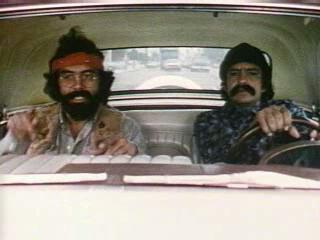
Cheech & Chong Leading Venezuelan Protests?

I am confused. The Venezuelan interior minister reports that nine people have been detained for leading and financing protests. It is not entirely why that is a crime but let's move on to the next point, which is the truly perplexing one:

He said that those previously detained, whom they also identified as ringleaders, confessed they acted not just for the money but also in exchange for "genetically modified marijuana." 
"They give them that drug to get them high and keep them in permanent activity against security forces," Rodriguez said.
I am just wondering how someone high on marijuana can be kept in any permanent activity except sitting on a sofa. I did not know there was GM marijuana, so I Googled and discovered that it is quite common. The level of THC is higher than in the past, meaning that if anything you can't even be bothered to change the TV channel, much less get off the sofa.
                                                     

"There's the protest, man!"


Read more...

Tinsman's Buying into the Regime

I read Heidi Tinsman's Buying into the Regime: Grapes and Consumption in Cold War Chile and the United States (2014) to review for Journal of Interdisciplinary History. I don't know when that will come out, but here is a small taste. It analyzes what became a strong connection between the two countries based on grape exports and what I like in particular is that Tinsman consciously avoids easy answers and simplifications, which makes it a worthy contribution to the already large literature on Cold War Chile. There are a lot of contradictions and contrasts:

Academics from the United States are part of the contrasts. The Chilean grape industry grew substantially under the market-driven economy of the military government, but existed in the first place because of the state-driven policies of the Eduardo Frei and Salvador Allende administrations. Universities in the United States played important roles in both, as researchers from the University of California at Davis gave extensive agricultural assistance in the 1960s and Chilean economists from the University of Chicago created the policy architecture for the grapes to be exported in the 1970s and beyond.

As Tinsman points out, consumption was central to the historical development of the grape export industry and the long-term responses to it. Depending on your vantage point, eating (or choosing not to eat) grapes could denote support for a government, opposition to a government, general nationalism, protest over a repressive global economic system, support for labor and/or recognition of the human costs of feeding the United States. Those perspectives shift if you are a Chilean or if you are a U.S. citizen, and if you are eating fruit from Chile or from the United States.


Read more...

Tuesday, April 22, 2014

Posture Statements and Latin America

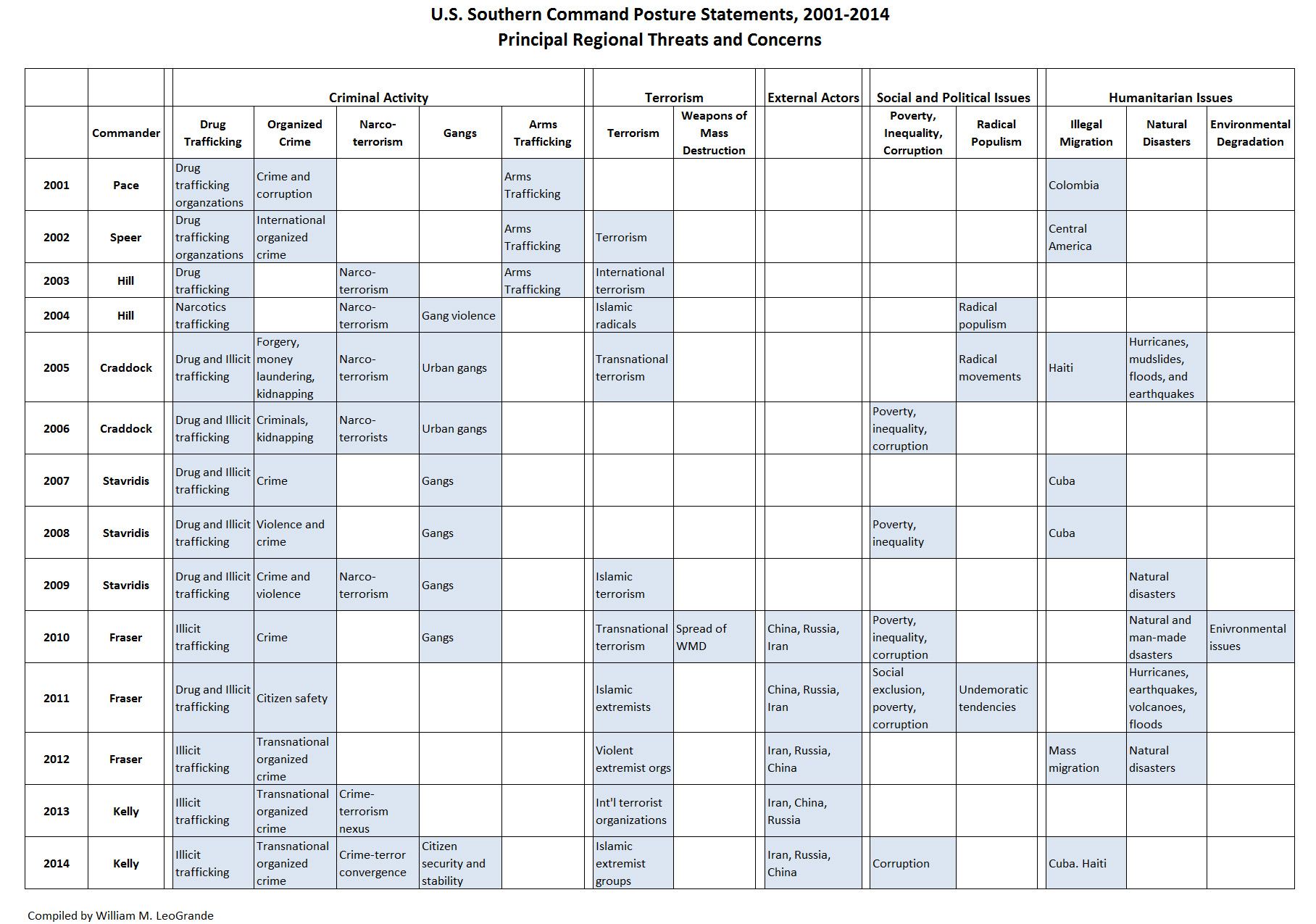
Bill LeoGrande (American University) has a nice graphic showing the emphases of Southern Command in Posture Statements from 2001-2014. His main point was to show concentrated it was on criminal activity and terrorism, which is true (and which I published an article about in 2006).


Other things also pop out. One is the recent obsession with China, Iran, and Russia, which is new in its intensity. The focus on external actors didn't even arise due to 9/11 but perhaps relates more to the Iran nuclear controversy. Who knows why China comes up now--maybe if we think we're supposed to be concerned about Russia then we need to think about China too. Oddly enough, there was a little break in obsession with transnational (really meaning Islamic as opposed to drug trafficking) terrorism in the second half of the Bush presidency, which ramped back up with Obama.

FYI, if you're going to LASA then come to the roundtable I organized, where LeoGrande will be a participant.


Read more...

Monday, April 21, 2014

The Invasion of Veracruz and Beyond

One hundred years ago today, the United States invaded Mexico, specifically Veracruz. Enrique Krauze has a very nice summary in the New York Times. Like so many other U.S. invasions, it did not achieve its goals and in many ways generated unnecessary resentment. However, I don't buy this:

Will an American president be willing to examine this long history of resentment and distrust, the better to construct a “happy ending” to these conflicts with “the other America”? Concrete actions are required: to pass long-awaited reforms of immigration laws, increase commercial relations and encourage mutual understanding, nourish cultural exchanges, lift the embargo on Cuba, close Guantánamo, and to be much more attentive and respectful toward Latin American countries and not treat them as the mere backyard of the nation they call “the Giant of the North.”

There are a few problems. One is that Mexicans' view of the United States is not easily characterized as "resentment and distrust." That sentiments were more common in the aftermath of the invasion. Similarly, today Americans are not angry at Germans for the Zimmermann Telegram. The same is true in many other places where the U.S. invaded: there is currently no rancor in the Dominican Republic, Panama, and elsewhere. The governments most antagonistic toward U.S. policy suffered no invasions at all (though certainly there was intervention). You don't hear Hugo Chávez or Nicolás Maduro rail on about the 1895 crisis.

I am also not so sure that anything will change if immigration reform is passed or if Guantánamo is closed. My hunch is that Latin Americans don't care very much about them. Maybe the embargo, but even that would not necessarily be earth-shattering.

Instead, I would juxtapose this op-ed with another in the New York Times on the importance of strengthening U.S.-Brazilian relations. A state visit was all lined up and what happened? The revelations of spying, which backed Dilma Rousseff into a corner. Immigration reform isn't going to change that and neither will cultural exchanges. Those things are important, but not sufficient.

The more question is how much you're stabbing your allies in the back while talking about the end of the Monroe Doctrine. It's about how hard you make it for allies to stick with you. Multiple recent studies have shown that Latin American views of the United States are positive, much more than most media reports would have you believe. The real trick is to translate that positive energy into higher levels of government.

Read more...

  © Blogger templates The Professional Template by Ourblogtemplates.com 2008

Back to TOP