Friday, August 19, 2011

Undocumented immigrants and NC

NC House Speaker Thom Tillis on undocumented immigration:


Tillis said he understood the motives of many people who come to the United States illegally, especially people who are fleeing drug gang violence in Mexico, but supported immediate deportation of any immigrant convicted of breaking the law.

He also understood the need to control immigration, and said that ultimately it is the responsibility of the federal government. At the same time, he said farmers depend on the immigrant labor, and Tillis noted Georgia passed such restrictive laws that many produce farmers couldn’t get any workers into the fields in time and their harvests rotted.


This should also be taken in the context of the Obama administration's decision to focus on criminals and to review 300,000 cases and possibly even give work permits to those without criminal records.  A focus on criminals is a welcome step.  From a more local perspective, I am also glad to see that the Republican leadership in North Carolina is taking a realistic approach to the issue.  Poorly thought out legislation leaves you in the position of Georgia, where the legislature did not even bother doing a study about the consequences, and so scrambled to do so after the fact when those consequences became more obvious.

Read more...

Thursday, August 18, 2011

The myth of border danger

Great editorial in the Washington Post about the myth perpetrated prominently by Republican presidential candidates (though by many others as well) that the border is dangerous and is seeing escalating violence.  I've written about this over and over, but it bears repeating and repeating.  The editorial gets it absolutely right that claiming the border needs to be "secured" first and then never admitting it is becoming more secure means you never have to tackle the more difficult issue of immigration reform.

Horror stories about an out-of-control border are untethered from the facts. They’re also irresponsible. By using the myth of escalating border insecurity as an excuse for inaction on the pressing reality of a broken immigration system, politicians perpetuate both a lie and the national disgrace of a dysfunctional policy.

Read more...

Cuban migration

Anya Landau French at The Havana Note analyzes the current push by hardline anti-Castro Congressman David Rivera to reform the Cuban Adjustment Act.  Currently, Cubans who reach the United States can become permanent residents after staying here for a year.  He wants that to be five years, and prohibit them from returning to Cuba in the meantime.  His rationale is that the law was intended to help political refugees, and if you are returning to Cuba quickly, clearly you are not facing persecution.

Actually, this makes some sense, but as she notes he does not take this to its logical conclusion, which is scrapping the Cuban Adjustment Act altogether:


So far, not even Rivera yet dares threaten the Cuban Adjustment Act and the benefits (which come with taxpayer-funded U.S. government benefits, by the way) afforded to Cuban Americans under it.  Ask Rivera and he'll say it should stay in place because the "political situation [in Cuba] remains the same today," as it did when the Act was passed.  But of course it hasn't remained the same; Cuban Americans aren't exiles the way they used to be.  And it is precisely those changed political circumstances that led Rivera to introduce his bill.

Here's a question someone should and surely will put to the Congressman and his supporters of this ridiculous idea: if you're so worried about Cubans who emigrate from Cuba to the U.S. under the Cuban Adjustment Act returning 366 days later, "abusing" a law intended for refugees who couldn't return home, and these emigrants clearly don't fit the bill because they go home all the time (Thanks a lot, Obama!), why don't you simply propose repeal of the Cuban Adjustment Act?
Why not?  Because that would mean admitting that Cubans are no longer FLEEING Cuba.  And if America admits that the Cuban people are no longer fleeing the island as political refugees but are now mainly economic migrants - like, I don't know, Mexican migrants - then the foundation for this anachronistic and wasteful policy would surely crumble. 


Even our immigration policy is rooted in an anachronistic view of Cuba.  The vast majority of Cubans are coming for economic reasons, not political, and therefore we should treat them in the same manner as we do all other migrants (I think we should do so more rationally and humanely for all, but that is another story).  The Cold War is over.  Way, way over.

Regardless, Rivera is facing serious ethics investigations so may not be around for too long anyway.

Read more...

Wednesday, August 17, 2011

Bay of Pigs documents

The National Security Archive obtained more declassified documents about the Bay of Pigs invasion, namely the CIA's own official history and some cables. The writing of the history is actually pretty lively. What we find is a mission that was in fact even more ill conceived and mismanaged than we already knew.

Some highlights:

--the CIA knew it would fail without airstrikes, and officials talked about that fact.

--the U.S. approved the use of napalm for the invasion. Further, Cubans training in Guatemala were disrupted by Guatemalan rebels, and so the Guatemalan government also requested napalm to use in its own country. That seems to have been turned down--cables noted that no one in Guatemala had experience with how to deal with napalm anyway.

--for "plausible deniability" the U.S. planes that were used had Cuban markings, which then drew friendly fire.

--Rafael Trujillo wanted to help in exchange for giving him a place to retire, but the U.S. said no and then of course helped assassinate him.

There is still more that remains classified, and I cannot imagine why (see Peter Kornbluh's discussion in the Daily Beast here).  They Bay of Pigs can hardly become more embarrassing for the United States, and the relevant policy makers are dead.  Maybe the CIA feels that bringing up its incompetence of the past will bring new efforts to de-fund it in the present.

Read more...

Possible end of binomial system

Fascinating discussion at Infolatam about the possible end of the binomial electoral system in Chile.  People have been talking about Chilean electoral reform for years (and I've written a number of posts on it, the last one here) but it does seem to be inching closer and closer, in large part because now it is being pushed by a president of the right.  Both the left and right are increasingly seeing it as a way to bring back popular confidence, which is now very low.  This is a new wrinkle, as reform has not previously been viewed as something that would satisfy a constituency.

Notably, no one has agreed on what would replace it, and of course that is where the real dispute will come, as both the left and right jockey to create a new system that will benefit them the most.

On a cynical aside, Sebastián Piñera may also see it as a way to halt the momentum and of and the steal the press from the student protests.  Electoral reform would be a very big deal.

Read more...

Tuesday, August 16, 2011

2012 and immigration

Although the election is not for more than a year, as a political scientist I can't help but get into the horse races at times.  One topic du jour is Rick Perry's stance on immigration.  In short, he is pretty rational--here is a good take by the Washington Post.


I understand this is seen as a liability for Perry by a segment of the base. But we’ll have to see if it really is, or whether it is an argument for his electability.
Perhaps this approach is too “soft” for conservatives. Maybe the RedState bloggers who helped kick off his campaign (and who are staunchly opposed to immigration reform) will recoil in horror and drop him like a hot potato. But I sort of doubt it.


Yes, yes, it's early and I am not making predictions, but in the last three elections even the Republican base overlooked the relatively liberal views of the candidates (though John McCain tried to tack right at the last minute) on immigration.  Immigration is an important issue, but fairly low down on the list of voter priorities, and Perry is very conservative on the issues of higher salience.  He has done well with the Latino vote in Texas, and could potentially benefit from voters unhappy with Obama's enforcement-only policies.

Read more...

Monday, August 15, 2011

Immigration and citizenship

Mike Munger links to a New York Times article on the Dutch response to Muslim immigrants and rightly calls it interesting but grim reading.  Read that article first.  There are two parallel points I would make to responses in the United States to immigrants from Latin America.

First, crime is very low among first generation Latino immigrants (even undocumented) but it can grow with subsequent generations, particularly if people feel marginalized.  There is no easy answer to this, but current state laws that essentially transform Latinos into targets for police will backfire.

Second, there was a very poignant quote that relates directly to efforts in the United States to deny citizenship to people born in the country to undocumented parents:


In the United States, citizenship once granted is never questioned, said Mr. Overbeek of VU University. “But in Europe it’s never quite established, no matter how long you’ve been here. Here it’s still, ‘When did you get here, and when are you going back?’ ”

East of Amsterdam, in Almere, the youngest city in the Netherlands, 30 percent voted for Mr. Wilders.

Shopping in the city center, Raihsa Sahinoer, 24, born here of Surinamese immigrants, was not surprised. “Wilders says we all have to go back even if we were born here,” she said. “It’s not only about Muslims, it’s about colored people, too.”

She lives as the Dutch do, she said. “But they tell us if you’re colored, you’re not Dutch.” Does she feel Dutch? “No,” she said, then paused, then asked: “What is Dutch?”


Denying citizenship (or looking at Latino citizens warily simply because of how they look or talk) will certainly make things worse.  The more you pass laws to marginalize people, the more resentful they will become.  And as more marginalized people become resentful, there is greater opening for neo-fascist ideas to popularize (and perhaps take violent form).

Read more...

Immigration and wages

A core immigration restrictionist argument, made by both academics (George Borjas being a major example) and politicians alike, is that undocumented immigrants drive down the wages of low wage legal workers in the United States.  By extension, then, policies like auditing companies should have the effect of driving out illegal workers and thereby increasing wages.

As this Wall Street Journal story notes, such policies are having the exact opposite effect.  The Obama administration has been raiding companies like crazy (2,393 companies in the past fiscal year, the highest ever) and this is depressing wages further.

Shortly after, Alba and Eugenio, who declined to have their surname published, landed at a small janitorial concern, scrubbing car dealerships for about half the pay, without benefits. Earlier this year that employer, too, was hit by an immigration audit. In late February, Alba and Eugenio were let go.

The purpose is to encourage those companies to start hiring legal workers, but that has not been the result:


Many employers say the administration is depriving them of foreign workers who do jobs Americans refuse, even during an economic downturn, without proposing immigration reform that would supply a stable, legal labor force.

"All the audits do is keep employers in certain industries awake at night, while driving immigrants into work environments and arrangements that are indefensible," said Bill Blazar, a senior vice president of the Minnesota Chamber of Commerce.


Instead, everyone at the low wage level is getting less.

Read more...

Saturday, August 13, 2011

Truthiness in Honduras

Picture this: members of a Latin American government trample on the constitution and conduct ongoing attacks on fellow citizens who disagree with them politically. Hoping to gloss over these abuses, these same government officials create a truth commission, which concludes that the abuses aren't really so bad. Then the people who continue to suffer abuse are mocked because the report claims they are not suffering anything.

That is the mind of Mary Anastasia O'Grady, who never lets facts get in the way of a story. RAJ has it here.

Read more...

Friday, August 12, 2011

Rigoberta Menchú and Guatemala

Mike Allison notes that Rigoberta Menchú was interviewed on CNN.  That got me wondering whether there was ever any other presidential candidate who generated so much international attention while receiving nothing but indifference at home (in the 2007 presidential election she received 3% of the vote, which was good for 7th place).  I couldn't think of any.

I see a certain parallel to post-Soviet Union Mikhail Gorbachev, a fellow Nobel Prize winner, who has consistently failed to generate interest in his new political party ideas and instead has made Pizza Hut commercials.  He's hailed here and largely ignored there.  Each had an important Cold War part to play, but that did not translate into long-term domestic political influence.

Read more...

Thursday, August 11, 2011

Decentralization and party disintegration in Colombia

Eduardo Dargent and Paul Muñoz, "Democracy Against Parties? Party System Deinstitutionalization in Colombia." Journal of Politics in Latin America 3, 2 (2011): 43-71. Click here for ungated PDF.

Abstract:

This article argues that in Colombia, decentralization and electoral reforms adopted in the late 1980s and in the 1991 Constitution – designed to improve democratic quality – brought about a gradual deinstitutionalization of this country’s traditional party system as an unintended consequence. Building upon resource-based theories of party configuration, we contend that in developing countries, where resources are usually crucial for party aggregation, “democratizing” reforms designed to distribute power and resources in the political system can reduce local candidates’ incentives to join and remain loyal to political parties, particularly when those parties’ reputations are weak. In Colombia, these reforms (i) reduced the power of intermediate-level party leaders over the distribution of selective incentives, making these leaders less important for local politicians, and (ii) gave more political and financial autonomy to local candidates, reducing their need to join parties in order to advance their electoral goals. As a result, party cohesion and discipline become difficult to maintain, and the party system gradually deinstitutionalizes.
Decentralization is often portrayed as a positive force, since its goal is to weaken clientelist ties and increase accountability at the local level.  The argument here, though, is that local leaders don't need national parties anymore to achieve their programmatic goals, which makes individual politicians more important than the party they belong to.  As a result, Alvaro Uribe came very close to amending the constitution again to run for a third term.  Fortunately he backed off, but it was a warning sign for Colombian democracy.

Read more...

Wednesday, August 10, 2011

Mexican presidentialism and the drug war

Interesting article in Political Science Quarterly, and currently ungated as well.

Juan D. Lindau, "The Drug War's Impact on Executive Power, Judicial Reform, and Federalism in Mexico." Political Science Quarterly 126, 2 (Summer 2011): 177-200.

There is no abstract, but the first two paragraphs lay it out:


The drug war, and the Mexican governmentʼs increasingly assiduous pursuit of drug-trafficking organizations, complicates the countryʼs institutionalization of democracy in a number of ways. The intensification of the drug war in Mexico has come during the waning decades of an authoritarian regime and the first years of a nascent democracy. The drug war hinders fundamental democratic institutional development, or more accurately, fosters the expansion of non-democratic institutions and practices. These effects come against the backdrop of genuine democratic gains during the last two decades, including the development of transparent and credible electoral procedures, the emergence of an assertive, divided legislature, judicial reforms, and increases in substantive federalism.

Juxtaposed against this real democratization, the drug war preserves certain authoritarian proclivities of the Mexican state and fosters corruption and impunity, reducing the efficacy of judicial reforms and complicating the professionalization of the judicial branch. The security crisis engendered by the drug war fosters expanded executive power. At the same time, the drug war undermines federalism, increasing the power of the central government vis-à-vis states and municipalities.

The argument is ironic.  Democratization left a power vacuum that drug trafficking organizations moved into fill.  Subsequently, the state's efforts to combat those organizations stalled or reversed a number of gains in democratization as re-centralization took place.


Read more...

Tuesday, August 09, 2011

Nopecu

This cracks me up. From Adam Isacson:


El Tiempo: ¿Por qué Uribe tiene la idea, y lo ha dicho, de que esta acción contra la corrupción es una acción contra su gobierno?

Juan Manuel Santos: Un segundo... mmmm... Nopecu, nopecu, nopecu...
El Tiempo: ¿Qué significa "nopecu"?

Juan Manuel Santos: No pelear con Uribe. NO-PE-CU
Santos has been dealing with this since before he even took office, most notably with his asserton that he would smooth relations with Venezuela, whereas Uribe hates Hugo Chávez and let the world know he hated him, and hated that the fact that Santos didn't sufficiently hate Chávez.


The fact that Santos has actually made it into a joke reflects well on him, and could even make Uribe's pronouncements into a caricature of himself. It could make a good SNL skit.

Read more...

Monday, August 08, 2011

International Migration in the Americas

The OAS, along with OECD and ECLAC, has published a length document, International Migration in the Americas.  Particularly noteworthy is the fact that it does not simply center on migration to the United States.

One important point to take away is in fact troubling:


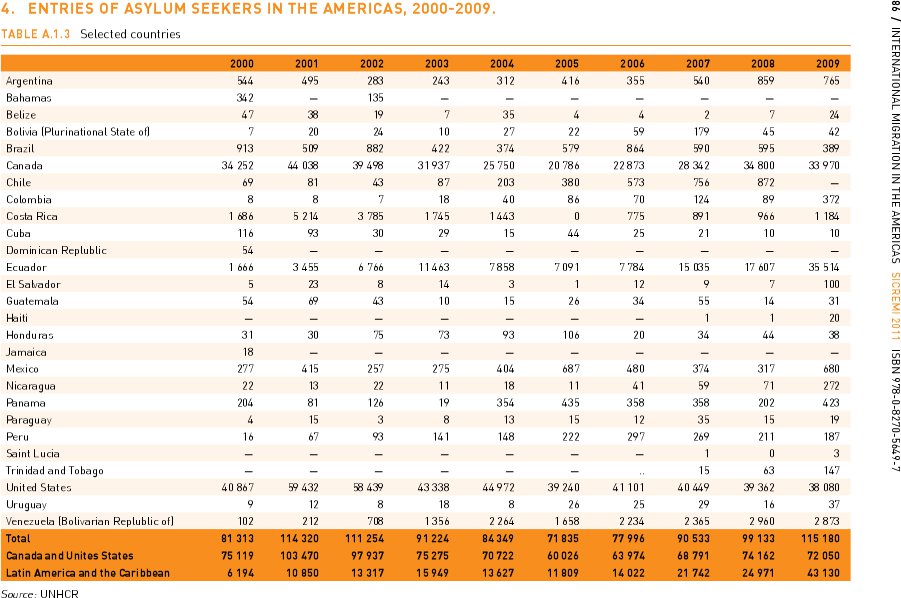
Although Latin America and the Caribbean are not considered as important destination regions  for persons seeking asylum from persecution, requests for asylum have increased to approximately 49 000 in 2009, an increase of 73% when compared to figures from 2008, and quadruple the total recorded in 2000. By contrast, Canada alone received about 34 000 claims in 2009 and the United States 38 000. Ecuador was the principal receiving country of requests for asylum in Latin America and the Caribbean, receiving almost 36 000 requests, in large part from Colombian citizens fleeing conflict zones near the border with Ecuador.  

Here is the table from the report (you can click for a bigger view):


It is a reminder that we need about the effects of Colombian violence on Ecuador, where the growth of asylum seekers is staggering.  It also raises a question to which I do not know the answer: why was there a major dip, then a major surge, in people seeking asylum in Canada?

Read more...

Sunday, August 07, 2011

The US and UNASUR

Unregulated capitalism, invasions and occupations in Iraq and Afghanistan, and political incompetence in the United States are serving to do what Hugo Chávez wanted but was very far from achieving: bring South America together economically in a way that not only excludes the United States, but consciously keeps it at arm's length. Bolívar would be proud.

Read more...

Friday, August 05, 2011

Piñera gets CEPped

The Centro de Estudio Públicos poll just came out, with lots of information on education.  Since students were out in force, as were the police in response, this was not a pleasant irony for Sebastián Piñera (check out some images here).  The CEP poll shows his presidential approval at 26 percent, with little confidence in how he is handling, well, most anything.

An interesting point to keep in mind, though, is that for years approval of handling the economy trends very closely to presidential approval.  Irrespective of the education protests, Piñera has a shot at recovery if he can turn around perceptions about how he is handling the economy.

But he's not in a happy place.

Update: Wow, how does Piñera respond?  By saying, "Remember the miners!!"

Read more...

Thursday, August 04, 2011

Cuban immigration waves

I agree with this article in the Sun-Sentinal that when the Cuban government starts talking about easing emigration rules, then you need to pay close attention.  In the past, that was how Fidel Castro signalled that a) he wanted certain concessions from the United States; and b) if he didn't get them he would open the floodgates.  That happened in 1965, 1980, and 1994, so we are even slightly overdue.  There is no need for alarmism, but it has worked very well for Fidel Castro in the past.

Read more...

Wednesday, August 03, 2011

Cabinets in Chile

From Adimark: Sebastián Piñera's approval rating remains very low, at 30%.  Borrowing a long standing tradition from the Concertación, he has responded to his lack of popularity by changing his cabinet. At least in the Chilean case, presidents tend to think that shuffling the cabinet will be seen as a signal that he/she is acknowledging problems and taking positive action.  However, I have never seen any evidence that such signals function as intended.  Presidential approval is based largely on other issues, and cabinet changes tend just to generate gossip about who will be running for president in the future.

Read more...

Tuesday, August 02, 2011

Extradition from Colombia

Nazih Richani writes at NACLA that more Colombian narcotraffickers want to be extradited to the United States.

Between 2000 and 2010, 1,121 narcotraffickers were extradited to the United States. I suspect that through their negotiations with the U.S. judicial system, these narcotraffickers have found that they can obtain benefits outweighing the costs. Some of the perks include prison terms reductions, protections for themselves and their families, and securing part of their wealth. The new Citizen Security Law offers the added bonuses of an expedited extradition and possibly even better benefits.


This is a big change.  In the past, the Colombian judicial system was seen as so corrupt and porous that people fought to stay in the country, and for years the U.S. constantly pushed for extradition laws.  Alvaro Uribe opened the floodgates.

This is a glass half empty/half full issue.  Richani sees it as empty:

With all of the above we have to ask if extradition is truly an effective tool to fight crime. More and more evidence says it is not. Especially for those that have committed war crimes, extradition has become a safe haven since they will only be tried for “narcotrafficking” while their “crimes against humanity” are largely forgotten.
However, it is also worthwhile to ask whether the Colombian judicial system has improved to the point that it cannot be gamed as much as in the past.

Read more...

Monday, August 01, 2011

U.S. or Chile?

Picture this: A country with a growing gap between rich and poor, where the legislature and political parties are extremely unpopular, though individual politicians sometimes have solid approval ratings. People even protest in the streets at times, though as yet there is no coherent independent political movement. The two main political parties/coalitions point fingers at each other, but when push comes to shove they agree just to create commissions to avoid making difficult decisions.

The United States or Chile?

Read more...

  © Blogger templates The Professional Template by Ourblogtemplates.com 2008

Back to TOP