Saturday, September 03, 2011

Palestinians in Central America

Manzar Faroohar, "Palestinians in Central America: From Temporary Emigrants to a Permanent Diaspora." Journal of Palestine Studies 40, 3 (Spring 2011): 6-22.

Abstract:


The article presents an in-depth examination into the diaspora of Palestinians in Central America throughout the 20th century. An overview is presented citing data from interviews and government documentation evaluating the scope of the Palestinian population in Honduras and El Salvador. Accounts are given mapping two major immigration movements, one in the 1910s and 1920s and the other spanning in the post-1967 era. Details are provided noting the economic success of the Palestinians in Central America, their struggles with discrimination, and their eventual cultural assimilation. The extent to which Palestinians engage in Central American politics is also analyzed.


This is particularly relevant given all the discussions about Latin American governments recognizing the Palestinian State.  As Mike Allison very recently noted, El Salvador just did so.  One interesting point the article makes is that the Palestinian community is mostly conservative and supportive of U.S. policy in the region.  In other words, they may disagree about the Israeli-Palestinian conflict but likely agree with the U.S. on most everything else.  Unfortunately, alarmists in the U.S. tend to view them as a threat.

Read more...

Friday, September 02, 2011

Red Hot Chile Protests

I recommend this analysis by Pancho Díaz and Robert Funk on the broader implications of the student protests in Chile.  The essence is that Chilean democracy is not under attack, but given stifling institutional constraints there is growing pressure for plebiscitary democracy rather than representative democracy.  Indeed, much of the U.S. media ignores the fact that the students have been calling for a plebiscite, but its details--or even its usefulness--are a very hot topic.  What they argue in the article is that politicians, especially younger ones, need to demonstrate that they deserve to lead.

I have pointed to similarities between the U.S. and Chile with regard to disgust with parties and the legislature, yet it is notable that in the U.S. the plebiscitary pressures are at the state level, not the national.  The Tea Party dislikes Congress, yet still wants to work through Congress.

Read more...

Thursday, September 01, 2011

Stating the blatantly obvious

Love this headline from the Washington Post:

Casino Massacre in Mexico May be Rooted in Corruption

It may be?  Of course it was!  At least now there appears to be concrete evidence, which should surprise no one.

Calderon cast the attack as a galvanizing moment in his administration’s battle against the cartels, characterizing the tragedy as a steep escalation of the conflict between security forces and gangsters who increasingly target civilians. 

But a video and series of photographs showing the brother of Monterrey’s mayor receiving bundles of cash at a casino days before the massacre suggest its origins might lie in the old, familiar networks of corruption that have long plagued the country and nurtured the rise of organized crime.

Read more...

Wednesday, August 31, 2011

Impossible immigration enforcement

A sponsor of Alabama's immigration bill wrote an opinion piece in USA Today that emphasizes something I've repeated ad nauseam, namely that no such thing as sufficient enforcement exists.

Most people, including myself, wish the federal government would enforce its laws, but that is not going to happen any time soon. The people who oppose state initiatives are simply against any enforcement. They have little regard for the negative impact that illegal immigration has on the legal residents of the states or the rule of law.

Now, the numbers.  From the Department of Homeland Security, here are the number of deportations for the past ten years.

 2000 188,467
 2001 189,026
 2002 165,168
 2003 211,098
 2004 240,665
 2005 246,431
 2006 280,974
 2007 319,382
 2008 359,795
 2009 395,165
 2010 387,242  

Quite clearly, the Obama administration has deported far more people than any previous administration.  Now, let's move on to getting rid of criminals.  According to DHS, the U.S. deported 92,221 criminals in 2005 and 168,532 in 2010.  And employers?  In 2010 the administration started 2,746 formal workplace investigations in addition to audits, which was double that of 2008.

The Obama administration has enforced immigration laws more than any past administration, Republican or Democratic.  You may think that to be positive or negative, but it is empirically true.  It is therefore unfortunate that the myth of non-enforcement persists, and that this myth becomes an unsubstantiated rationale for congressional refusal to pursue anything beyond enforcement or for states to pursue harsh laws of questionable constitutionality.

Read more...

Tuesday, August 30, 2011

The image of Chile in the U.S.

I've been finding the U.S. media response to the Chilean student protests to be even more interesting than the protests themselves.  To the extent that Americans are paying attention, they are getting a truly bizarre version of events.  I've noted other examples, but take Andres Oppenheimer, who has a syndicated column with broad readership.  Note the apocalyptic straw man:

Judging from the polls, and from what I heard here, they want the Chilean model to make a much-needed correction and transfer more of the country’s recent prosperity to the needy, but they won’t support destroying a vibrant democracy that produced sustained growth for the past two decades.

Say what?  Nobody is calling for or expecting the destruction of anything, most certainly not democracy.  Inserting that suggests that Chilean students are somehow intent on overthrowing the system.  So many of these commentaries have an anachronistic flavor, perhaps because a key student leader is a member of the Communist Party.  But Chilean politics in 2011 are not anything like 40 years ago.  The Socialist Party has long been committed to free market capitalism, and the Communist Party long ago rejected armed struggle or anything approximating it.  It is not terribly radical to argue that students are saddled with too much debt to get a university education.  You can either agree or disagree with the students' arguments, but it is ridiculous to suggest that it equates to an attempt to destroy democracy.

Read more...

Monday, August 29, 2011

Piñera and the right

If you want to understand the conservative response to the protests and strikes in Chile, then check out this editorial at Investor's Business Daily.  It is a U.S. publication, but I think can usefully serve as a proxy for the Chilean right as well.  It is written by someone who seemed to have gone to sleep around 1982, then suddenly woke up in 2011 and thought Ronald Reagan was alive and the Cold War was still going on.  The bottom line is that Santiago is Berkeley, and the Chilean protests are led by Communists who want to destroy everything that is good.  Absurd, yes. But believed by many.

The editorial's lesson: never have dialogue with anyone.  (I am not making that up.)  If the Chilean right believes this sufficiently, then it may well erode the right's already shaky confidence in Sebastián Piñera thought perhaps he could pick up support from the center.

Read more...

Sunday, August 28, 2011

Quote of the day: Venezuela

From Venezuela's UN Ambassador:

“For such reasons, the Bolivarian Republic of Venezuela condemns these violent hordes who just want to kill the sovereign leader of Libya, Muammar Al Gaddafi and his people. In addition, it has become clear that their only goal was to spread violence,”

Clearly, Hugo Chávez has decided to double down on Libya, which puts him in a small select group, namely joined only by Daniel Ortega.  Poor Gaddafi, who was just a nice anti-imperialist guy, suddenly attacked by violent hordes for no valid reason.

Read more...

Saturday, August 27, 2011

Pointing dedos in Mexico

I am of two minds about Felipe Calderón blaming the United States for the vicious attack in Monterrey because of drug demand.

The first is to agree to a considerable extent.  There is a very basic supply and demand dynamic at work, while the balloon effect has pushed some of the most pernicious effects of the drug trade into Central America and Mexico.  Without a wealthy population in the United States with a seemingly bottomless appetite for drugs, there would be less violence.  To its credit, the Obama administration has publicly acknowledged the demand side, but this needs to sink deeper into the U.S. consciousness.  Instead, we see loads of headlines about "Mexico's drug war," which gives us a smug sense of satisfaction that those Mexicans are causing all our problems.

The second is to be skeptical, especially about this particular case.  The United States did not create the organized crime that hovers around Mexican gambling and has for decades.  There is a real danger that, as happened for years with immigration, the Mexican government uses the U.S. as a convenient scapegoat and thereby feels less pressure to address serious structural reforms that Mexico needs.

I tend to agree with Malcolm Beith's take in Foreign Policy:

Calderón is right to point the finger at the United States, but not at this particular moment in time. Drug consumption in the United States was not what allowed the attack in Monterrey to occur. The total impunity that reigns in Mexico -- due to the failure of police and security forces to maintain any semblance of trustworthy authority, the dragging speed of reform in the police forces, and the absence of any investigative capacity or will whatsoever -- is responsible for this atrocity. And Calderón's inability to admit fault or honestly describe the sorry state of his signature initiative is exactly what is making it so difficult for him to convince Mexicans of anything, including the notion that his party should remain in office next year.

Read more...

Friday, August 26, 2011

Imre Kertész's Detective Story

Imre Kertész is a Hungarian novelist who won the Nobel Prize for Literature in 2002, for his fiction on the Holocaust.  However, he also wrote a book about Latin America, Detective Story, that was originally published in 1977 but translated into English in 2008.  It is narrated by Antonio Martens, a police detective who became involved in torture in an unnamed Latin American dictatorship and now in the postauthoritarian period is on trial for murder.  He was on the trail of Enrique Salinas, the son of a department store magnate, who the police believe has joined the opposition.

The essence of the novel is Martens' totally clinical and hard boiled tone.  He narrates like a Raymond Chandler character, uninterested in others' pain (while complaining about his own headaches).

It's nasty work, I can tell you, but it's part of the job. We take away the offender's mind, shred his nerves, paralyze his brain, rifle through pocket and even his innards. We slam him into a chair, draw the curtains, light a lamp--in short, we go by the book. We didn't make any effort to surprise the offender with some original twist. Everything happened the way those ham-handed films would have prepared him for; everything happened the way he would expect (p. 83).

Martens never wants to mention the violence itself.  Torture simply occurs, because that's the way it is, but he doesn't want to talk about blood or pain very much.

I won't spoil the ending, which has a twist, but suffice it to say the novel also examines what makes people seem guilty to paranoid and dictatorial authorities even when they have done nothing.  The police start going after people, while torture and death pile up almost of their own accord.

I grasped that we had now cast away everything that bound us to the laws of man; I grasped that we could no longer place our trust in anyone except ourselves. Oh, and in destiny, in that insatiable, greedy, and eternally hungry mechanism (p. 103).

Read more...

Thursday, August 25, 2011

Views of the Chilean strike

It will take time to judge the impact of the strike in Chile, but certain viewpoints are developing:

--the U.S. media sees it mostly as a mass of violence (but thank goodness copper mining is not disrupted)

--so does Al Jazeera

--the Piñera government says this is no big deal, and those jerks aren't paralyzing the country like they claim

--the CUT says it has been quite a success

--the Concertación is a bit bummed out that it is irrelevant

--Sebastián Piñera figured this was a good way to get more followers on Twitter

--the IMF says forget all that and enact more austerity policies

Read more...

Wednesday, August 24, 2011

Understanding the protests in Chile

If you want to understand the implications of the protests in Chile, I recommend Kirsten Sehnbruch and Sofia Donoso's article here at Open Democracy.  The argument is basically what Silvia Borzutzky and I argued in our edited volume.  This is a key paragraph:

The problem behind the present-day citizen discontent is that the same conditions which ensured Chile’s socioeconomic success and political stability also explain the inability of politicians to improve Chile’s historically persistent inequality. The very path initiated by the Concertación governments, now adopted by the Piñera administration, has defined new challenges to which neither the right nor the left have been able to respond. If anything, the mobilizations of the last months have been a reminder of the fact that responses such as “no congressional majority”, “not politically feasible”, or, “insufficient resources” are not credible any more. The legitimizing discourses that accompanied the elite-led transition to democracy, defined the boundaries of democratization, and provided an appeasement mechanism for social demands for greater equality, have been exhausted. At the same time, the most negative effects of neoliberal reform are now evident. So, as the successes of the Concertación have not been accompanied by any significant reduction of inequality, cultural breaches have been unearthed. The clanging of pots in many middle class neighbourhoods over the last weeks show that an important part of the Chilean public is unwilling to excuse the lack of deeper reform and limited popular input as simply a necessary condition for maintaining the delicate power balance that characterized the transition. And although the government removed the Minister of Education and has presented several reform proposals,  most Chileans agree with the students and consider these measures to be insufficient (La Tercera survey). 

As we noted in the book, this had been bubbling up for quite some time and had a considerable and negative impact politically on the Concertación.  It seems the change to a center-right government was the proverbial straw to break the camel's back.

Read more...

Rethinking drug policy

The Financial Times has a long and thoughtful look at fighting the flow of drugs in Latin America.  What I find striking is that the mainstream media is increasingly echoing what many academics started saying a decade or more ago, namely that the drug war has failed on virtually every front and needs to be rethought.  Not surprisingly, this idea is slowest to take hold in the United States, but still the facts are overwhelming and it is only a matter of time.


Some in the region believe that, while they take steps to deal with the problem, the west appears less willing to make sacrifices. Mexico, for example, has embarked on police reforms that will require constitutional change to come into effect, while a US ban on domestic sales of semi-automatic rifles that expired in 2004 is yet to be reinstated. Many believe the west has also failed to tackle money laundering. As Carlos Slim, the Mexican telecoms magnate who is the world’s richest man, has observed: “It is unfair that the drug-producing countries get to keep all the problems, and the consumer nations all of the profits”.

There is no silver bullet that can solve the drugs problem. But many in the region feel that the longer western consumer countries fail to take a meaningful role in reducing the extreme violence associated with attempts to curb their citizens’ desire to take illicit drugs, the more it will become apparent that they have blood on their hands. Security forces and traffickers have become embroiled in a kind of “arms race”, as the GCDP report put it. “Break the taboo on debate and reform. The time for action is now.”


Read more...

Tuesday, August 23, 2011

Cuba and terrorism

A few days ago the State Department released its annual list of countries designated as state sponsors of terrorism.  Like every year since 1982, Cuba is on the list.  Every year, the reasons become so devoid of substance that we get to the point now where it should be considered embarrassing, simply held hostage to domestic politics.  There is no other way to interpret the report, the conclusions of which are based on four broad points:

First, the Cuban government publicly condemns terrorism

Second, there is no evidence that the Cuban government provides material or financial support for the FARC

Third, there are media rumors that members of ETA are in Cuba

Fourth, the Cuban government criticizes U.S. foreign policy related to counterterrorism

As should be clear, points one and two are evidence of opposing terrorism.  Point three is a rumor, and point four is something shared by the majority of countries in the world.

So the farce will continue for another year..

Read more...

Monday, August 22, 2011

Libya and Venezuela

The liberalization of Libyan politics is going to be a messy and difficult affair (see Blake Hounshell for a good discussion) but there is no doubt that the end of Gaddafi's regime is a good thing.  Arguing that the rebels are terrorists and that his overthrow represents imperialism is an odd mirror image of U.S. rhetoric particularly during the Bush administration, both of them simplistic.  Meanwhile, both the U.S. and Venezuela continue to support their respective Middle Eastern dictatorships, while each criticizes the other for the nature of the particular dictatorships they support.

Read more...

Saturday, August 20, 2011

Iraqis and Sinaloa

via Sylvia Longmire, a very creepy story about Iraqis and the Sinaloa Cartel in El Cajon, California, which is extremely close to where I grew up, in the East County of San Diego.

From the El Cajon police:

Our officers had noticed increased narcotics trafficking and violent crime in certain neighborhoods of El Cajon. These crimes have been attributed primarily to Iraqi organized crime elements, and as this investigation has discovered, the Sinaloa Cartel, a Mexico-based drug trafficking organization (DTO) which supplies them. 

Her immediate response was the same as mine, namely that it will not take long for people to jump on this as a sign that Middle Eastern terrorists are infiltrating the country.


I really need to emphasize here that there is no evidence that operational terrorists from Iraq or elsewhere in the Middle East have entered the US in this manner. Of course, it's a huge concern for DHS that a member of Hizballah or al-Qa'ida might try to infiltrate a group of emigrating Chaldeans and sneak in with fraudulent documents. I'm not saying that this has never happened; however, if it has, no one in our government knows about it. Besides, the Chaldean community is pretty tight-knit, as are the groups of them that travel halfway across the world to Mexico in order to cross the border from Tijuana. They would be wary of an outsider trying to join their group. Again, while this scenario is always a possibility, it's less likely than you might think.

Moving onto the more interesting issue...the association between Chaldean TCOs and the Sinaloa Federation. I saw this and was immediately concerned that some media outlets would start screaming about the association between Mexican TCOs and terrorists. Trust me, that is NOT what is going on here. In fact, it's no different than all the other drug trafficking arrangements Mexican TCOs have with gangs and other criminal groups here in the US.


As long as demand remains high, then supply will move to fill it.  The lessons here is that we need to maintain effective criminal law enforcement but also to reduce demand.  Alarmism, however, is often more politically appealing.

Read more...

Friday, August 19, 2011

Undocumented immigrants and NC

NC House Speaker Thom Tillis on undocumented immigration:


Tillis said he understood the motives of many people who come to the United States illegally, especially people who are fleeing drug gang violence in Mexico, but supported immediate deportation of any immigrant convicted of breaking the law.

He also understood the need to control immigration, and said that ultimately it is the responsibility of the federal government. At the same time, he said farmers depend on the immigrant labor, and Tillis noted Georgia passed such restrictive laws that many produce farmers couldn’t get any workers into the fields in time and their harvests rotted.


This should also be taken in the context of the Obama administration's decision to focus on criminals and to review 300,000 cases and possibly even give work permits to those without criminal records.  A focus on criminals is a welcome step.  From a more local perspective, I am also glad to see that the Republican leadership in North Carolina is taking a realistic approach to the issue.  Poorly thought out legislation leaves you in the position of Georgia, where the legislature did not even bother doing a study about the consequences, and so scrambled to do so after the fact when those consequences became more obvious.

Read more...

Thursday, August 18, 2011

The myth of border danger

Great editorial in the Washington Post about the myth perpetrated prominently by Republican presidential candidates (though by many others as well) that the border is dangerous and is seeing escalating violence.  I've written about this over and over, but it bears repeating and repeating.  The editorial gets it absolutely right that claiming the border needs to be "secured" first and then never admitting it is becoming more secure means you never have to tackle the more difficult issue of immigration reform.

Horror stories about an out-of-control border are untethered from the facts. They’re also irresponsible. By using the myth of escalating border insecurity as an excuse for inaction on the pressing reality of a broken immigration system, politicians perpetuate both a lie and the national disgrace of a dysfunctional policy.

Read more...

Cuban migration

Anya Landau French at The Havana Note analyzes the current push by hardline anti-Castro Congressman David Rivera to reform the Cuban Adjustment Act.  Currently, Cubans who reach the United States can become permanent residents after staying here for a year.  He wants that to be five years, and prohibit them from returning to Cuba in the meantime.  His rationale is that the law was intended to help political refugees, and if you are returning to Cuba quickly, clearly you are not facing persecution.

Actually, this makes some sense, but as she notes he does not take this to its logical conclusion, which is scrapping the Cuban Adjustment Act altogether:


So far, not even Rivera yet dares threaten the Cuban Adjustment Act and the benefits (which come with taxpayer-funded U.S. government benefits, by the way) afforded to Cuban Americans under it.  Ask Rivera and he'll say it should stay in place because the "political situation [in Cuba] remains the same today," as it did when the Act was passed.  But of course it hasn't remained the same; Cuban Americans aren't exiles the way they used to be.  And it is precisely those changed political circumstances that led Rivera to introduce his bill.

Here's a question someone should and surely will put to the Congressman and his supporters of this ridiculous idea: if you're so worried about Cubans who emigrate from Cuba to the U.S. under the Cuban Adjustment Act returning 366 days later, "abusing" a law intended for refugees who couldn't return home, and these emigrants clearly don't fit the bill because they go home all the time (Thanks a lot, Obama!), why don't you simply propose repeal of the Cuban Adjustment Act?
Why not?  Because that would mean admitting that Cubans are no longer FLEEING Cuba.  And if America admits that the Cuban people are no longer fleeing the island as political refugees but are now mainly economic migrants - like, I don't know, Mexican migrants - then the foundation for this anachronistic and wasteful policy would surely crumble. 


Even our immigration policy is rooted in an anachronistic view of Cuba.  The vast majority of Cubans are coming for economic reasons, not political, and therefore we should treat them in the same manner as we do all other migrants (I think we should do so more rationally and humanely for all, but that is another story).  The Cold War is over.  Way, way over.

Regardless, Rivera is facing serious ethics investigations so may not be around for too long anyway.

Read more...

Wednesday, August 17, 2011

Bay of Pigs documents

The National Security Archive obtained more declassified documents about the Bay of Pigs invasion, namely the CIA's own official history and some cables. The writing of the history is actually pretty lively. What we find is a mission that was in fact even more ill conceived and mismanaged than we already knew.

Some highlights:

--the CIA knew it would fail without airstrikes, and officials talked about that fact.

--the U.S. approved the use of napalm for the invasion. Further, Cubans training in Guatemala were disrupted by Guatemalan rebels, and so the Guatemalan government also requested napalm to use in its own country. That seems to have been turned down--cables noted that no one in Guatemala had experience with how to deal with napalm anyway.

--for "plausible deniability" the U.S. planes that were used had Cuban markings, which then drew friendly fire.

--Rafael Trujillo wanted to help in exchange for giving him a place to retire, but the U.S. said no and then of course helped assassinate him.

There is still more that remains classified, and I cannot imagine why (see Peter Kornbluh's discussion in the Daily Beast here).  They Bay of Pigs can hardly become more embarrassing for the United States, and the relevant policy makers are dead.  Maybe the CIA feels that bringing up its incompetence of the past will bring new efforts to de-fund it in the present.

Read more...

Possible end of binomial system

Fascinating discussion at Infolatam about the possible end of the binomial electoral system in Chile.  People have been talking about Chilean electoral reform for years (and I've written a number of posts on it, the last one here) but it does seem to be inching closer and closer, in large part because now it is being pushed by a president of the right.  Both the left and right are increasingly seeing it as a way to bring back popular confidence, which is now very low.  This is a new wrinkle, as reform has not previously been viewed as something that would satisfy a constituency.

Notably, no one has agreed on what would replace it, and of course that is where the real dispute will come, as both the left and right jockey to create a new system that will benefit them the most.

On a cynical aside, Sebastián Piñera may also see it as a way to halt the momentum and of and the steal the press from the student protests.  Electoral reform would be a very big deal.

Read more...

Tuesday, August 16, 2011

2012 and immigration

Although the election is not for more than a year, as a political scientist I can't help but get into the horse races at times.  One topic du jour is Rick Perry's stance on immigration.  In short, he is pretty rational--here is a good take by the Washington Post.


I understand this is seen as a liability for Perry by a segment of the base. But we’ll have to see if it really is, or whether it is an argument for his electability.
Perhaps this approach is too “soft” for conservatives. Maybe the RedState bloggers who helped kick off his campaign (and who are staunchly opposed to immigration reform) will recoil in horror and drop him like a hot potato. But I sort of doubt it.


Yes, yes, it's early and I am not making predictions, but in the last three elections even the Republican base overlooked the relatively liberal views of the candidates (though John McCain tried to tack right at the last minute) on immigration.  Immigration is an important issue, but fairly low down on the list of voter priorities, and Perry is very conservative on the issues of higher salience.  He has done well with the Latino vote in Texas, and could potentially benefit from voters unhappy with Obama's enforcement-only policies.

Read more...

Monday, August 15, 2011

Immigration and citizenship

Mike Munger links to a New York Times article on the Dutch response to Muslim immigrants and rightly calls it interesting but grim reading.  Read that article first.  There are two parallel points I would make to responses in the United States to immigrants from Latin America.

First, crime is very low among first generation Latino immigrants (even undocumented) but it can grow with subsequent generations, particularly if people feel marginalized.  There is no easy answer to this, but current state laws that essentially transform Latinos into targets for police will backfire.

Second, there was a very poignant quote that relates directly to efforts in the United States to deny citizenship to people born in the country to undocumented parents:


In the United States, citizenship once granted is never questioned, said Mr. Overbeek of VU University. “But in Europe it’s never quite established, no matter how long you’ve been here. Here it’s still, ‘When did you get here, and when are you going back?’ ”

East of Amsterdam, in Almere, the youngest city in the Netherlands, 30 percent voted for Mr. Wilders.

Shopping in the city center, Raihsa Sahinoer, 24, born here of Surinamese immigrants, was not surprised. “Wilders says we all have to go back even if we were born here,” she said. “It’s not only about Muslims, it’s about colored people, too.”

She lives as the Dutch do, she said. “But they tell us if you’re colored, you’re not Dutch.” Does she feel Dutch? “No,” she said, then paused, then asked: “What is Dutch?”


Denying citizenship (or looking at Latino citizens warily simply because of how they look or talk) will certainly make things worse.  The more you pass laws to marginalize people, the more resentful they will become.  And as more marginalized people become resentful, there is greater opening for neo-fascist ideas to popularize (and perhaps take violent form).

Read more...

Immigration and wages

A core immigration restrictionist argument, made by both academics (George Borjas being a major example) and politicians alike, is that undocumented immigrants drive down the wages of low wage legal workers in the United States.  By extension, then, policies like auditing companies should have the effect of driving out illegal workers and thereby increasing wages.

As this Wall Street Journal story notes, such policies are having the exact opposite effect.  The Obama administration has been raiding companies like crazy (2,393 companies in the past fiscal year, the highest ever) and this is depressing wages further.

Shortly after, Alba and Eugenio, who declined to have their surname published, landed at a small janitorial concern, scrubbing car dealerships for about half the pay, without benefits. Earlier this year that employer, too, was hit by an immigration audit. In late February, Alba and Eugenio were let go.

The purpose is to encourage those companies to start hiring legal workers, but that has not been the result:


Many employers say the administration is depriving them of foreign workers who do jobs Americans refuse, even during an economic downturn, without proposing immigration reform that would supply a stable, legal labor force.

"All the audits do is keep employers in certain industries awake at night, while driving immigrants into work environments and arrangements that are indefensible," said Bill Blazar, a senior vice president of the Minnesota Chamber of Commerce.


Instead, everyone at the low wage level is getting less.

Read more...

Saturday, August 13, 2011

Truthiness in Honduras

Picture this: members of a Latin American government trample on the constitution and conduct ongoing attacks on fellow citizens who disagree with them politically. Hoping to gloss over these abuses, these same government officials create a truth commission, which concludes that the abuses aren't really so bad. Then the people who continue to suffer abuse are mocked because the report claims they are not suffering anything.

That is the mind of Mary Anastasia O'Grady, who never lets facts get in the way of a story. RAJ has it here.

Read more...

Friday, August 12, 2011

Rigoberta Menchú and Guatemala

Mike Allison notes that Rigoberta Menchú was interviewed on CNN.  That got me wondering whether there was ever any other presidential candidate who generated so much international attention while receiving nothing but indifference at home (in the 2007 presidential election she received 3% of the vote, which was good for 7th place).  I couldn't think of any.

I see a certain parallel to post-Soviet Union Mikhail Gorbachev, a fellow Nobel Prize winner, who has consistently failed to generate interest in his new political party ideas and instead has made Pizza Hut commercials.  He's hailed here and largely ignored there.  Each had an important Cold War part to play, but that did not translate into long-term domestic political influence.

Read more...

Thursday, August 11, 2011

Decentralization and party disintegration in Colombia

Eduardo Dargent and Paul Muñoz, "Democracy Against Parties? Party System Deinstitutionalization in Colombia." Journal of Politics in Latin America 3, 2 (2011): 43-71. Click here for ungated PDF.

Abstract:

This article argues that in Colombia, decentralization and electoral reforms adopted in the late 1980s and in the 1991 Constitution – designed to improve democratic quality – brought about a gradual deinstitutionalization of this country’s traditional party system as an unintended consequence. Building upon resource-based theories of party configuration, we contend that in developing countries, where resources are usually crucial for party aggregation, “democratizing” reforms designed to distribute power and resources in the political system can reduce local candidates’ incentives to join and remain loyal to political parties, particularly when those parties’ reputations are weak. In Colombia, these reforms (i) reduced the power of intermediate-level party leaders over the distribution of selective incentives, making these leaders less important for local politicians, and (ii) gave more political and financial autonomy to local candidates, reducing their need to join parties in order to advance their electoral goals. As a result, party cohesion and discipline become difficult to maintain, and the party system gradually deinstitutionalizes.
Decentralization is often portrayed as a positive force, since its goal is to weaken clientelist ties and increase accountability at the local level.  The argument here, though, is that local leaders don't need national parties anymore to achieve their programmatic goals, which makes individual politicians more important than the party they belong to.  As a result, Alvaro Uribe came very close to amending the constitution again to run for a third term.  Fortunately he backed off, but it was a warning sign for Colombian democracy.

Read more...

Wednesday, August 10, 2011

Mexican presidentialism and the drug war

Interesting article in Political Science Quarterly, and currently ungated as well.

Juan D. Lindau, "The Drug War's Impact on Executive Power, Judicial Reform, and Federalism in Mexico." Political Science Quarterly 126, 2 (Summer 2011): 177-200.

There is no abstract, but the first two paragraphs lay it out:


The drug war, and the Mexican governmentʼs increasingly assiduous pursuit of drug-trafficking organizations, complicates the countryʼs institutionalization of democracy in a number of ways. The intensification of the drug war in Mexico has come during the waning decades of an authoritarian regime and the first years of a nascent democracy. The drug war hinders fundamental democratic institutional development, or more accurately, fosters the expansion of non-democratic institutions and practices. These effects come against the backdrop of genuine democratic gains during the last two decades, including the development of transparent and credible electoral procedures, the emergence of an assertive, divided legislature, judicial reforms, and increases in substantive federalism.

Juxtaposed against this real democratization, the drug war preserves certain authoritarian proclivities of the Mexican state and fosters corruption and impunity, reducing the efficacy of judicial reforms and complicating the professionalization of the judicial branch. The security crisis engendered by the drug war fosters expanded executive power. At the same time, the drug war undermines federalism, increasing the power of the central government vis-à-vis states and municipalities.

The argument is ironic.  Democratization left a power vacuum that drug trafficking organizations moved into fill.  Subsequently, the state's efforts to combat those organizations stalled or reversed a number of gains in democratization as re-centralization took place.


Read more...

Tuesday, August 09, 2011

Nopecu

This cracks me up. From Adam Isacson:


El Tiempo: ¿Por qué Uribe tiene la idea, y lo ha dicho, de que esta acción contra la corrupción es una acción contra su gobierno?

Juan Manuel Santos: Un segundo... mmmm... Nopecu, nopecu, nopecu...
El Tiempo: ¿Qué significa "nopecu"?

Juan Manuel Santos: No pelear con Uribe. NO-PE-CU
Santos has been dealing with this since before he even took office, most notably with his asserton that he would smooth relations with Venezuela, whereas Uribe hates Hugo Chávez and let the world know he hated him, and hated that the fact that Santos didn't sufficiently hate Chávez.


The fact that Santos has actually made it into a joke reflects well on him, and could even make Uribe's pronouncements into a caricature of himself. It could make a good SNL skit.

Read more...

Monday, August 08, 2011

International Migration in the Americas

The OAS, along with OECD and ECLAC, has published a length document, International Migration in the Americas.  Particularly noteworthy is the fact that it does not simply center on migration to the United States.

One important point to take away is in fact troubling:


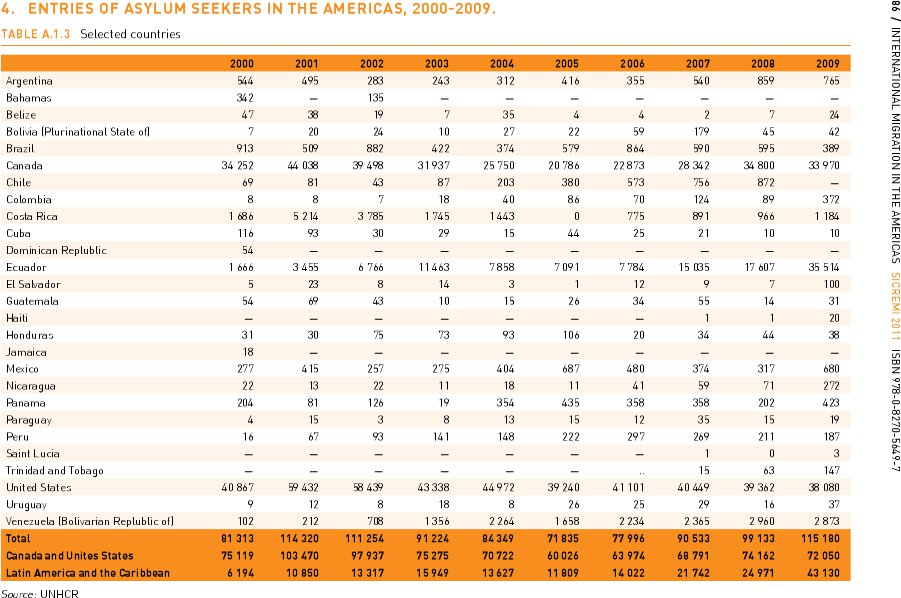
Although Latin America and the Caribbean are not considered as important destination regions  for persons seeking asylum from persecution, requests for asylum have increased to approximately 49 000 in 2009, an increase of 73% when compared to figures from 2008, and quadruple the total recorded in 2000. By contrast, Canada alone received about 34 000 claims in 2009 and the United States 38 000. Ecuador was the principal receiving country of requests for asylum in Latin America and the Caribbean, receiving almost 36 000 requests, in large part from Colombian citizens fleeing conflict zones near the border with Ecuador.  

Here is the table from the report (you can click for a bigger view):


It is a reminder that we need about the effects of Colombian violence on Ecuador, where the growth of asylum seekers is staggering.  It also raises a question to which I do not know the answer: why was there a major dip, then a major surge, in people seeking asylum in Canada?

Read more...

Sunday, August 07, 2011

The US and UNASUR

Unregulated capitalism, invasions and occupations in Iraq and Afghanistan, and political incompetence in the United States are serving to do what Hugo Chávez wanted but was very far from achieving: bring South America together economically in a way that not only excludes the United States, but consciously keeps it at arm's length. Bolívar would be proud.

Read more...

Friday, August 05, 2011

Piñera gets CEPped

The Centro de Estudio Públicos poll just came out, with lots of information on education.  Since students were out in force, as were the police in response, this was not a pleasant irony for Sebastián Piñera (check out some images here).  The CEP poll shows his presidential approval at 26 percent, with little confidence in how he is handling, well, most anything.

An interesting point to keep in mind, though, is that for years approval of handling the economy trends very closely to presidential approval.  Irrespective of the education protests, Piñera has a shot at recovery if he can turn around perceptions about how he is handling the economy.

But he's not in a happy place.

Update: Wow, how does Piñera respond?  By saying, "Remember the miners!!"

Read more...

Thursday, August 04, 2011

Cuban immigration waves

I agree with this article in the Sun-Sentinal that when the Cuban government starts talking about easing emigration rules, then you need to pay close attention.  In the past, that was how Fidel Castro signalled that a) he wanted certain concessions from the United States; and b) if he didn't get them he would open the floodgates.  That happened in 1965, 1980, and 1994, so we are even slightly overdue.  There is no need for alarmism, but it has worked very well for Fidel Castro in the past.

Read more...

Wednesday, August 03, 2011

Cabinets in Chile

From Adimark: Sebastián Piñera's approval rating remains very low, at 30%.  Borrowing a long standing tradition from the Concertación, he has responded to his lack of popularity by changing his cabinet. At least in the Chilean case, presidents tend to think that shuffling the cabinet will be seen as a signal that he/she is acknowledging problems and taking positive action.  However, I have never seen any evidence that such signals function as intended.  Presidential approval is based largely on other issues, and cabinet changes tend just to generate gossip about who will be running for president in the future.

Read more...

Tuesday, August 02, 2011

Extradition from Colombia

Nazih Richani writes at NACLA that more Colombian narcotraffickers want to be extradited to the United States.

Between 2000 and 2010, 1,121 narcotraffickers were extradited to the United States. I suspect that through their negotiations with the U.S. judicial system, these narcotraffickers have found that they can obtain benefits outweighing the costs. Some of the perks include prison terms reductions, protections for themselves and their families, and securing part of their wealth. The new Citizen Security Law offers the added bonuses of an expedited extradition and possibly even better benefits.


This is a big change.  In the past, the Colombian judicial system was seen as so corrupt and porous that people fought to stay in the country, and for years the U.S. constantly pushed for extradition laws.  Alvaro Uribe opened the floodgates.

This is a glass half empty/half full issue.  Richani sees it as empty:

With all of the above we have to ask if extradition is truly an effective tool to fight crime. More and more evidence says it is not. Especially for those that have committed war crimes, extradition has become a safe haven since they will only be tried for “narcotrafficking” while their “crimes against humanity” are largely forgotten.
However, it is also worthwhile to ask whether the Colombian judicial system has improved to the point that it cannot be gamed as much as in the past.

Read more...

Monday, August 01, 2011

U.S. or Chile?

Picture this: A country with a growing gap between rich and poor, where the legislature and political parties are extremely unpopular, though individual politicians sometimes have solid approval ratings. People even protest in the streets at times, though as yet there is no coherent independent political movement. The two main political parties/coalitions point fingers at each other, but when push comes to shove they agree just to create commissions to avoid making difficult decisions.

The United States or Chile?

Read more...

Sunday, July 31, 2011

Change of wardrobe in Venezuela

This is funny. Way back in 2007 I wrote a post about political fashions in general and Hugo Chavez's red shirts in particular, which generated a spirited discussion.

Now he says everyone should stop wearing red all the time.

The president, whose signature red shirts have long been a symbol of his socialist movement, also suggested his allies ought to be more moderate in their wardrobes.

"Why do we have to go around all the time wearing a red shirt?" he asked.
So what's the new color?

Read more...

Why we should be critical of Huntington

Patrick Porter at The Duck of Minerva argues that academic jealousy is the only reason Samuel Huntington gets criticized. We just wish we were more famous!

No, academics like to dismiss these works because the authors have appealed to a mass market, made meta-scale interpretations and predictions, and come as close to intellectual celebrity as possible for anyone who isn't Stephen Hawking or Albert Einstein. In an academic world that cherishes specialism and hair-splitting, that largely devotes its energy to internalised dialogues in exclusionary language, and which looks on fame and glory with envious suspicion, its no wonder that the mention of all three causes respectable scholars to roll their eyes.

He goes on to defend Huntington specifically. Maybe I am just showing my own jealousy, but I have read Clash of Civilizations and Who Are We? and the reason I don't like them is because you cannot read them in tandem and come to any conclusion but that Huntington ignores a lot of empirical evidence and is convinced that people of Latin American descent are inferior and ruining the United States. It is pure xenophobia.

Read more...

Saturday, July 30, 2011

Latinos and Southern Redistricting

The latest issue of PS has an article on Latinos in the South and redistricting.

J. Salvador Peralta and George R. Larkin, "Counting Those Who Count: The Impact of Latino Population Growth on Redistricting in Southern States." PS: Political Science and Politics 44, 3 (2011): 552-561.

The purpose of this article is to examine the potential impact of Hispanics on the electoral geography of the southern United States after the 2010 decennial census. Hispanics are the largest and fastest-growing minority group in the United States today. In addition to traditional Hispanic destinations such as Florida and Texas, many of the areas experiencing the most rapid growth in Hispanic population are southern states such as Georgia, North Carolina, and Virginia. Geographic information systems are used to determine where majority-minority and influential districts are likely to emerge in southern states. We argue that although the Latino population has increased significantly over the past decade, the proportion of Latinos living in southern states remains relatively low in comparison to the general population. Therefore, no new majority-minority or influence districts will emerge in Louisiana, Mississippi, or Tennessee. Majority-minority and influence districts are likely to emerge in Arkansas, Georgia, North Carolina, South Carolina, and Virginia at the state and local levels, but not at the U.S. congressional level. Texas and Florida are the only southern states where new majority-minority and influence districts are likely to emerge at the U.S., state, and local levels after the 2010 decennial census

This goes along with other evidence that the Latino vote in new gateways (such as here in NC) will not be a decisive factor in the short term, though certainly will be in the long term. For 2012 we will hear a lot about that vote for both the presidential and congressional levels, but it is not likely to be critical in most states. Not only is the population currently too small, but too few Latinos are eligible to vote.

Read more...

Friday, July 29, 2011

Toothpaste and Latin America

This story about Colgate caught my eye. Basically, prices for toothpaste will rise in Latin America to make up for the fact that people in the United States would not be willing to accept price increases. Several points come to mind:

First, there has been a lot of talk of overheating and inflation in Latin America, and this is an example (albeit very small) of how the U.S. recession is contributing.

Second, it is quite amazing, and rare, for the Latin American market to be seen as stronger than the U.S. market.

Third, watch out for the person next to you, because in the U.S. we seem to be hesitant about buying toothpaste.

Read more...

Thursday, July 28, 2011

Britain and Bolivia

A new twist in the fight against drug trafficking: as more Latin American cocaine ends up in Britain, the British start becoming involved. From the BBC, the example of Bolivia.

The British government has announced a new co-operation deal with Bolivia in the fight against drug trafficking.

During a two-day visit to Bolivia, Britain's Minister for Latin America, Jeremy Browne, said the Serious Organised Crime Agency in London will join forces with the counter-narcotics police in La Paz.

Along with assistance from Brazil, I see this as entirely positive. The U.S. has long been criticized for the "drug war" for many different reasons, not the least of which was a very condescending attitude that failed to take Latin American reactions into account. This is a global problem and deserves global solutions, so this development will hopefully inject fresh perspectives and produce a better outcome than what we've seen thus far.

Read more...

Wednesday, July 27, 2011

Understanding Alan García

It is nice to see the MSM in the U.S. start to explain why Alan García was so unpopular when he left office despite economic growth, and therefore also why Ollanta Humala won the election. More of these articles would break through all the clueless puzzlement about Peru. From the AP:

While the guerrilla war was largely over when Garcia returned to office, social conflicts in which authorities had to intervene nearly tripled on his watch. Critics claimed his pro-business policies often ignored Peru's native peoples and damaged the environment.
The resulting unrest has claimed 104 deaths and 1,398 injuries since 2008, according to Peru's national human rights ombudsman's office. And few of the underlying conflicts have been resolved.
Garcia leaves President-elect Ollanta Humala, an apparently moderate leftist who assumes office Thursday, with a ticking time bomb of disputes stemming in large part from objections by indigenous groups to the damage to water supplies, crops and hunting grounds wrought by mining, logging and oil and gas extraction.
"On the positive side, (Garcia) leaves a basically healthy economy," said historian and political analyst Nelson Manrique. "On the negative side, he has been authoritarian, hasn't been open to political dialogue and put off dealing with a series of demands that have generated a climate of social volatility."

We hear constantly that we have to wait and see whether Humala will govern responsibly. A better question is whether he can clean up Garcia's huge mess.

Read more...

Tuesday, July 26, 2011

Local elections and violence in Colombia

Any triumphalism about security in Colombia should take the following from Colombia Reports into account:

Twenty candidates in the local elections held in Colombia in October have been assassinated so far, the Electoral Observation Mission (MOE) announced Sunday.

According to the NGO, another 32 candidates have received threats, four have been kidnapped and seven survived assassination attempts.

It sounds sadly like Guatemala, and the violence is occurring for very similar reasons. It is also the same type of situation staring Mexico in the face.

Read more...

Sunday, July 24, 2011

Asylum for Mexicans

More and more Mexicans are seeking asylum in the US because of TCO violence. However, the "well-founded fear of persecution" argument is very difficult for people who are being threatened by gangs. I know from experience that such arguments are very difficult even for people who have minor children who are US citizens. Given the current climate, it is very hard to see that changing.

Read more...

Saturday, July 23, 2011

Malcolm Beith's The Last Narco

I read Malcolm Beith's The Last Narco: Inside the Hunt for El Chapo, the World's Most Wanted Drug Lord and enjoyed it. The title, however, is not entirely accurate since most of the book is about the drug organizations in Mexico and the government fight against them rather an inside account of the search for Chapo.  The military and police won't talk, so it is virtually impossible to get inside the hunt.

It is both chilling and discouraging. The details of how deep the TCOs reach into every corner of Mexico are morbidly fascinating. They aren't really new to anyone who reads the news regularly, but Beith's book brings it to gory life.

One of the serious challenges for the Mexican government is the fact that the army is not welcomed in many parts of Mexico, either because people like what Chapo (and other similar leaders) give them and/or because they see all state institutions as fundamentally corrupt and violent. There is far too little trust, and even less trust between the military and the police.

Finally, the book shows how many years drug kingpins like Chapo were setting up their operations. It is convenient to blame Felipe Calderón with his strong militarized policies beginning in 2006, but there are many other contributing factors. The cartel infighting had already been growing, which brought with it new levels of brutality as they moved into each other's territories.  The balloon effect from Colombia and the end of the PRI's reign in the presidency also helped set the stage. The complex confluence of all those factors would be a great research project.

As a coincidental P.S., Beith recent wrote a post on his blog about how Chapo seems to be losing influence in Mexico, even as his global reach has expanded.

Read more...

Thursday, July 21, 2011

Whatcha gonna do when they come for you?

The Georgia immigration law originally had a provision allowing for anyone to sue if they felt it was not being enforced. That was a terrible idea, and has been replaced by something that is both terrible and creepy.

Called the Immigration Enforcement Review Board, the seven-member panel will have the power to investigate complaints filed against city, county and state officials, hold hearings, subpoena documents, adopt regulations and hand out punishment. That punishment could include loss of state funding for government agencies and fines up to $5,000 for officials who "knowingly" violate the laws.

So the solution to immigration is an unaccountable and costly bureaucracy that can cripple anyone it wants.

Read more...

Wednesday, July 20, 2011

US Defense and Mexico

Richard Downie, Director of the Center for Hemispheric Defense Studies, published a working paper entitled "Critical Strategic Decisions in Mexico: The Future of US-Mexican Defense Relations." After looking at various options, he comes to the unsurprising conclusion that the military-oriented strategy is the best one (he is, after all, a retired military officer in a Defense Department think tank).

Even if you disagree with the argument, it is an articulate vision of the basic military view of TCOs in Mexico. However, the issue of US politics is a confounding factor. He acknowledges that many Mexican officials believe the US needs to do more to reduce drug demand, but essentially says that is impossible because of domestic politics. Yet he does not explain how that fact affects his preferred policy option.

Those in Mexico who oppose a strategy to confront the TCOs assert that the US is not taking the actions  necessary to assist Mexico solve its problems. In many ways these critics are right. Achieving a US strategy that would truly support Mexico is difficult because it demands consensus from influential domestic interest groups. To accomplish their political agendas, these groups do not necessarily intend to scapegoat Mexico. But the collective result can be a US policy or program that does not demonstrate the appropriate urgency or solidarity with Mexico on challenges that affect the US. Such a plurality of views results in a lackluster effort in providing effective assistance. More importantly, it emphasizes to our Mexican neighbors that too few in the US recognize or even care that the stakes are high in Mexico. The US/Mexican defense relationship is a demonstrable, unifying element toward confronting our shared security challenges.

We want a better relationship even as we refuse to enact policies that would improve it. Unfortunately, that means the policies outlined in the paper won't work as planned.

Read more...

Tuesday, July 19, 2011

Allende's suicide

Salvador Allende's death has officially been ruled a suicide.  I think it is fair to say that very few people believed otherwise.  Nonetheless, there is evidence that the military (under the orders of Augusto Pinochet) would have murdered him if they found him alive.

I recently published a book chapter about the efforts by Concertación presidents, the Chilean military and others to proclaim the transition complete, which would then allow everyone to "move on."  This is yet another example of how traumatic the coup and military regime were, which makes "moving on" a difficult proposition (see Steve Stern's trilogy on memory in Chile for a great analysis).

Read more...

Monday, July 18, 2011

Deportation and immigration views

Gabriel Sanchez, a political scientist at the University of New Mexico and one of the bloggers at Latino Decisions, has an interesting hypothesis.  Individuals who know someone who has been deported are more likely to be critical of current immigration policy.  Since the Obama administration has deported more people than any administration in U.S. history, more Latinos now know someone who has been deported, and therefore have become more critical.

I am not entirely convinced that Latinos consider immigration the most important problem facing the country, because the poll asks them what is the most important issue "facing the Latino community" when in fact people vote based on what is most important period, and not what is most important for a more vague community identification.  Nonetheless, this is a new and intriguing argument about the effects of Obama's policies.

Read more...

Sunday, July 17, 2011

Mexican public defenders

I've been critical of the Mérida Initiative, but the following is a more positive component.  There is actually a grant competition to bolster the Mexican public defender system, which was extensively reformed in 2008.  The idea is to get public defenders used to an accusatory system.

The goal of this project is to assist the IFDP make the administrative changes necessary for its altered responsibilities under an accusatory system, and to assist the IFDPs attorneys become effective in their roles in the reformed system. INLs support for IFDP and its responsibilities as an integral aspect of an accusatory criminal justice system will bolster accountability and public confidence in Mexico's federal criminal justice institutions. This program is intended as a three-year project with a funding ceiling of up to $6,000,000 (six million dollars) during the three-year period, pending funding availability. Up to $2,000,000 will be available for the first year, with the possibility of funding at similar levels on an annual basis for two more years. There is the possibility of continued funding beyond three years based upon performance and availability of funds.

This type of effort will likely pay greater benefits--and certainly more bang for the buck--than guns and helicopters.

Read more...

Friday, July 15, 2011

Underemployment in Chile

Gonzalo Durán at CIPER Chile has a great post on underemployment in Chile.  The upshot is that there are 42.3% more people underemployed now than in 2009, and 20.5% more than when Sebastiá Piñera took office. A major problem is that the Chilean government does not bother to publish anything on underemployment, preferring instead to make grand statements about creating a million new jobs.

The spread of underemployment provides more insight into the discontent currently evident in Chile at a time when its economic model is held up as a model for the region and the rest of the world.

For more on the tenuous nature of employment in Chile, check out Kirsten Sehnbruch's book The Chilean Labor Market.

Read more...

Thursday, July 14, 2011

Hispanic births

The Wall Street Journal has an article on how the majority of the growth of the Hispanic population is due to births in the United States rather than new immigrants.  My esteemed colleague has a quote in the article that neatly sums it up:

"We just have to get through this transition time," says John R. Weeks, a demographer at San Diego State University. Ultimately, he says, "the children of immigrants are going to buoy up the economy. They are going to pay for Medicare and Social Security for the aging white population."

Read more...

Latin American growth

The Economic Commission for Latin America and the Caribbean says the region will grow by 4.7% this year.  The interesting part of the estimate is that it is based in large part on access to credit for consumption.  I had just written about concerns that consumerism could create the same type of economic crisis that hit the United States.  I don't consider myself a pessimist by nature, but I keep finding warning signs in all the rosy growth pictures.  To be fair, ECLAC does mention it:

The region could become more vulnerable to speculative capital movements that may create bubbles in financial and real estate markets.

As always, let's hope that economic growth is more equitable in the past.  The Peruvian presidential election is a stark reminder that it is dangerous to focus on GDP growth alone.

Read more...

Wednesday, July 13, 2011

Latin America links to read

I haven't had a linkfest in a while.
  • Setty on the anniversary of Chile nationalizing copper

Read more...

Tuesday, July 12, 2011

Adrian Gonzalez is a coward

I had been writing about the hubbub over whether Adrian Gonzalez might boycott the All Star Game because of Arizona immigration law.  Turns out he did a 180 and not only will he play but he claims he didn't even say what everyone knows he said.

"What I said was misinterpreted," Gonzalez told USA Today. "Especially the way the question was asked. At the time, I didn't know much about the law. I still don't. It's not something I'm even going to get into."

Sad and cowardly.

Read more...

Future glass half empty or full

Mauricio Cárdenas at the Brookings Institution has a short opinion piece on how Latin America has a "once in a lifetime opportunity" to achieve prosperity.  When it comes to Latin America, someone always seems to be saying there is a once in a lifetime opportunity, which reminds me of the joke about Brazil always being the country of the future.

What he is really arguing, however, is that Latin America is on the brink of a very difficult period.  Within about a decade, there will be a larger old population with a smaller working-age population to support it, the commodity boom will end, and foreign investment will fall from current high levels.

Ultimately, the argument is nothing new.  When commodity prices are high, then tackle tax reform, judicial reform, and education.  If you don't, then we will just a new iteration of the same old boom and bust cycles.

Read more...

Monday, July 11, 2011

Recall in Arizona

Russell Pearce, the Arizona state senator who authored S.B. 1070, will face a recall election, the first of a state legislator in Arizona's history.

Here are the 2010 results:

Russell Pearce (R) 17,552 (56.6%)
Andrew Sherwood (D) 10,663 (34.4%)
Andrew Garcia (L) 2,808 (9%)

Obviously, a relatively small number of votes can mean a lot, but Pearce has never lost an election and won handily in 2010.  It will be very difficult to find a candidate who is sufficiently conservative for the district yet also opposed to Pearce's position on immigration.  In addition, more than one person can run against him if they get a small handful of signatures, and multiple candidates will almost guarantee a Pearce victory.

Therefore, it will likely be a symbolic measure, and one that cannot be copied everywhere.  Only nine states have broad recall provisions, while 29 others have some type of more restrictive laws for different state-level officials (more info here specifically on state legislators).

Read more...

Sunday, July 10, 2011

Politics of free trade

Kezia McKeague at Americas Quarterly takes a good look at the politics of passing FTAs with Colombia and Panama.  It is sausage making at its worst.  Further, after reading about this issue for several years, I have to wonder whether many legislators care much whether an FTA passes.  Democrats want to make a point about human rights, while Republicans want to make a point about Obama's failures in Latin America.  The economics of the agreement often seem tangential to the debate.

In fact, there is obvious concern that an FTA with Colombia would actually mean a net loss for the United States.  We are even contemplating punishing Mexicans and Canadians as a result!


Canadian exporters warned Friday of a possible deterioration in North American trade relations due to a push in Congress to slap U.S.-bound Canadian and Mexican travelers with a surcharge.
The surcharge, estimated at $5.50 per passenger and proposed by the House Ways and Means Committee, is designed to offset lost revenue resulting from a free-trade pact with Colombia.


Not exactly a good neighbor policy.

Read more...

Friday, July 08, 2011

Now I'm free, free fallin'

The latest Adimark poll for Sebastián Piñera is abysmal, with 31% approval and 60% disapproval.  Only 39% consider him credible.  In my last post I compared him to Alan García, but a look at the detailed numbers brought Richard Nixon to mind because Chileans only think he is doing a good job with foreign affairs.


This is embarrassing for a president who came to office proclaiming that as a businessman he was well positioned to achieve growth and prosperity, and that the Concertación had squandered economic opportunities.  Approval of his handling of the economy has also been plummeting (it was 64% in October 2010).

Finally, the percentage of people who identify neither with the government nor with the opposition has increased to 30%.  These ni-nis are not a new phenomenon, and have yet to coalesce into a viable third party, but show how disconnected many Chileans feel from government.

Read more...

Thursday, July 07, 2011

Dynamics of illegal immigration

Damien Cave (@damiencave) at the New York Times has an article very much worth reading about the decrease of illegal immigration from Mexico to the United States.  He comes up with many different possibilities, including Mexican demography, economic growth, consular help, broader access to education, and enforcement in the United States.  There are, however, two points that need mentioning.

First, this covers only Mexico, which is not the only source of undocumented immigration.  It is just over half, but that leaves many people out of this equation.

Second, even leaving aside my first point, the article does not mention demography in the United States, which must be viewed in conjunction with Mexican demographic change.  As my esteemed co-author and I argue in our book, we are slowly leaving the "demographic fit" that served both as a push and a pull for migration.  Demographic change in Mexico alone is insufficient.  There are many more young people in the United States today compared to five or ten years ago, in large part because of the migration that has already occurred, both legal and illegal.

Read more...

Wednesday, July 06, 2011

Piñera's freefall

Sebastián Piñera got hammered in the latest CERC poll (their site seems to be under construction so I can't find the original report).  His approval is down to an Alan García-ish 35 percent, with 53 percent disapproval.  That is consistent with the 36 percent that Adimark reported in June.  Mirroring the Concertación years, however, this does not mean a boon for the opposition, which is also viewed with distaste.

So despite all the vaunted Chilean political and economic successes, Chileans are not all that happy with their elected leaders.  If you want to understand the big picture of why, then read my co-edited book on the Bachelet government.  As for the more immediate causes, read Robert Funk's post on the topic (you can also read his chapter in that book):

So with thousands participating in street demonstrations in favour of better public education, the president responded tonight with a televised announcement: The plan includes a new education fund, improving access and accreditation of universities (he didn't say how), creating a new bureaucracy for universities (he didn't say what) which would, amongst other things, seek greater transparency in order to determine which universities are for-profit, something which is currently illegal in Chile.

Read more...

Tuesday, July 05, 2011

Helen Marrow's New Destination Dreaming

I read and really enjoyed Helen Marrow’s New Destination Dreaming. An anthropologist, Marrow conducted comparative research with a “context of reception” approach.  To that end she examines the specific characteristics of two counties in eastern North Carolina, selected for variation.  One exhibits characteristics of the new rural South (with rapidly growing immigrant populations) while the other is the old rural South (with relatively little migration and a majority of African Americans).  She labels them pseudonymously as Bedford and Wilcox.

Her conclusions are more optimistic than most of the literature, and focus on assimilation, race relations, and the political and institutional responsiveness to immigrants.  Her argument about rural assimilation is particularly interesting.  Unlike their urban counterparts, rural areas are more working class, and so recent migrants find it easier to achieve some measure of satisfaction about upward mobility.  In other words, their low wage employment is stable and not too far beneath the rest of the population.  Plus, jobs like poultry processing are stigmatized by many, so there are more opportunities for internal upward mobility.  Still, she tempers this relatively rosy picture with a nuanced analysis of the cross-cutting differences between different Hispanic populations, which include citizenship status, country of origin, affluence, and even gender.  All of these strongly affect who can move up more easily and rapidly.  Further, there is more upward mobility in poultry processing than in textiles (an industry that has been shrinking for well over a decade) so the structure of the receiving community can lead to significant variation.

She also does a nice job of contextualizing the rural experience of migrants, which vary not only by the receiving context, but also by the background of the migrants themselves.  In particular, migrant perceptions are colored by their own urban or rural origins.  More specifically, people from Latin American cities tend not to like rural North Carolina, while those from rural Latin America have a much more positive view.  For me, it raised a question about whether such a response would be common for much of the urban South as well.  Some interviewees compared rural North Carolina unfavorably to Chicago or Miami, but most southern cities (such as Charlotte or Raleigh) are smaller and more sprawling than those larger counterparts.

Her conclusions about race relations are more sobering, but reveal less hostility than is commonly assumed.  Marrow notes a larger gap between Hispanics and Blacks than between Hispanics and Whites, with a growing sense of a black-nonblack color line.  This is particularly pronounced in the minority African American county she studied versus the majority counterpart.  When in the minority, African Americans perceived a political and economic threat more acutely.

With regard to political representation, newly arrived migrants—especially those who do not speak English well—face daunting challenges.  Marrow argues that elected officials have shown relatively little interest in reaching out to the Hispanic population or addressing it needs, but that public bureaucracies have done so.  Since relatively few Latinos are eligible to vote, they are of less interest to politicians, but many individuals in bureaucracies view their own role as service-giving, and so often reach out to the immigrant population, even to the point of bending rules (it should come as no surprise to anyone that DMV officials were the least likely to be helpful!).  This contradicts political science literature, which would expect bureaucracies to follow political dictates.  That highlights the usefulness of a multi-disciplinary approach for understanding Latino immigration to the United States.  Nonetheless, as more restrictive laws were passed, state and local employees found it increasingly risky to do so, thus negating some of the more positive effects.

Notwithstanding the shrill media attention to restrictionist legislation being pursued at the state level in the South (as well as elsewhere, most famously Arizona) research like Marrow’s is pointing to more positive outcomes.  There is more work to be done to better understand why, but also to determine whether it is something that changes much—for better or worse—over time.  In sum, the book provides much food for thought as we try to understand the “Nuevo New South.”  As such, this and other works can provide a foundation for more comparative research on the political, economic, geographic, racial, and cultural impacts of Latino immigration to the South.

Read more...

Monday, July 04, 2011

Chomsky on Venezuela

Interesting transcript of an interview with Noam Chomsky about Venezuela and Latin American democracy in general. The upshot: he hates to criticize Chavez but is concerned about concentration of executive power. Even Chomsky thinks it undermines democracy.

RC: Finally professor, the concerns about the concentration of executive power in Venezuela: to what extent might that be undermining democracy in Venezuela?

NC: Concentration of executive power, unless it's very temporary and for specific circumstances, let's say fighting world war two, it's an assault on democracy.

RC: And so in the case of Venezuela is that what's happening or at risk of happening?

NC: As I said you can debate whether circumstances require it – both internal circumstances and the external threat of attack and so on, so that's a legitimate debate – but my own judgment in that debate is that it does not.

Read more...

Sunday, July 03, 2011

Where's the love for consumerism?

We constantly hear about what the U.S. needs to do to regain a stronger leadership role in Latin America. A quote from Brazil is a reminder that the U.S. is losing ground when it comes to economic policy. Has there ever been a time when U.S. style consumerism has been mocked by governments that are not so far away ideologically?

That concern was repeated by former central bank President Arminio Fraga, who said on the Charlie Rose television program that Brazil is focusing too much on consumption and not enough on saving and investing. That "American" style of consumerism could lead to a credit crisis within the decade, Fraga said.

Of course, this comes on the heels of the U.S. employing bailout strategies that it pressured Latin American governments not to employ in the 1980s.

Read more...

Saturday, July 02, 2011

Barbara Demick's Nothing to Envy

I've long had a fascination with North Korea, dating back to when I first taught an Intro to Comparative Politics course and used the country as an example of an ongoing totalitarian dictatorship.  There are a lot of great books about it, most notably Bradley Martin's Under the Loving Care of the Fatherly Leader, which I heartily recommend.  I also recommend the blog North Korean Economy Watch.  I just read Barbara Demick's Nothing to Envy: Ordinary Lives in North Korea and it is excellent. Demick uses interviews with six North Koreans who left the country, and really effectively shows their gradual disillusionment.

At times the book made me angry, even though I am well aware of the political history--the personal histories pack a punch.  The regime's callous attitude toward famine in the mid-late 1990s is maddening, such as the rousing slogan "Let's Eat Two Meals a Day."  One of the defectors was a doctor, and she recalls the many people she saw die, the telltale signs of protruding stomachs and lethargy.  When she snuck into China it was a revelation: "But now she couldn't deny what was staring her plainly in the face: dogs in China ate better than doctors in North Korea" (p. 220).  Another defector soon realized after reaching South Korea that his head and body were out of proportion because of severe malnutrition during his growing years.

The "ordinary lives" of the title is true. These people had no political positions and were not opposing the regime as such. They just didn't want to die of starvation and in different ways had caught a glimpse of the outside world.  And only a glimpse was necessary to let them know that virtually everything they heard from the government was a lie.

For one of the North Koreans, Kim Il-Sung's death was the turning point, and her response as it became clear that no change would occur really sums the situation up nicely:

As she sat alone in the apartment, the enormity of it all started to sink in. Any hope that the North Korean regime might change with the death of Kim Il-sung was quickly dashed. The power had passed to his son. Things weren't going to get any better. She heard her father's words replaying in her ears. "The son is even worse than the father."
"Now we're really fucked," she said to herself.

Unfortunately, yes.  And yet defecting didn't solve things either, because they found they had few skills, jobs were not easy to find, people took advantage of them, and some had siblings back in North Korea who were sent to prison camps as punishment for their defection. With North Korea, it is hard to find happy endings.

Read more...

  © Blogger templates The Professional Template by Ourblogtemplates.com 2008

Back to TOP