Friday, December 01, 2006

Center for Development in Central America

Yesterday I neglected to give a plug to the Center for Development in Central America, which came to UNCC and a representative spoke to my Latin American Politics class on Wednesday. It is a very cool non-profit that focuses mostly on micro-enterprise projects in rural Nicaragua, with an emphasis on community development.

Part of their work involves production of a wide variety of things for sale/export, and so they set up a table in the university bookstore with all sorts of items for sale. One of the things I bought was a pound of Nicaraguan coffee grown by a local cooperative (and I am drinking it as I write). They worked to fulfill the requirements of being labeled “organic” and then looked to niche markets in the U.S.

Poverty in Nicaragua can seem so crushing, and what I really liked was the commitment to doing one project at a time, community by community, and not letting the big picture overwhelm them.

Read more...

Thursday, November 30, 2006

More on Bolivia

Yesterday I wrote about the land reform bill passed by the Bolivian senate, and now signed by President Morales. The update today is that the two assistants voted in place of their respective senators, though it is not clear why the senators themselves did not vote. From the Associated Press:

The reform's rocky passage in the Senate could also hamper Morales' effort. The president relied on votes cast by two absent senators' assistants to pass the controversial bill, granting the opposition legal leverage to question the law's validity.

Former Bolivian President Jorge Quiroga, leader of the conservative party Podemos, which led the Senate boycott, said Wednesday that Morales' tactics were "contemptible and disgusting, both legally and morally."


Podemos has accused the senators' assistants of accepting government bribes to pass the law. On Wednesday, the assistants were being guarded by police for their safety.

So the plot thickens. Did those two senators want to vote for the bill, or were the assistants paid off?

Read more...

Wednesday, November 29, 2006

Quick update: Bolivia

I had recently written about the political stand-off in Bolivia. Now the BBC reports that three opposition senators broke ranks and voted with the government on President Morales' land reform bill. Democracy, though very fragile, is hanging on.

Update to the update: the anonymous commenter alerted me to the fact, not reported by the BBC, that only one senator voted. From CNN:

But Tuesday night, one Podemos senator returned to the chamber to vote for the land reform, joined by assistants filling in for two other opposition senators.

It was not immediately clear whether the assistants' votes would hold up to legal scrutiny.

Now, who exactly were these assistants? What legal right do they have to vote?

Read more...

Anticipating the Venezuelan election

The Venezuelan presidential election is coming up on Sunday. The Miami Herald has an interesting article on the proliferation of questionable polls. You can find a poll that gives either candidate a clear victory.

There is even dispute about popular mobilization, as both candidates just held large rallies. But which was larger? Ka even comes up with a very creative estimate using Google earth, and calculating width of the road used, etc.

The article makes the very good point that these disputes suggest that each side believes it should win, and therefore will claim fraud if that outcome does not occur. An article by Oxford Analytica concurs, and has an analysis arguing that Rosales will lose and his campaign has failed. It also speculates that Rosales supporters are more likely to stay home because of fraud concerns, which will further fuel mutual suspicion and hostility.

It is hard to conceive of an outcome that will contribute to political and social stability in the country. Or at least I haven't seen one.

Read more...

Tuesday, November 28, 2006

Hall of Fame list

This year’s crop of first time eligible baseball Hall of Famers just came out. Topping the list are Tony Gwynn and Cal Ripken. They both will easily make it in, and the only question is how high their tallies will be. And why wouldn’t they be 100%?

Then we get to Mark McGwire, who has been nailed hard by the steroids investigations, famously refusing to answer questions at a congressional hearing. I say no to McGwire, whose individual accomplishments are just too tainted, even though I loved watching him when I was living in the Bay Area.

He’s not a first timer, but I think Goose Gossage should be in the Hall of Fame (and yes, I have a soft spot for Padres). He was one of the people who revolutionized the idea of an intimidating closer, and worked much harder than any current relievers, by commonly pitching 2-3 innings. Does that mean Lee Smith should be in there? And Trevor Hoffman eventually? Very tough call.

Read more...

Monday, November 27, 2006

Ecuador election postmortem

Initial results suggest that Rafael Correa won by a wide margin in Ecuador (he won 57% of the vote or even higher). We will, of course, have all sorts of articles about how he’ll cozy up to Hugo Chávez and fight the power.

This would ignore the fact that for the runoff he moved to the center, and toned down the radical rhetoric (even toward the United States). The message he sent was more populist, with promises of bonuses, housing, and other payments that would presumably be based on the current high price of oil. We’ll have to wait and see whether he governs like the traditional left or a more mainstream populist (or some sort of mixture).

Perhaps the most problematic for democracy will be the resistance he will face in the legislature, with the lack of a loyal opposition, though this will obviously depend on what types of reforms he attempts. That plagued recent presidents (including a military ouster) and may be similar to the situation in Bolivia, where the opposition recently exited the Senate to ensure that a quorum was unobtainable and thereby prevent votes on President Morales’ more controversial measures. In both countries, the president has expressed a desire to place more power in the hands of the president (or, in the Bolivian case, eliminate the Senate altogether). Neither solution (blocking every presidential proposal or moving toward hyperpresidentialism) is good for democracy.

Read more...

Sunday, November 26, 2006

Today's election in Ecuador

There are many articles today framing the presidential election in Ecuador as a microcosm of Latin American political divisions, the left versus the right, the haves versus the have-nots, free trade versus socialism, Venezuela versus the United States. Kudos to the Washington Post for publishing an article rejecting such alarmist and simplistic analyses:

No matter who wins Ecuador's presidential election on Sunday, many outside the country will view it as a decision between dueling political stereotypes: Venezuelan President Hugo Chávez's dream of a unified region liberated from U.S. influence, or that of free-market backers embracing a globalized economy.

For most who will actually make the choice, it's nothing of the sort.

Ecuador has experienced some of the worst instability in the region in recent years, and people want someone who will provide results. Unfortunately, the following is also true:

"It doesn't matter which of the two candidates wins, Ecuador will have a weak president, at the mercy of the Congress and facing difficulties of governability," said Adrián Bonilla, director of the Latin American Faculty of Social Sciences in Quito.

So let’s stop claiming that Latin American elections are a titanic struggle between the opposing forces of Chávez and Bush, which essentially removes Ecuador from the equation through the claim that we can only understand the election by looking outside the country.

Read more...

Saturday, November 25, 2006

Pinochet takes "political" (but not legal) responsibility

On his 91st birthday, Augusto Pinochet has issued a statement in the form of a letter read by his wife (audio is here), saying that he takes “political responsibility” for everything that happened while he was in power, a shift from the past, when he blamed “excesses” on subordinates. I’m not sure what “political” responsibility is versus other types of responsibility, though I am guessing in legal terms it is supposed to be different from “criminal” responsibility, so that this letter can’t be used against him in court. In other words, he’s not taking much responsibility for anything.

Over the past several years, since his arrest in Great Britain, Pinochet has issued a number of similar letters, and I don’t see this one as especially different. They all do the following:

--assert that the military saved Chile from a totalitarian dictatorship
--argue that current human rights proceedings are political motivated and unfair
--portray himself as a selfless advocate for the country
--offer up platitudes about achieving national unity and harmony

Ultimately, he really wants to be a hero in Chilean history, and is concerned that as he gets very old, it isn’t happening.

Read more...

Philip Short's Pol Pot

I finished Philip Short’s Pol Pot: Anatomy of a Nightmare. A while ago, I had seen a very positive review in The Economist, and finally got around to reading it. It is a bit slow, but very compelling. The magnitude of killing and starvation in Khmer Rouge Cambodia is staggering, and Short does a good job of detailing how it came about.

Ultimately, though, it isn’t really a biography per se. The first half does discuss Pol’s exposure to Marxism, especially in Paris, but the latter half focuses on the regime itself. There is a missing connection there—what transformed the quiet, polite student into a killing machine? Murder was indiscriminate, based on Pol’s paranoia and his everchanging view of Marxism (so, for example, you might be tortured and killed if you foraged for food, because that is selfish, and your family would then also be tortured and killed).

Mostly, Short comes back to Khmer culture, combined with the fact that Cambodia was caught in a dispute between Vietnam/USSR and China/U.S., all of which were aware of and mostly unconcerned with the massive and unnecessary loss of life taking place. Once Vietnam had invaded Cambodia, both China and the U.S. wanted everyone there to suffer, as that would weaken Vietnam and by extension also the Soviet Union. But this seems to make Pol Pot just a cog in a machine, and suggests that anyone else would’ve done the same. Maybe we can never really know.

Read more...

Friday, November 24, 2006

Ecuador election

The presidential runoff in Ecuador takes place on Sunday. As Boz notes, the campaign has become very negative. The AP has some examples of the exchange of insults.

Correa: "At stake here is whether to have a nation or be just one more plantation for the conceited Noboa."

Noboa: "He runs with communists but he isn't man enough to call himself communist."

The big question is whether the people of Ecuador win either way.

Read more...

Thursday, November 23, 2006

Charlotte Turkey Trot 8K

All over the country, people get up on Thanksgiving morning to run races. For the past several years, we've run the Charlotte Turkey Trot 8K. This year, over 2000 people ran (even more when you count the shorter fun runs), and it was cool to see that someone 83 years old finished the race, which is what I hope to be doing at that age. I see that the overall winner for women was Cassie Ficken, a very good runner for UNC Charlotte (who I think has now graduated).

Read more...

Wednesday, November 22, 2006

Pinochet's legal problems

The Miami Herald has a good discussion of Augusto Pinochet’s legal woes. My only complaint would be that it is vague about the laws that block prosecution. It’s not simply a matter of “lax amnesty laws” but rather an often confusing combination of immunity as former head of state, and protection via the 1978 amnesty, depending on when the crime took place. Added to that is the argument is that he has “dementia” (he will soon be 91) and therefore is unfit to stand trial. All of these issues must also filter through several levels of court hearings and appeals.

I had also neglected to mention the truly surreal statements his daughter made a few days ago, in which she said Pinochet “felt great pain” for people who suffered while he was in power. Further:

"He is not prepared to ask for a national forgiveness as some want, but he is prepared to meet any of those people and talk to them," Lucia Pinochet told the television's Wednesday late news program. "There, he would see whether to ask for their forgiveness."

Under his personal direction, the dictatorship was engaged in cold hearted, cold blooded murder. And yet he talks about a) having a chat with victims’ families; and b) deciding afterward whether he would bother asking for forgiveness.

Read more...

Tuesday, November 21, 2006

Trade agreements with Latin America

An interesting debate is brewing about whether to extend the Andean Trade Promotion and Drug Eradication Act, which is a trade preference deal that provides access to U.S. markets for certain goods from Bolivia, Colombia, Ecuador and Peru. Unless Congress acts, it will expire on December 31.

Democrats have expressed skepticism about all the pending trade deals (e.g. FTAs with Colombia and Peru). Charles Rangel has indicated that he wants more labor provisions in the ATPDEA. This is a standard criticism by Democrats, and often it is a legitimate one, as labor is routinely abused.

In this case, however, and especially with regard to Bolivia, it doesn’t make much sense. Not only do human rights organizations (like the Washington Office on Latin America) support it, but Evo Morales himself wants it extended, and is sending his Vice President to the U.S. to lobby for it.

Trade agreements should certainly be scrutinized, and not rubber stamped. But when it comes to whether an agreement will hurt the poor in Bolivia, I think Evo Morales is the expert I’ll listen to. In addition, the purpose of the agreement is to provide alternatives to growing coca. So if we criticize the military response to drugs (which I have often done) then we need to offer up something else.

Read more...

Monday, November 20, 2006

Mexico report

The Mexican government released a report about the targeting of government opponents from the 1960s to the early 1980s. Most importantly, it directly implicates three former presidents (Gustavo Diaz Ordaz, Jose Lopez Portillo and Luis Echeverria) as knowing about killing and torture and doing nothing about it.

"This was not about the behavior of certain individuals," Carrillo said. "It was the consequence of an authorized plan to do away with political dissidents."

News reports say that the report is on the internet, but I haven't found it (I'll keep looking, but if anyone comes across the link, let me know). This leaves a lot of questions. How many people were targeted? Was it the police? Military? A combination?

It is also further evidence that Mexico's one party state wasn't as different from Latin American dictatorships as it would like to claim.

Read more...

Sunday, November 19, 2006

Immigration reform

Apropos my question of whether Democrats would really start moving on immigration reform, there is an article by Tamar Jacoby in the latest issue of Foreign Affairs. Right away, it argues something I’ve been saying for a while:

In fact, the nation is far less divided on immigration, legal or illegal, than the current debate suggests. In the last six months, virtually every major media outlet has surveyed public attitudes on the issue, and the results have been remarkably consistent. Americans continue to take pride in the United States' heritage as a nation of immigrants. Many are uneasy about the current influx of foreigners. But an overwhelming majority -- between two-thirds and three-quarters in every major poll -- would like to see Congress address the problem with a combination of tougher enforcement and earned citizenship for the estimated 12 million illegal immigrants already living and working here.

The thrust of the article is that now with the elections behind it, Congress will likely move quickly to address immigration. It provides a really good analysis of the U.S. economy’s need for labor, the futility of enforcement-only policies, etc.

These facts are stark, and those who buy into the comprehensive vision see no point in quarreling with them. Rather than seeking to repeal the laws of supply and demand -- or trying futilely to block them, as current policy does -- reformers want an immigration policy that acknowledges and makes the most of these realities.

The only problem is that she never addresses her initial premise: that Congress will start working on reform. At the beginning of the essay, she writes:

The political stars will realign, perhaps sooner than anyone expects, and when they do, Congress will return to the task it has been wrestling with: how to translate the emerging consensus into legislation to repair the nation's broken immigration system.

But she then takes this as self-evident, and never gets back to it. Why is it obvious that Congress will tackle it? There is a vocal minority against it, and therefore it will be tempting to avoid it. Nonetheless, if you're interested in the debate it is a nice, concise analysis.

Read more...

Saturday, November 18, 2006

Is that juice really worth the squeeze?

Like a number of other local governments, Gaston County, right here next to Charlotte, has enacted new laws prohibiting illegal immigrants from receiving local services. The essential argument is that illegal immigrants represent a net cost to the county, so this law should save the county money. Right? Well, no.

First of all, the county commissioner who sponsored the bill said illegal immigrants are a “drain” on county services. When asked how much money was being spent, his response was…he didn’t know.

Second, county officials believe that the enforcement efforts will cost more than illegal immigrants do.

For instance, the county Health Department must provide some programs by federal law, regardless of citizenship, said Colleen Bridger, health director. Why, she asked, should illegal immigrants be excluded if they're entitled to programs anyway?

"It would add expense to ask a question we can do nothing with," Bridger said.

Another issue is the number of people such screenings would catch. About 11 percent of Health Department customers are Hispanic, Bridger said, and officials don't know how many are in the U.S. illegally.

"Is that juice really worth the squeeze?" she asked. "If you're looking for efficiency in government, this isn't it."

This law would also mean that when is story time at the Gaston library, librarians would be breaking the law if they did not determine the immigration status of every child there.

Unfortunately, unless the federal government addresses immigration these local laws will continue to gain momentum.

Read more...

Friday, November 17, 2006

News Flash: Border Enforcement is Not Cheap

The inspector general of the Department of Homeland Security has issued an estimate that the recently authorized border fence will cost anywhere between $8 and $30 billion. You may remember that the original estimate, confidently asserted right before an election, was $2 billion. Given that only $67 million has actually been approved so far, I don't see Congress coughing up that much.

This entire episode annoys me in many ways and on many levels. One of the outcomes will be a confirmation that the federal government is simply not interested in addressing immigration at all. Unfortunately, this will lead more local governments to enact their own laws, with a resulting morass of lawsuits and local political conflict.

I've been mulling over whether the new Democratic leadership will push for immigration reform in 2007, and although conventional wisdom suggests they will, I'm not sure yet. Certainly, they want the Latino vote, but I think doing nothing also secures some of that vote--in other words, the only harm comes when you go for enforcement-only policies. Many of the newly elected Democrats are fairly conservative, and might not want to jump right into a sticky topic. Plus, with the Murtha episode it also appears that the Democrats aren't very united and don't have a solid idea what they're doing. Or maybe I am just tired and cynical this morning.

Read more...

Thursday, November 16, 2006

Say it ain't so

The Padres are reportedly pursuing Barry Bonds. We lose Bruce Bochy and then might gain Barry Bonds? What a strange off season.

I hope this isn't true, or at least doesn't happen (his price tage must be massive). I'm not sure if I can learn how to root for him.

Read more...

Wednesday, November 15, 2006

U.S.-Venezuela podcast

My second podcast, a look at U.S.-Venezuelan relations, is now up on my website. Thanks yet again to Scott Phillipson, who reduced the size of the files and made it much easier to just click and listen.

Read more...

Blogging anonymously

I think students might be surprised to learn how many professors blog anonymously. I read a number of such blogs, and thought about this in light of a gaffe yesterday by Dr. Crazy, who inadvertently left a clue about her real identity in a post and didn’t notice it for some time. She then wrote about the dynamics of blogging anonymously. I don’t think I could ever do so, precisely because everything you write potentially tells people who you are, which would take the fun out of it.

Something else struck me—it seems that for academic blogs, more men use their real names, while most (though not all) anonymous blogs are written by women. There are many blogs out there I haven’t read, so maybe there is some sort of selection bias, but that is the trend I’ve noticed. For example, out of all the political science blogs out there (admittedly, a small sample), Michelle Dion’s is the only one I know of written by a woman. If I am wrong, I'd love to learn otherwise.

Read more...

Tuesday, November 14, 2006

Remittances in El Salvador

Via Tim’s El Salvador Blog: an interesting article on the effects of remittances. Especially because of the 1980s civil war, about ¼ of Salvadorans live in the U.S. and send money home, to the tune of a whopping 16.6% of GDP. This in turn creates an incentive for recipients not to accept low paying jobs. To fill these jobs, more Nicaraguans and Hondurans are entering the country, almost entirely illegally. Meanwhile, economic growth in El Salvador in 2005 was the lowest in Central America.

Read more...

Monday, November 13, 2006

Cuba embargo vote at the UN

A few days ago, the UN voted overwhelmingly to request that the U.S. end the embargo against Cuba. The vote was 183-4, rejected only by the U.S., Palau, Marshall Islands, and Israel (for some reason, the Federated States of Micronesia abstained).

These days, it's just plain hard to defend the embargo and sound rational, especially since we've opened up to China and Vietnam. For example, part of the U.S. response was that:

The measures had been maintained in an effort to promote the exercise of human, political and socio-economic rights for all Cuban people.

I'm still trying to figure out that logic.


Read more...

Sunday, November 12, 2006

College professor is a great job

So says Money Magazine. We're second to software engineers.

NEW YORK (MONEY) - To find the best jobs in America, MONEY Magazine and Salary.com, a leading provider of employee compensation data and software, began by assembling a list of positions that the Bureau of Labor Statistics projects will grow at an above-average rate over 10 years and that require at least a bachelor's degree.

Using Salary.com compensation data, we eliminated jobs with average pay below $50,000; total employment of less than 15,000; dangerous work environments; or fewer than 800 annual job openings, including both new and replacement positions.

Next we rated positions by stress levels, flexibility in hours and working environment, creativity, and how easy it is to enter and advance in the field.

Read more...

The U.S. government believes that Castro may die someday

In one of the more incisive examples of political intelligence I’ve seen, the U.S. government thinks that Fidel Castro’s health is “deteriorating” and he is unlikely to live past next year. As the article notes, this is all hush hush: “American officials will not talk publicly about how they glean clues to Castro's health.” Now maybe I am going out on a limb here, but I’m guessing this startling conclusion was reached after months of careful examination of such things as:

--Castro himself saying his health problems were serious
--everyone in Cuba saying his health problems were serious
--publicly aired videos showing his health problems were serious

U.S. government officials believe he has cancer of the stomach, colon, or pancreas. Or something. A year ago it was Parkinson’s, but maybe that one didn’t pan out.

Here’s my question: why does the U.S. government bother leaking these predictions? I guess officials figure that one day, they’ll finally be right.

Read more...

Saturday, November 11, 2006

Burrito vs. sandwich

The rise of Americanized Mexican fast food is remarkable. In the early 1970s, when my parents lived briefly in Michigan as transplanted Californians, no one had even heard of Mexican food, much less eaten it. Nowadays it is ubiquitous, and of course transformed, because in the U.S. we don’t particularly like the true, healthy style of Mexican food. Americans tend to want nacho cheese, extra sour cream (why, I will never understand), and we want massive burritos that resemble white bricks.

Anyhow, via Crescat Sententia comes a court case in Worcester, MA, which shows just how popular the burrito has become.

The burrito brouhaha began when Panera, one of the country's biggest bakery cafes, argued that owners of the White City Shopping Center in Shrewsbury violated a 2001 lease agreement that restricted the mall from renting to another sandwich shop. When the center signed a lease this year with Qdoba, Panera balked, saying the Mexican chain's burritos violate its sandwich exclusivity clause.

A judge denied the claim, saying a burrito was not a sandwich. That is a no-brainer, as I have never ordered a bean sandwich with guacamole, just as I have never ordered a burrito with pickles and mayo. They even had someone from the government weigh in.

Judith A. Quick, who previously worked as a deputy director of the Standards and Labeling Division at the US Department of Agriculture, said in her affidavit: "The USDA views a sandwich as a separate and distinct food product from a burrito or taco."

And she got paid for that testimony. I’m glad we’ve straightened that out. But it demonstrates that Mexican food is so widespread and popular that it’s seen as threatening to sandwiches. For those of us addicted to it, that’s just fine.

Read more...

Friday, November 10, 2006

Immigration and "irrational" voters

Thanks to my brother for pointing out this article at Cato Unbound by an economics professor on the irrationality of voters, which uses immigration as its main example (and, I should say, he sent me the link because it was provocative and not because he agreed with it). The argument is that economists agree that immigration is good for the economy, and therefore voters who disagree are irrational. If voters are wrong, politicians will pursue bad policies in order to win elections.

The Survey of Americans and Economists on the Economy asks respondents to say whether "too many immigrants" is a major, minor, or non-reason why the economy is not doing better than it is. 47% of non-economists think it is a major reason; 80% of economists think it is not a reason at all. Economists have many reasons for their contrarian position: they know that specialization and trade enrich Americans and immigrants alike; there is little evidence that immigration noticeably reduces even the wages of low-skilled Americans; and, since immigrants are largely young males, and most government programs support the old, women, and children, immigrants wind up paying more in taxes than they take in benefits.

Even though I have argued many times in this blog for a more open immigration policy, I think his argument is oversimplified. First of all, since 1 out of 5 economists do think it is a reason, are they irrational too? Or just defined as bad economists and therefore not expert? His claims that “experts” find consensus and are "right" is unconvincing, since highly intelligent, capable people can make disastrous policy decisions (just read The Best and the Brightest) that others find repugnant.

But a bigger problem is that “too many immigrants” is the wrong question. A better question is whether illegal immigration has a positive or negative effect on, say, wages of low income groups. Since the recent debate on immigration is focused on the illegal side, any argument about immigration should include the perceptions of that phenomenon. Especially on that point, experts disagree far more than he gives credit for, and if experts disagree, then the public cannot be labeled “irrational” because they receive highly conflicting information (and, unfortunately, some of this information comes from suspect sources like Lou Dobbs).

Here is a possible twist on his argument. Voters are perhaps rational about illegal immigration, because it does have a number of negative effects. However, many are less rational about the optimal solution, which is to find a way to legalize them, rather than to spend money trying to eject people who will come right back anyway. On that point, I would love to see a poll asking people exactly how enforcement-only can work. Then you might point to irrationality.

Read more...

Padres moves

In comments in the previous post, Matthew Shugart wondered why I hadn’t made any mention of the major Padres news. Truth is, I’ve been so busy I’ve barely had time to sort it out.

First, Bud Black is the new manager. I guess it is old fashioned, but I like the idea of teams having a hometown angle. He went to SDSU with Tony Gwynn, and later was a good pitcher (Royals) and then pitching coach (Angels). The only negative is that he doesn’t have managerial experience, but I get the impression that these days the major moves are going to be decided upstairs, not in the dugout, as is the case with the A’s. For the Padres, I think it is becoming Moneyball time (all baseball fans should check out the book, it is a great read).

Second, we traded Josh Barfield for two guys I’d never heard of (Kevin Kouzmanoff and Andrew Brown) though apparently Kouzmanoff is a very good hitting prospect. Some have argued it’s a good trade, mostly out of the belief that Barfield won’t exceed his 2006 numbers, and a hot July pumped them up. I’m not sure about that—he is so young and has so much potential (and his dad Jesse had good power). Now we also have a hole at second, which we’ll fill with a few agent (Marcus Giles’ name keeps popping up).

It is going to be a very different team in 2007, with a different style as well. Alderson and Towers do know how to win, so I’ll just try to keep the faith.

Read more...

Thursday, November 09, 2006

Ortega and the U.S. media

The Associated Press has an article today with a garish headline about Daniel Ortega's embrace of leftists. Its first paragraph claims he will "reject Republicans." However, when you read more closely, you see the following:

--he pledges to work with the U.S.
--he says specifically that no land will be seized and that the country needs private investment
--he wants to build on the Central American Free Trade Agreement

The article then quotes a businessman:

"My fears aren't really about Ortega," said Berry, general manager and part owner of the Pelican Eyes resort in San Juan del Sur who holds both American and Nicaraguan citizenship. "He's among a group of wealthy men who want to protect their investments."

Corruption is a much greater problem than supposed "leftism." At the very least, let's wait and see what policies he pursues.

Read more...

Wednesday, November 08, 2006

Good morning, Mr. President

Not a fun morning for President Bush. The Democrats have control of the House, a majority of governorships, and are poised to take 51 seats in the Senate (a tense few weeks while those two contested races are sorted out). But on top of that, Daniel Ortega officially won the Nicaraguan presidency. Further, a new poll shows Hugo Chávez with a 22 point lead for the December 3 presidential election in Venezuela (though, I should ask, why is the state oil company commissioning polls?). Finally, Mexican president-elect Calderón is scheduled to visit the White House to ask him why he signed the ridiculous authorization for a border fence.

I will be very curious to see what kind of tone the president takes at his 1 p.m. press conference.

Update at 1:40 p.m.: announcing Rumsfeld's resignation is far more than I expected. Amazing.

Read more...

Tuesday, November 07, 2006

Voting machines

I wonder how many voting machines had problems today. There are already scattered reports. There is even one story of a guy going nuts and destroying one with a paper weight (which carries a charge of felony criminal mischief and tampering with voting machines).

I used an ES&S iVotronic touch screen machine to vote today, which also produces a printed copy as you go. I asked whether they'd had any problems, and the answer was no. At that point (11:30 a.m. or so) all had been working fine.

Read more...

Annoyed on election day morning

This is the first election since we moved houses, and in the past I would usually vote in the morning, at a church not far from our house. I have a morning meeting, so I figured I would vote on the way, just leaving a little early. But something hadn't registered (no pun intended). Now I vote at an overcrowded elementary school on a school day. Who thought this up? The school is on a major street, but both lanes were backed up so far that the school was not even in sight, and the traffic wasn't moving much. I didn't have time to wait, so made a u-turn and came to campus. I'll have to go back later in the morning, and wonder where I will even park.

In addition, the school system has Friday off as a teacher workday. Why couldn't they schedule it today instead?

I am definitely going to make sure I vote early in the future.

Read more...

Monday, November 06, 2006

Transparency International

Transparency International's 2006 Corruption Perception Index is out. Latin America doesn't fare all too well, though Chile is tied with the United States as 20th least corrupt country in the world. Venezuela and Ecuador are tied for worst in Latin America. Incidentally, Iraq is now considered the third most corrupt country, behind only Myanmar and Haiti.

20 Chile
28 Uruguay
55 Costa Rica (it has been slipping down)
57 El Salvador
59 Colombia
66 Cuba
70 Brazil
70 Mexico
70 Peru
84 Panama
93 Argentina
99 Dominican Republic
105 Bolivia
111 Guatemala
111 Nicaragua
111 Paraguay
121 Honduras
138 Ecuador
138 Venezuela

Read more...

Sí Ortega?

Initial results show Daniel Ortega with a bigger lead than expected in Nicaragua. With 14.65% of the ballots counted, he has just over 40%. This is the magic number, because it means winning the election outright without a runoff. However, Montealegre is at just over 33%, so there is more than the 5% gap necessary to win if Ortega dips under 40% (unless, of course, that is accompanied by a big Montealegre surge). I haven’t seen anything about results for the legislature.

The U.S. government issued a statement:

The U.S. Embassy said it was too soon to "make an overall judgment on the fairness and transparency of the process."

"We are receiving reports of some anomalies in the electoral process," including polling stations that opened late and closed early, the embassy said.

A fairly bland statement, but still I wonder why say anything at all before the final results are announced.

Roberto Rivas, president of the Supreme Electoral Council, dismissed the U.S. statement.

"We have promised the Nicaraguan people transparent elections, and that's what we've done," he said. "I think there were enough observers to witness that."

Read more...

Sunday, November 05, 2006

Venezuela

In the wake of the video scandal, in which employees of the state oil company were told to vote for him or leave their jobs, Hugo Chávez has once again raised the possibility of cutting off oil exports to the U.S. He’s done so many times before, so there is a boy crying wolf feeling to it.

"If they try to destabilize PDVSA, if the empire and its lackeys in Venezuela attempt another coup, ignore the outcome of the elections or cause election or oil-related upheaval, we won't send another drop of oil to the United States," Chavez said in a speech to PDVSA workers in the coastal city of Puerto La Cruz, 150 miles east of Caracas.

At the same time, the NYT has an article about the boom in the auto business in Venezuela, where American auto makers are increasing production at their Venezuelan plants. A few months ago, another NYT story highlighted all the many mutually beneficial capitalist relationships that exist between the U.S. and Venezuela.

The example of Cuba is there for all to see. Can a Latin American country, even one rich in oil, really afford to cut off economic ties with the U.S.? A unilateral cut in oil would trigger a host of other cuts as the U.S. would retaliate, Venezuela would counter, etc. Is Hugo Chávez really ready to take that step? He is aggressive but, I think, not irrational. Can his fear and loathing of the U.S. actually trump economic realities?

Read more...

Saturday, November 04, 2006

Half marathon

Amy and I ran the Dowd YMCA Half Marathon this morning, alternating pushing the kids in the double jogger stroller. Very chilly race (about 30 degrees at the start). I can’t say I felt fast (just over 2 hours) but it went pretty well, despite a lot of hills (the finish was straight up).

To the spectator at mile 12—blowing a whistle in runners’ ears as they pass is not a good way in encourage them.

Read more...

Friday, November 03, 2006

Upcoming election in Nicaragua

Thanks to my student Carla for sending me the link to this article on Daniel Ortega. The Nicaraguan presidential election is coming up this weekend.

The U.S. government has made known its desire for Ortega to lose, and yet is doing all it can to help him win. Oliver North was in Managua and couldn’t help himself--he compared Ortega to Hitler and Mussolini. And that has worked so well with Hugo Chávez. These signs of meddling will very likely turn off voters.

Perhaps it’s because so many in the Bush administration are old Cold Warriors that they view Nicaragua as if it is still 1981. The current incarnation of Ortega isn’t exactly pleasant, but neither is it Marxist. His power sharing deal with conservative former president (and convicted embezzler) Alemán shows willingness to make deals that clearly violate his old ideology. So he may be corrupt, but he’s not very Marxist.

Michael Shifter wrote a good Op-Ed about this Cold War flashback. Amazingly, the U.S. reaction has included calls from some members of Congress to block Nicaraguan remittances if Ortega won. I agree with Shifter’s overall assessment:

Yet Ortega's possible comeback would not have far-reaching repercussions in Latin America and surely would constitute no threat to the United States. Intervention in Nicaragua's internal affairs is unwarranted.

The curious thing about this particular race is that because of Nicaragua’s electoral rules, Ortega has a very good chance of winning in the first round, but if it went to a second, he would almost certainly lose. A candidate needs 35% of the vote, with the closest challenger at least 5 percentage points behind. Polls show Ortega very close to that (see Matthew Shugart’s post). The right is split, but would unite in a second round with only two candidates.

Read more...

Former Padres becoming Giants

It was bad enough that Bruce Bochy became the Giants manager, but now he has brought Tim Flannery along as a coach. Although he was never a great hitter, he became one of the most popular Padres of all time, and never played for any other team. Next thing you know, Tony Gwynn will become hitting coach.

I guess this is similar to how Red Sox fans feel, when The Boss signs all their players.

Read more...

Thursday, November 02, 2006

Immigration talk

I just did a radio interview for Think Mornings, a new radio program in Charlotte, regarding a talk I’m giving tonight on immigration. I am really looking forward to it, as the other speakers will be a Captain from Charlotte Mecklenburg Police Dept., and Angeles Ortega-Moore, Executive Director of the Latin American Coalition. (If you are in Charlotte and want details, just email me).

Interestingly, I think almost everyone—regardless of ideology—agrees that the latest effort at the federal level is a joke, despite the flowery words at the signing ceremony for the border fence. It’s really an abdication of responsibility.

On that topic, there was a good column recently in the Pittsburgh Tribune-Review by someone who actually wants more enforcement. The columnist started making calls to figure out whether any money was appropriated for the border fence (and if so, how much), the estimated overall cost and whether there was any start (and completion) date for construction. After calling Frist’s office, OMB, DHS, he came to the following conclusion:

No money is appropriated for the fence. DHS does not know the total cost. There is no start date for construction. No one can say when -- or if -- it will be completed.


In addition, a recent poll shows only 45% of those surveyed supported the construction of a border fence. I would like to see the results of the question, “Do you believe the recently passed legislation for a border fence will decrease illegal immigration?”

Read more...

Wednesday, November 01, 2006

And the winner is.........Panama

That's right. The latest news is that after 47 rounds and many hours of negotiation, Venezuela and Guatemala have agreed to step down and to introduce Panama as a consensus candidate. Forget the Dominican Republic rumors, forget my Costa Rica prediction (yes, please forget it), forget the Bolivia addition, and forget the darkhorse Uruguay possibility.

There is much we don't know here, to say the least, because as far as I know Panama was never mentioned by anyone. I will be waiting for the insider accounts that will inevitably start appearing before long. I will also be very interested to see how all the countries involved spin it.

Read more...

Time management and academia

Dr. Crazy has a really good post on publishing and getting other work done even with a heavy teaching load. Actually, the lessons are good even if you don't have a heavy teaching load.

Read more...

47 rounds and counting

Now we’re up to 47 rounds. In the last, Barbados, Ecuador, and Uruguay each received a vote. In another vote, Jamaica also got one. I suppose those are just frustration votes. In recent days, the Dominican Republic has been the most commonly rumored choice as consensus candidate, but there is nothing concrete.

The Venezuelan and Guatemalan foreign ministers are going to meet again today, but in the absence of an agreement, voting will start right up again.

Read more...

Tuesday, October 31, 2006

Halloween on campus


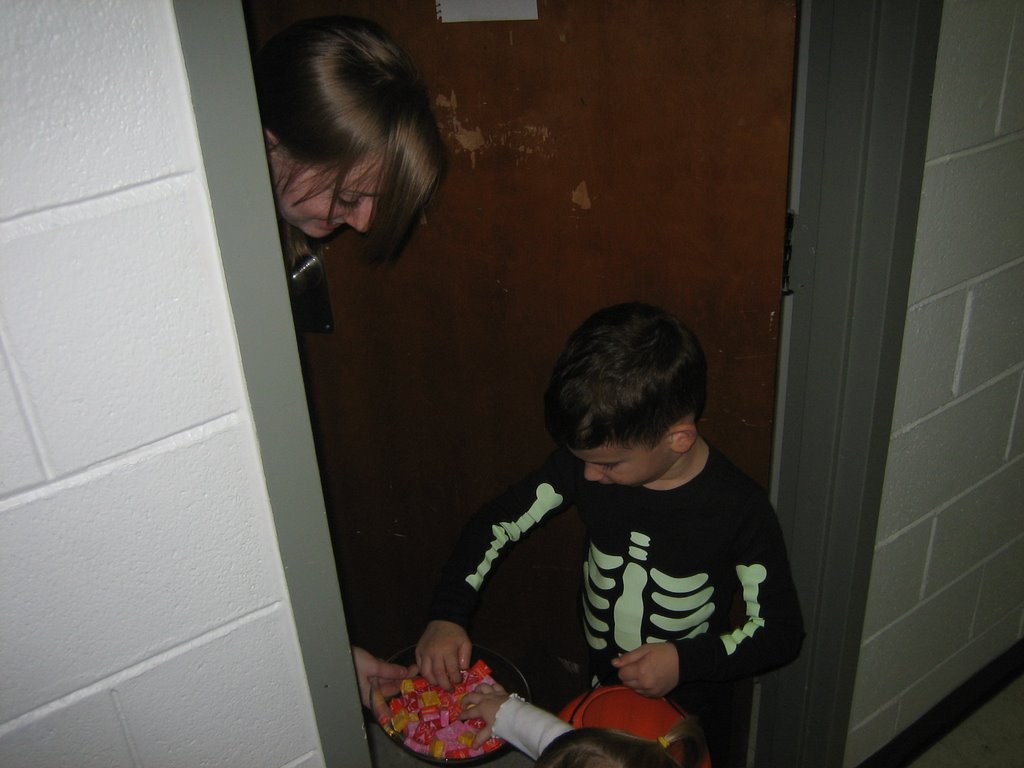
Thanks to all the students at Sanford Hall (a UNC Charlotte dorm) for the very cool Halloween set up. Every year, students in a number of dorms host trick or treating for children, so last night the kids went around various floors, knocking on doors and getting an enormous amount of candy.

Read more...

How do we evaluate border arrests?

The Border Patrol announced that the number of arrests made on the U.S.-Mexico border is down 8% from last year, citing better enforcement. Incidentally, this was reported now—one week before the election—instead of January, which is when it is normally released.

Analyzing the number of arrests is tricky, and in general it’s a pretty blunt instrument. For example, the number of arrests may be down since last year, but it is still up from 2003. In addition, as the article itself notes, yearly arrests are like a roller coaster, going up and down in ways that are not necessarily predictable, or that may be responding to short-term shocks (like 9/11).

In addition, arrests overall mask what is happening in specific border areas. Earlier in 2006, there were reports that arrests were increasing in New Mexico as well as in San Diego. What is particularly striking is that these increases are attributed to more enforcement in Arizona, and widespread reports of people dying in the Arizona desert. However, the original increase in Arizona and other more dangerous areas had been attributed to better enforcement in California in the past (on this, see Massey et al.).

In short, immigrants often respond to short-term stimuli, but clearly the enforcement in California has not deterred anyone from crossing there. Maybe this current dip in arrests is due to more workplace enforcement and the use of the National Guard, but the truth is that we really have almost no idea, and we also can’t predict how the numbers will change in the near future.

Read more...

Monday, October 30, 2006

Fidel is back (again)

I finally got around to checking out the new photos of Fidel, looking pretty fit and wearing a snazzy Adidas track suit. As he says, he’s just recuperating and doing nothing more than just trying to be “useful.”

Hago todo lo posible por apoyar a los compañeros, ser útil, y me siento satisfecho.

He would also like everyone to know that he is not, in fact, deceased.

Something that struck me about his new track suit is that “F. Castro” is stitched on the front. I can’t figure out why that’s necessary. Is there anyone—in Cuba or elsewhere—that doesn’t know who he is? Or maybe he’s had problems with Raúl taking his clothes, so Raúl gets his own with “R. Castro.”

Read more...

Sunday, October 29, 2006

A novel by Subcomandante Marcos

Via Marc Cooper: Subcomandante Marcos has teamed up with a famous Mexican mystery writer (Paco Ignacio Taibo II) on a new crime fiction novel entitled, The Uncomfortable Dead. Writing popular fiction doesn't seem particularly revolutionary, but the idea is to provide a glimpse into the Zapatista's key issues. From Amazon:

Taibo's striking collaboration with the charismatic leftist leader known as Subcomandante Marcos is a curious animal, laying forth planks in the Zapatistas' platform for the rights of indigenous peoples against globalization and privatization with subversive, comic panache.

Read more...

Voting machines and Chávez

This story in the NYT is just too bizarre. The company that makes voting machines for 17 states and DC has been taken over by a Venezuelan firm. Now the U.S. is trying to figure out whether it has any ties to the Venezuelan government.

So would the machines be rigged to vote for Noam Chomsky?

Read more...

Saturday, October 28, 2006

Count Fidel

Hugo Chávez reports that Fidel Castro is doing better, and is up and around. But the way he did so immediately made me wonder whether Castro has turned into a vampire, touring the countryside, but only at night. Now that would be a great rumor.

Venezuela President Hugo Chavez said Friday that Cuban leader Fidel Castro is up and about again, taking trips at night into the countryside as he recovers from surgery.

"He is walking around already and goes out at night to tour the countryside, towns and cities. I'm soon going to go see you, Fidel," Chavez said during a speech to cacao producers in Venezuela Friday.

Read more...

Friday, October 27, 2006

Getting that UN Security Council seat

Via Ideas al Vuelo. There is nothing new regarding the Venezuela-Guatemala hubbub, but a recent article in Journal of Political Economy shows how the U.S. makes sure that countries on the UN Security Council get more money. That money increases when the country’s vote is especially valuable.

Read more...

Goodbye Bruce Bochy

Via Ducksnorts: The San Jose Mercury News reports that Bruce Bochy has signed with the Giants. ESPN says he has agreed "in principle." This is painful. You just go back to the late 1980s and early 1990s to see the shuffle of managers and horrible records (including 101 losses in 1993). Bochy has consistently won with minimal talent for years now. He often takes heat for on the field decisions (who to pinch hit, whether to keep a pitcher in, etc.) but I think he gets the most out of his players. He was longtime Padre, spending the last 24 years with the team, including the big 1984 season, which is when I first really paid attention to him. Over the years I've become a big fan.

And he's going to the Giants. The only team I like less than the Giants is the Dodgers. (I wonder how he'll deal with Bonds).

Adios, Boch, and unfortunately I have to say that I hope you lose many games.

Read more...

Thursday, October 26, 2006

And the beat goes on

Negotiations today seem not to have yielded any consensus candidate for the UN. Both Venezuela and Guatemala are officially willing to withdraw, but for whom? After the Bolivia candidacy was clearly going nowhere, Venezuela offered up the Dominican Republic, but just as with Bolivia, it wasn't really discussed:

In Washington, the president of the Dominican Republic, Leonel Fernandez, said Maduro had offered to propose his nation as an alternate candidate for the seat. But diplomats said this did not arise at the talks.

If this is true, then Venezuela's suggestions have now been shot down twice, from some combination of resistance to Chávez and the U.S. twisting arms.

Now there is a five day pause, and if by Tuesday there is no new candidate, then voting resumes.

Read more...

Up to 41 rounds

We’re up to 41 rounds, and the AP report and others on the voting don’t mention how in the last round, both the Dominican Republic and Chile received votes (from themselves?). It looks like no voting is scheduled for today.

According to Ecuador’s UN Ambassador (who chairs the Latin America and Caribbean group):

He held talks with the Guatemalan and Venezuelan ambassadors "in a very good atmosphere," and he said negotiations will continue Thursday with the foreign ministers of both countries.

"My expectation is that we are going to have - perhaps not tomorrow because these are very difficult things - but that we are going to have an agreement," Cordovez said.

I think John Bolton is loving this. Venezuela won’t get the seat, Guatemala has already said it won’t accept Bolivia, which is Chávez’s second choice, and UN ambassadors (including Latin Americans) are getting annoyed at all the time this is taking. Since Venezuela has the fewest votes yet refuses to back down, it will get most of the blame for every day that a solution is not reached.

One solution that hasn’t been mentioned is to allow each country to take the seat for a year. Apparently that happened in 1960, when Poland and Turkey deadlocked for 52 rounds before reaching that compromise. At 41 rounds, this is now the third longest in UN history.

Read more...

Wednesday, October 25, 2006

The end in sight

Another day of deadlock at the UN, where at least they waited until the afternoon to vote, thus wasting much less time. Current count is 36 rounds, with barely changing results (the last was 109-72).

But Venezuela and Guatemala have both agreed in principle to withdraw, and will meet tomorrow to find another country to support. I still figure Costa Rica is the most likely choice, with Uruguay second. It's hard to imagine the Bolivian bid going anywhere.

Read more...

Will Venezuela withdraw?

More signs of Venezuela’s willingness to withdraw—its ambassador says the country is “exploring ways out.” Also see Ka’s discussion in comments to a previous post, where the Venezuelan government expressed the need for some vague conditions before it would withdraw, like having “dialogue” (conversaciones).

I had lost track, but there have been 35 rounds, and the UN is scheduled to begin again today. I get the impression that Chávez really wants out now, as the current situation works against him. Meanwhile, Evo Morales says it could be a candidate in place of Venezuela, but I would have to think that is a nonstarter.

The article quotes some Latin Americanists about the effect of this entire saga, and I must say I disagree with them. Similar to statements by President Chávez, the gist is that simply blocking the U.S. choice is a victory.

“This is like a boxing match. You have a heavyweight in the form of the U.S., you have a junior weight in the form of Venezuela, and the fact that Venezuela has lasted this long speaks tremendously to the kind of influence that they were able to generate,” said Miguel Tinker Salas, a Latin American studies professor at Pomona College in Claremont, Calif.

And

“I think Chavez has achieved a lot to put Venezuela in a position of significant global leadership,” said Dan Hellinger, a political scientist at Webster University in St. Louis.

I don’t think these arguments work well. Chávez’s goal was to win, not simply to block the U.S. choice, and he spent a considerable amount of money to do so. His speech to the UN clearly hurt him, and I just don’t see that all this adds up to “significant global leadership.” With the secret vote, each government was able to vote its conscience, but did not flock to him. With anti-U.S. sentiment so strong right now, and with President Bush so incredibly unpopular abroad, for Chávez this represents a failure to establish himself as the voice of less developed countries.

Read more...

Tuesday, October 24, 2006

The latest U.S.-Latin America conspiracy theory

The latest, and strangest, rumor flying around is that President Bush has bought a very large plot of land in Paraguay. Just google "bush paraguay" and see for yourself. Adam Isacson has a list of all the recent U.S.-Paraguay connections, including a recent visit by Jenna Bush.

The rumor was picked and really spread by Prensa Latina, which is Cuban and therefore highly biased (as is anything about Cuba coming from the U.S. government). It credits an Argentine online publication, Misiones On Line, for the original story. The spread of bizarre information via the internet is really interesting:

Las informaciones sobre el tema son escuetas dado que ninguna fuente oficial quiso confirmarla, empero, una fuente oficiosa confirmó a NEIKE que efectivamente el jefe de Estado norteamericano compró las tierras y su hija Jenna recorrerá el campo durante la visita que está realizando a Paraguay desde el pasado fin de semana.

The conspiracy theorists are having a field day with this one. Maybe he is planning to flee the U.S. because otherwise he'll tried for war crimes (as if Paraguay would protect him better than the United States?). Maybe it is a plan to invade Bolivia. Maybe the U.S. has run out of space in New Mexico to communicate with aliens, and so is looking elsewhere? (OK, I just made that one up, but I like it).

Read more...

Illegal immigrants in each district

Via ImmigrationProf Blog: A new study estimating the number of illegal immigrants per congressional district. Its key findings:

In 2005, undocumented immigrants accounted for about 10 percent or more of the total population in only 27 (or roughly 6 percent) of the 435 congressional districts.

Conversely, undocumented immigrants comprised about 5 percent or less of the population in more than half (or 232) of all congressional districts in 2005.

Between 2000 and 2005, the undocumented population of 107 districts doubled, although most of these districts had relatively few undocumented immigrants to begin with.

More strikingly, 39 districts experienced either a decline or no change in their undocumented population between 2000 and 2005. Many of these districts had been major destinations for new arrivals in the past, but are becoming less so as immigrants move to other parts of the country.

There’s not much analysis, but it’s interesting nonetheless. Even though there may be only 27 districts where illegal immigrants comprise 10% of more of the population, there are many where the percentage growth has been quite high.

I see that in my own district, illegal immigrants are 3.6% of the total population, and the total number has doubled since 2000. My representative is Sue Myrick, a Republican who is running almost entirely on this issue. Unfortunately, she is also considered a shoo-in to win handily over Bill Glass.

Read more...

Monday, October 23, 2006

Venezuela: saving face

When you're losing politically, sometimes the best strategy is to declare victory and move on. Hugo Chávez is showing some signs of this, by asserting that the UN vote really showed the United States a thing or two.

"We have taught the empire a lesson," Chavez told thousands of supporters in Valencia, an industrial city about 65 miles west of Caracas. Even if "Venezuela isn't able to enter the Security Council, we've done damage to the empire. That was our objective."

To my knowledge, this is the first time he's discussed possibly losing. Voting is scheduled to resume on Wed., so it is entirely possible we'll have a new candidate by then. Chávez stands to lose more than Guatemala if the voting goes on and on.

Read more...

Sunday, October 22, 2006

Fainaru and Sánchez's The Duke of Havana

I just read The Duke of Havana: Baseball, Cuba, and the Search for the American Dream, by Steve Fainaru and Ray Sánchez. I enjoyed it immensely, and would highly recommend it for anyone interested in baseball and Cuba. It's now on my sidebar list.

It tells the story of Orlando “El Duque” Hernández, who defected from Cuba in late 1997, and who was a huge baseball star there. His brother, Liván, had defected the previous year, which created a stampede mentality as Cuba players sought to get out and sign huge deals with major league teams in the U.S. An almost hyperactive would-be agent followed the Cuban teams all over the place, trying to convince players to defect.

Ultimately, the Cuban government banished El Duque from all official levels of play, saying his association with such people (and with his brother) made him a bad example for revolutionary baseball—he was forced to play sandlot games. It was this that sparked the chain of events that would eventually bring him to the New York Yankees and the 1998 World Series (unfortunately, against the Padres). It’s a remarkable story.

Throughout, the book is highly critical of Cuban politics, especially the combination of total power and arbitrariness. With no explanation, your livelihood is taken away. Once you are labeled as a counter-revolutionary, then you are largely shunned and you have to struggle even harder to make ends meet. At the same time, however, it also highlights the shaky promise of major league baseball, and capitalism in general. Once spirited out of Cuba, the players would try out (Costa Rica was a popular destination—the players needed to establish residency in another country in order to be free agents). If they didn’t cut the mustard, then they were tossed aside, to the vagaries of a capitalist system they did not understand. If they weren’t good enough, then immediately no one cared whether they starved or not.

El Duque himself admitted that he did not defect because of dissatisfaction with life in Cuba—in fact, everyone discusses being poor, but this does not lead to a desire to leave their homes and families. El Duque’s family was very ambivalent about following him to the U.S. Instead, he left because he had been banned from baseball—if the Cuban government hadn’t gone that far, he might have stayed. The book ends with a discussion between several Cuban émigrés, and some of them wondered whether they would’ve been better off in Cuba.

Read more...

Venezuela: Hub of Terrorism?

My student Alejandro sent me an interesting story from El Tiempo, which discussed a new report from the Committee on Homeland Security in the U.S. House of Representatives to the effect that Venezuela is a terrorist threat because it is funneling terrorists up through the U.S.-Mexico border.

No matter what you think of Venezuela, I think we can all agree that if you make an allegation of that magnitude, then you need to provide some serious evidence. Or, well, maybe not. The burden of proof these days seems pretty minimal.

Here is the full text of the report, which argues, “[A]ccording to senior U.S. military and intelligence officials, Venezuela is emerging as a potential hub of terrorism in the Western Hemisphere, providing assistance to Islamic radicals from the Middle East and other terrorists.” Venezuela has reportedly provided government IDs “to people who should not be getting them.”

What are the sources for these particular accusations, and the general idea that Venezuela is becoming a terrorist state?

--a 2003 article in U.S. News and World Report
--a 2003 article in the Financial Times
--a 2006 article in the Washington Times
--one anonymous interview

And that’s it.

In July, the State Department announced that Venezuela was “not cooperating fully” in the “war on terror,” and coined the “terrorist hub” phrase. It is based mostly on Chávez’s relationship with Iran, and that he questioned the validity of the UN resolutions on counterterrorism.

Cozying up to Iran, blundering around the UN, talking about pursuing a relationship with North Korea, are all examples of how Chávez seems inept and politically tone deaf (both domestically and internationally) with regard to foreign policy. But it is a very big leap to take that to the level of terrorist state.

Read more...

Thursday, October 19, 2006

Baseball and UNC Charlotte

We are not known as a baseball powerhouse, but Mets pitcher John Maine was a star here just a few years ago. What I didn't know is that one of the NLCS umpires, Field Culbreth, also played baseball here and graduated in 1986.

Even ESPN radio announcer Dave Campbell joked about it on a recent flight from New York to St. Louis, at one point asking Culbreth if there was a "little conflict of interest."

"Are you kidding?," Culbreth said. "When I was at UNC Charlotte, he wasn't even born yet."

Read more...

More on Venezuela

Andres Oppenheimer asks whether Hugo Chávez has peaked, a question everyone is asking. There is one point in particular that I find compelling—whether Chávez can recover depends in part on the Bush administration. Will it try to beat him when he’s down, and thus snatch defeat from the jaws of victory? A juicy comparison to Hitler to give him a little boost?

[I must say I find his argument about Castro dying and Cuba becoming a quasi Venezuelan protectorate to be totally uncompelling and alarmist].

Meanwhile, later this morning the UN voting will begin yet again, as Venezuela adamantly refused to withdraw. Not a fun time to be a UN delegate.

Read more...

Wednesday, October 18, 2006

No voting today

There won't be any voting today, in an effort to give Latin American delegates time to figure out a solution to the impasse. Venezuela says it would withdraw if the U.S. stopped pressuring countries to vote for Guatemala, but it is unclear how that would work in practice. The Guatemalan Foreign Minister said that Venezuela should withdraw because it is so far behind, but opened the door to both countries stepping back:

"We believe that the General Assembly should not be held hostage to the position of one country," Rosenthal said. "So there are limits of how far we're gong to try to carry this out, although I have to say that it isn't us that is holding the General Assembly hostage."

I think the further Venezuela pushes this, the more Chávez's image suffers.

Read more...

Tuesday, October 17, 2006

Round 22 in the UN

After 22 rounds not much has changed. In number 22, it was Guatemala 102, Venezuela 77, and a whopping 12 abstentions (perhaps out of sheer exhaustion?). This is possibly just like AMLO's protest, where a principled stand has been taken (i.e. seeking the UN seat to counter U.S. hegemony) and so an exit strategy must allow for a save of face.

Clearly, neither country will win, and both know that.

Read more...

Vote for Weeks


Vote for my Mom. The only caveat is that you have to live in the east county of San Diego.

Read more...

UN voting resumes

Round 11: Guatemala 107, Venezuela 76, and 8 abstentions. Incidentally, all this can be viewed live at the UN website. They are now moving directly to a new round.

(Update at 1:30 p.m.) Round 14: 108 to 76. From Reuters:

Latin American nations were trying to convene a meeting later in the day in an effort to break the impasse but Venezuela was resisting a withdrawal of its nomination, diplomats said.

Hugo Chávez has to be seriously annoyed. Venezuela drew even at one point yesterday, but now the vote totals are barely changing.

(Update at 2:30 p.m.) Round 16: 108 to 76. Same thing.

I'd put Costa Rica as the front runner for the consensus candidate. South America is already represented by Peru, so there would be regional balance. In addition, Costa Rica is viewed as politically independent from the United States.

Read more...

Can AMLO pull a Nixon?

This may be it for AMLO. He lost the election, lost support for the Mexico City protests, and now his favored candidate (for whom he campaigned) lost the governor's race in his home state, Tabasco. With 96% of the vote counted, he was 10 points down.

Óscar Luis Rodríguez, a longtime member of Mr. López Obrador’s party in Tabasco, put it more bluntly. “Andrés Manuel has lost credibility,” he told the daily newspaper El Sol. “He has lost respect. Here Andrés Manuel was born, and here he has been buried.”

There is also a good quote from Ricardo’s blog:

“Andrés Manuel López Obrador es como los elefantes. Se vino a morir a su tierra"

"Andrés Manuel López Obrador is like the elephants, he came to die on his own land"

Fernando Moreno Peña, from the PRI, as quoted by El Universal


At the very least, he’ll have to pull off a Nixon. After losing the presidential and then the CA gubernatorial elections, he famously told the press, “You won’t have Dick Nixon to kick around anymore.” And he was elected president six years later.

Read more...

Monday, October 16, 2006

UN vote update

From MSNBC: Guatemala received 109 votes, 15 short of the necessary 2/3. Venezuela received 76, which is certainly less than it had been claiming. So there will be a second round.

Updating the update: In two subsequent rounds, Guatemala received 114 and then 116, while Venezuela went from 74 to 70.

Round 4: Guatemala 110, Venezuela 75. So the votes are not continuing to move in Guatemala's direction anymore.

Round 7: Now moving in Venezuela's direction. Guatemala 93, Venezuela 93, Mexico 1.

Round 10: Guatemala 110, Venezuela 77, 4 abstentions. Back to round 4 numbers!

Read more...

UN vote

Today is the UN General Assembly's vote on the nonpermanent members of the Security Council. The vote begins at 10 am. Chile officially announced its intention to abstain, adding it to Peru and perhaps others as countries that don't want to be in the middle of a U.S.-Venezuela dispute.

There is little chance that either Venezuela or Guatemala will receive the necessary 2/3, though I will be very interested to see how many each gets. I'm sure Venezuela will require multiple rounds of voting before it would contemplate stepping aside for a new consensus candidate.

We just have to wait and see.

Read more...

Sunday, October 15, 2006

Baseball and comedy

Via Knuckle Curve: very funny segment from Conan O'Brien as he goes to the reenactment of a Civil War-era baseball game.

Read more...

Saturday, October 14, 2006

Tasting Coca Sek

About 10 months after I wrote about it, I get tons of hits on my post about Coca Sek, the Colombian drink made from coca leaves. Now, finally, news from someone who has tried it--Adam Isacson at Plan Colombia and Beyond.

How to describe the taste? If you grew up in a temperate climate, did you ever jump into a pile of newly raked autumn leaves, only to get a bunch of dead, dried leaves in your mouth? The taste is sort of reminiscent of that, only with lots of added sugar.

Obviously, you would need a better ad campaign than that. So why would anyone drink it?

Not only did it keep me awake, it also made it a bit easier to string words together in Spanish.
If given a drug test, however, right now I would produce a big, huge "positive."


So don't start looking on the shelves of your local mini-mart or in campus vending machines just yet...

Read more...

Paul Blustein's And the Money Kept Rolling In (and Out)

I read Paul Blustein’s And the Money Kept Rolling in (and Out) which is about the Argentine economic collapse. A former student, John Hyatt, had really liked it and I thought I would take a look. I enjoyed it, and it’s a quick read, a good way to get an overview of the Argentine implosion.

The book was billed as a critique of the IMF and, to a lesser extent, the Bush administration for the failure to address the situation adequately. Normally, such critiques center on the IMF’s penchant for forcing structural adjustment policies on developing countries. Blustein actually goes the opposite direction, and argues that the IMF should have pulled the plug on loans much earlier than it did, and should have been more insistent that Argentine policy makers abandon the dollar peg (aka “convertibility”) whereby one peso was worth exactly one dollar, and the government guaranteed that anyone with pesos could convert them to dollars at any time.

This conclusion left me a bit unsatisfied. The IMF has been justly criticized for its disastrous policies of the 1980s, when it paid too much attention to economic orthodoxy and almost none to the human cost associated with it. The fact that it granted several emergency loans to Argentina as a way to help Argentine policy makers fix their own problem doesn’t seem quite as sinful to me as he portrays. Obviously, things went very, very wrong, but even Blustein admits that many in the IMF simply wanted to make sure that whatever happened, the decision would be Argentina’s.

Read more...

Friday, October 13, 2006

Hugo Chávez on love

You can always count on Hugo Chávez to come up with something new. Now he is the Barry White of Latin America, doing it all for love. He just wants a big national hug.

Newspaper ads by President Hugo Chávez's campaign include a solemn ''message of love'' for the Venezuelan people that reads: ``I have always done everything for love.''

And

In a speech on Thursday, Chávez reiterated that his political movement is about love. ''That love, what it has done is grow all these years,'' he said.

And

''There is still much to do. I need more time. I need your vote. Your vote for love,'' the Chávez ad concludes.

All these years in Political Science, we've focused on issues like power, ideology, institutions, etc. It never occurred to us that it's all just about love.

Read more...

Venezuelan oil

Apropos our discussion in class on Venezuela, my student Sara asked me about Venezuelan oil. This got me thinking—way back in February, Hugo Chávez threatened to cut off oil exports to the U.S. Although he’s been talking oil deals with China and Iran, he hasn’t said any more about that, or at least not that I’ve seen. There was much talk about reducing our dependence on Venezuelan oil, but I wonder whether that has indeed happened. I'd even wager that the same people who decry Chávez's speech to the UN then unknowingly pull into Citgo and fill 'er up.

Read more...

Thursday, October 12, 2006

The embargo

Yesterday in my Latin American Politics class, my student Michael asked about the tightening of sanctions against Cuba, and I had to admit I hadn’t seen the news. The government has created a new task force to crack down more on violations of sanctions, such as traveling to Cuba. What an utter and complete waste.

Acosta acknowledged that the agencies already work together on embargo enforcement. He said it was "an appropriate time to make it clear to the community that we seek to enforce this law aggressively."

The “appropriate time" seems to be when Republicans fear the upcoming election results, and want to be sure they shore up the anti-Castro Cuban American vote.

The rules, Acosta said, are meant to speed up a transition to democracy in Cuba.

I see. Does it matter that such rules have not achieved that goal now in over 40 years? I would love to hear precisely how the embargo will ever do anything except hurt Cubans and bolster Castro.

Read more...

Wednesday, October 11, 2006

The UN vote

From the Miami Herald: another discussion of the UN race. Even more useful than the article is a link to a Security Council document, which is worth a look if you want to know how the voting works. Combined, the article and link yield the following:

--the voting is secret. I had been reading that in the media, but never with a specific reference. It is rule 92 of the Rules of Procedure of the General Assembly.

--“informal” count puts Venezuela at 100 votes and Guatemala at 90. Last month, Guatemala claimed to have 110. These counts seem pretty meaningless, especially given the secret vote.

--Peru plans to abstain. In June, President García had said he could vote for Venezuela. He is currently in DC, however, and may be finding that the ire of the United States is not worth it at the moment, as he tries to get a free trade agreement set.

--this could take months. I had the image of delegates staying up until all hours, vote after vote, like the Vatican. I hadn’t known that the 1979 case, where Cuba and Colombia were deadlocked, and Mexico entered as a compromise choice, lasted over three months.

--consensus possibilities being floated are Costa Rica, Dominican Republic, Uruguay, and Panama.

Read more...

Tuesday, October 10, 2006

The border fence

The Washington Post has a very interesting article about building a border fence. In particular, the small amount of fence that was built in San Diego had massive cost overruns and environmental disputes, and never even was completed. Further:

The fence in San Diego forced illegal traffic into the deserts to the east, leading thousands of migrants to their death. In response, the Border Patrol shifted thousands of agents to Arizona to deal with the flow. But many of those agents came from the San Diego and El Centro sectors. So once again, the number of crossers in San Diego and El Centro is increasing even though the two sectors are the most heavily fenced in the nation.

Skeptics include the head of the Border Patrol’s union, the Marine Corps, the Texas Border Sheriff’s Association, the City of El Paso, and many native Americans. As one sheriff in Texas put it:

"A few years ago, they installed cameras and said the cameras would solve things," he said. "Those cameras can pick up a tick on a cow's back. But when half the monitors are all busted like they are now, they don't work."

His prediction for how illegal immigrants would deal with the wall: "They will get ladders made out of mesquite and climb it."


What a policy success. Let's put something in place that even law enforcement thinks is a bad idea.

Read more...

Monday, October 09, 2006

Columbus Day

There is no class today or tomorrow because of “Fall Break” here at UNC Charlotte. This coincides with Columbus Day, though I do not know if that coincidence is coincidental, so to speak, or not. I’ve worked all day and have been very productive, so the day off has been great.

At the same time, I much prefer thinking I got the time off to celebrate autumn rather than Columbus. When you really get down to it, there isn’t much to applaud. He had no idea where he was going, misnamed the people he found, happily brought some back as slaves, and was usually vicious when in charge of others. As is quite obvious, he didn’t discover anything. Check out Charles Mann’s book 1491 for an analysis of how complex native civilizations were.

This is one of those holidays that should be phased out or just renamed.

Read more...

One word to describe the Padres' NLDS experience

Embarrassing.

Or maybe "Pujols."

Read more...

Sunday, October 08, 2006

Who's a terrorist?

Especially in my Intro to Comparative Politics class, we spend some time trying to figure out what “terrorist” means. The NYT has a good profile of Luis Posada Carriles, who is implicated in the 1976 bombing of a Cuban plane, in addition to a wide variety of other violent activities. Is bombing an airliner terrorist? Most people would probably agree that it is, yet the U.S. government (not only the Bush administration, but previous governments as well) does not want to call Posada a terrorist, because he was attacking a country we had labeled an enemy.

The sister of one of the victims sums it up:

“It feels like a double standard,” Ms. Nenninger, who was born in Guyana but has since become an American citizen, said in a telephone interview from New York. “He should be treated like bin Laden. If this were a plane full of Americans, it would have been a different story.”

Also, the National Security Archive has some declassified documents about the case. It's very sordid.

Read more...

Saturday, October 07, 2006

Venezuela's arms purchases

A student of mine, Alejandro, asked me about all the recent Venezuelan arms acquisitions. In particular, he wanted to know whether there was a threat that they could eventually get into the hands of groups in neighboring countries, especially in Colombia. I think the answer is yes.

I blogged about the big Venezuelan purchase of Russian guns and helicopters in July. In the meantime, the U.S. has charged that other Latin American countries are becoming concerned about the arms build-up. Hugo Chávez rejected that idea, calling on Colombian president Uribe to say something if he had such a concern. Despite sometimes open tension between the two, Uribe simply said that Colombia had good relations with Venezuela, wisely choosing not to stick himself in between the U.S. and Venezuela (earning Chávez’s thanks in the process).

Any country will be concerned if a neighbor buys large amounts of weapons and even discusses opening a factory to manufacture more. In terms of regional harmony, there is nothing to good to say about arms purchases. Really, there is almost nothing good to say about arms purchases in general, especially in Latin America where external threats are few and far between.

The main question is why Chávez is buying them. I don’t think he has territorial conquest in mind, and although his government has repressive tendencies, I don’t think he is amassing weapons to use against his own people. He does want to be viewed as a regional and global leader, so a beefed up military may contribute to that (he hoped to be at the forefront of a regional force).

But I’d be willing to bet that to some degree (how much is difficult to tell) he is genuinely concerned about the U.S. attempting to overthrow him, and also wants to play that up to garner more popular sympathy. The Bush administration has done just enough to give that very impression, which then feeds right into Chávez’s paranoia. If the U.S. were friendly, would Chávez buy those arms anyway? There is, of course, no way of knowing, but I do think our short-sighted foreign policy is contributing.

Read more...

Friday, October 06, 2006

Immigration in Charlotte

I was one of several people to give a talk last night at the Levine Museum of the New South downtown about immigration to Charlotte. I was disappointed to see no press coverage in the Charlotte Observer, because the program really focused on breaking stereotypes (there was Spanish language press there, so hopefully it gets some attention in the Latino community). In fact, one of the audience members asked how we can get this sort of information out to the general public, when all we hear about is the negative side. I could only answer that we keep doing events, writing newspaper articles, going on radio, etc. until it begins to sink in.

The evening ended with the personal stories of three immigrants who had come to Alan Gordon (the moderator and head of the mayor’s immigration commission, who is also an immigration lawyer) for help. They were from Democratic Republic of Congo, Bosnia, and El Salvador. Everyone was riveted with their stories, which included death threats, relatives being killed, and illegal crossing over the U.S.-Mexico border (all are now U.S. citizens).

What I found so poignant was the fact that all three professed great love of the United States and pride in being a citizen. The pride, however, was based not on stomping on other countries, being the strongest, or other sources of “patriotism” that unfortunately we see so much, but rather it was far more simple. The pride came from a deep love of opportunity, liberty, and hope. Sometimes talking about such values seems trite, but coming from recent immigrants it was really powerful. It made me wish more native U.S. citizens could understand patriotism in those terms rather than as a projection of U.S. power abroad.

Instead, we get people like a Republican developer in South Carolina who is running for Congress, using illegal immigration as his key issue. It’s now reported that he works as hard as other developers to get as many illegal immigrant workers as possible, by not forcing his contractors to verify the status of their workers. Sometimes the hypocrisy is tough to stomach.

Read more...

Thursday, October 05, 2006

Immigration law

President Bush signed the Homeland Security bill, which includes the border fence. The Mexican government (both outgoing Fox and incoming Calderón) have been highly critical, and Fox’s spokesman even correctly pointed out the fact that the bill doesn’t include sufficient funds to build it.

I’m giving a talk on immigration at the Levine Museum of the New South tonight for the start of a new exhibit on Latino immigrants. Another speaker will be Alan Gordon, head of the mayor’s Immigration Study Commission. The bill just signed is a perfect example of how the federal government has totally abdicated responsibility, leaving local leaders to scramble as they figure out how to deal with illegal immigration, which the current system (regardless of enforcement measures) actively encourages.

In that same bill there is $20 million to celebrate success in Iraq and Afghanistan, with national festivities. I suppose if you’re earmarking money for a celebration that won’t happen, you might as well include a fence that won’t work.

Read more...

Wednesday, October 04, 2006

Rumsfeld in Nicaragua

Amazingly, Donald Rumsfeld went to Nicaragua yet managed not to say anything either about Daniel Ortega or Hugo Chávez (with the exception of being critical of arms purchases). Chávez was clearly hoping to bait him, with public declarations that Rumsfeld was a “dog of war,” “little dog,” or “Mr. Dog.”

I have never been referred to as “Mr. Dog,” but I have to say my first reaction would be to laugh rather than to feel insulted. Maybe it’s just me.

Let’s see if this policy of silence holds out—for the most part, members of the Bush administration blurt something out every week or so. Chávez loves it when U.S. officials call him names, and plays it up for weeks, spending time to come up with his own nicknames in response. I have not heard Ortega talk about the U.S., but if someone likes Rumsfeld talks about him, you can bet he will use it to his advantage.

Read more...

Tuesday, October 03, 2006

Nicaragua canal

At the meeting of defense ministers in Managua, Nicaraguan President Bolanos pitched the idea of a Nicaraguan canal, which would cost $18 billion. It’s hard to see this happening, but it immediately called to mind the era when Nicaragua almost became the canal site. I talk about this in my U.S.-Latin American relations class, especially since you can draw lines from those events to the Sandinista government of the 1980s.

At the turn of the last century, the U.S. government was trying to decide on a canal site, and was taking a good look at Nicaragua. In 1901, under the guidance of a government appointed commission, the U.S. purchased exclusive rights to build (for $5 million). A French company in Panama wanted to sell its rights, so lobbied hard to switch that recommendation to Panama (surely greasing the wheels as they did).

More problematic was that the Nicaraguan president, José Santos Zelaya, resisted U.S. demands for things like full judicial control over the canal zone. Ultimately, Theodore Roosevelt was set on Panama. The U.S. would not forget Zelaya’s intransigence, and were further angered when he arrested and executed two U.S. citizens plotting against his government. Through pressure from the U.S., Zelaya was forced out of office, and soon U.S. marines would arrive to occupy the country off and on until 1933, at which time they would help install Somoza as head of the National Guard. Those marines were also the source of nationalist resentment, the symbol of which was Augusto Sandino, whose name would be used by the guerrillas who would overthrow the younger Somoza in 1979.

Read more...

Monday, October 02, 2006

Winning the division

Yesterday the Padres won ugly (with Trevor almost blowing it) but ugly or not, we won the division. In fact, over the past ten years the Padres have won the division more times (four) than any other team.

We’re playing the Cardinals at home, starting tomorrow. Fortunately our home record improved a lot over the past few months, after a horrible start. This is a rematch, as last year the Cardinals swept us. This year, however, everything is up for grabs. The Cardinals have been falling apart, the Mets have not looked good and lost Pedro Martinez, and we’ve dominated the Dodgers. Meanwhile, the Padres are playing pretty well and have no major injuries.

Read more...

Sunday, October 01, 2006

Change in ICC policy

I find very little to feel good about in the recently passed defense bill. One small provision, however, does mark a change in U.S. policy toward Latin America. The U.S. will no longer punish countries that don’t sign waivers for the International Criminal Court by denying them military training. I’ve blogged about this before. Apparently there are still some punishments in place, such as denying financing for defense purposes and some USAID programs. It remains to be seen whether Latin American leaders resent those measures as much.

This does not mean I feel great about U.S. military training. In fact, a few years ago I published an article critical of it. But this policy was worse, because democratically elected Latin American leaders viewed it (correctly) as blackmail. As such, it was a prime example of clueless policy making that created unnecessary tension. This particular policy was especially ridiculous because the U.S. military (specifically Southcom) opposed it, even though it was intended to protect soldiers.

Read more...

  © Blogger templates The Professional Template by Ourblogtemplates.com 2008

Back to TOP