Monday, March 04, 2013

Latin American Political Scientists

Flavia Freidenberg and Andrés Malamud, "Politólogos on the Run: Contrasting Paths to Internationalization of Southern Cone Political Scientists." Latin American Politics & Society 55, 1 (Spring 2013): 1-21.

Abstract (full text is gated).


Political scientists from the Southern Cone have enriched the discipline with pioneering work. Many of them went into exile for political reasons, and thus produced part of their work abroad. Although Latin American political science has professionalized since the 1980s, many scholars still emigrate for study and employment. Argentines most numerously seek academic careers abroad, while Brazil has many more domestic doctorates and returns home after doctoral studies abroad. Uruguayans emigrate in proportionally high numbers and tend to settle in Latin American countries, while the number of Chileans and Paraguayans abroad is minimal. These contrasting patterns are explained by reference to factors such as the availability of high-quality doctoral courses, financing for postgraduate studies, and the absorptive capacity of national academic markets. Paradoxically, the size and performance of the diasporas may increase rather than reduce the visibility and impact of national political science communities.


This is the sort of thing that deserves more attention, since political science (like many other disciplines) has long been dominated by the United States (and to a lesser extent Europe) but there is more and more cross-pollination. As the authors note, however, they chose their cases on the dependent variable--people who left--and so there is a lot left to explain. The vast majority of respondents are also Argentine, which leaves open the question about why people didn't leave other countries.

I think of the Chilean case, where there are plenty of well known political scientists who received their Ph.D. abroad and then returned to become professors at various universities in Chile.

Overall, this type of study can fruitfully connect to the broader question of how much higher education is valued in each country. To what degree do governments value "brain gain"?

Read more...

Sunday, March 03, 2013

Baseball Uh-Huh

Below is a sure sign of spring:


Forget that it snowed a bit in the morning. By afternoon we got to see UNC Charlotte beat Youngstown State. One of the local curiosities is a guy who paces the concourse, often with baseball mitt all ready for a foul ball, calling out to the field and ending every sentence with a loud "UH-HUH!" So if the opposing pitcher throws a ball in the dirt, it's "Dirtball! UH-HUH!" or if an opposing batter watches a strike, it's "That's called taking a strike, UH-HUH! UH-HUH!" He even has signs, 10 or so in different scripts, all of which say "Uh-Huh." Later in the game he put on a "Uh-Huh" shirt and cap.


We've seen him at Kannapolis Intimidators games too. It's just odd enough not to be annoying. He's obviously a very friendly guy, periodically chatting with people. I don't know whether he finishes every sentence with "Uh-Huh."

Update: Here's a video of the Uh-Huh guy from two years ago:


Read more...

Friday, March 01, 2013

More on Election Boycotts

I wrote a short piece at Foreign Policy on the ineffectiveness of election boycotts in Latin America. The basic idea is that they can very easily result in things you don't want.

Read more...

Wednesday, February 27, 2013

Boycotting Elections

The Egyptian opposition says it will boycott the upcoming parliamentary elections. This is so ripe for comparative analysis with Latin America, where similar boycotts have taken place in all kinds of contexts. At least anecdotally, my first thought is that the boycott will not have the effect the opposition wants, which is to delegitimize the regime. Instead, the most likely outcome is that the Islamists will consolidate their power and have more free rein to pass what they want.

In that regard, there are a lot of similarities to Venezuela in 2005, when the opposition pulled out of legislative elections based on similar dislike of the government and distrust of how the election would be handled. The result, though, was a huge win for Hugo Chávez. I also think of the Nicaraguan opposition boycotting the 1984 presidential election.

Read more...

Tuesday, February 26, 2013

Cuba and Terrorism

This is pretty much the definition of moving goal posts. José Cárdenas argues that Cuba is no longer supporting terrorism but that it should remain on the list of state sponsors of terrorism anyway. Oddly enough, he uses the example of North Korea to say that you must make a significant stride to get off the list. I am still puzzling over how to apply the North Korean case to Cuba.

Read more...

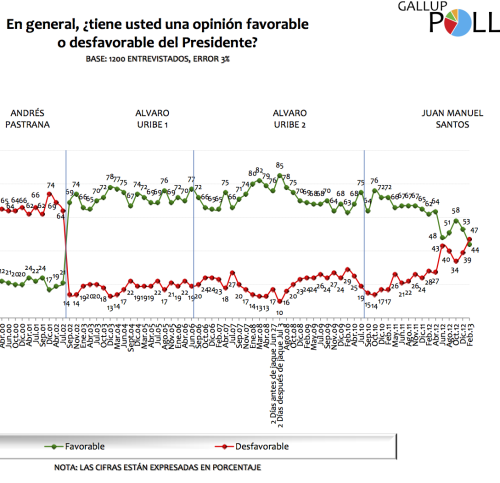
Santos Disapproval

I am stealing this image from Adam Isacson's blog.


Not so nice news for Juan Manuel Santos, clearly, though at least he's not in Andrés Pastrana-land quite yet. What's so unusual in this case is that Santos' most vocal opposition is actually to his right. Alvaro Uribe has kept up a relentless negative drumbeat on Twitter, arguing that Santos is soft on Hugo Chávez and stupid about the FARC. I can't recall any former president being so vocally derisive.

Read more...

Sunday, February 24, 2013

Pinochet's Defeat

Declassified documents reveal Augusto Pinochet didn't want to leave power, was pissed off about the results--because sycophants told him he would win--and was rebuffed, especially by the air force. I am trying to figure out why this is considered news, when it's been more or less the accepted sequence of events for quite a long time.

A key reason Pinochet could no longer cling to power was that he could not justify it to the rest of the junta, which by that time was thinking about a) international opinion and business climate; b) the end of the Latin American Cold War; and c) his megalomania.


Read more...

Wednesday, February 20, 2013

Getting tenure

Via an interview Mike Munger has some useful comments on getting tenure. I would add one thing:

Think about your external letters. Deans may not read and digest articles, but they can do so for letters. It is worth your while early on to start thinking about who would be good--or not good--to write you a letter. Typically this means someone who admires your work without being too close to you to constitute an obvious conflict of interest. Negative letters, or too much damning with faint praise, can easily derail a borderline case. Find out early on how much input you have in choosing the letter writers and vetoing those who you think might not be appropriate.

Read more...

Tuesday, February 19, 2013

Ecuador's Boring Election

I'm late to this, of course, because the election was on Sunday and the winner has been obvious for a long time. But after reading news reports of Rafael Correa's victory, I thought of one thing that doesn't get mentioned much--this was a boring election. After all, this is a country without much history of stable democratic rule, and Correa even faced a serious crisis in 2010. From the magic of Wikipedia, here are presidents in Ecuador for the last twenty years:

48Coat of arms of Ecuador.svgSixto Durán BallénAugust 10, 1992August 10, 1996President
49Abdalá Bucaram.jpgAbdalá BucaramAugust 10, 1996February 6, 1997President
-Coat of arms of Ecuador.svgRosalía ArteagaFebruary 6, 1997February 11, 1997Acting President
-Coat of arms of Ecuador.svgFabián AlarcónFebruary 11, 1997August 10, 1998Interim President
50JamilMahuad.jpgJamil MahuadAugust 10, 1998January 21, 2000President
51Coat of arms of Ecuador.svgGustavo NoboaJanuary 22, 2000January 15, 2003President
52Lucio Gutiérrez.jpgLucio GutiérrezJanuary 15, 2003April 20, 2005President
53Alfredo Palacio.jpgAlfredo PalacioApril 20, 2005January 14, 2007President
54Rafaelcorrea08122006.jpgRafael CorreaJanuary 15, 2007IncumbentPresident


That isn't pretty. It's Boz and Mike Allison have more skeptical views, and they're well taken, but look: this is a noteworthy state of affairs for a country that was in years of constant upheaval. Back in 2006 as the presidential election went to a second round, a Washington Post article ended with this:


Still, many Ecuadorans have had it with promises and politics. Vladimir Peña, 33, an accountant, said he would like wholesale change but sees most of the candidates as opportunistic populists. He invalidated his ballot. 
"We've had lots of populists here," he said. "And what happens is they last six months, and that's it."


A lot of people thought that was a distinct possibility, even probable. But over six years later, Correa won a boring election. I need to come up with a theory of boring elections.

Read more...

Monday, February 18, 2013

Chávez's Return

There are two takes on Hugo Chávez's return.

One is that this is a sign of transition. He's been shown to be in no condition to govern and so he'll just guide the country toward early elections.

The other is that he's going to tough it out and govern until he's dead. If he could claim to govern from Cuba, he certainly can do so from a Caracas hospital.

I think number two is the more likely option, as the logic is more compelling. But nothing with Chávez is easy to predict.

Read more...

Sunday, February 17, 2013

Emory and the 3/5 Compromise

I mentioned this on Twitter yesterday, but it really needs to be broadcast as widely as possible. The president of Emory University a) thinks the 3/5 Compromise was good; and b) thinks we need to use it as an example of how to fund--or really defund--liberal arts.

I've reread the thing and tried to be charitable in interpretation, but it's impossible: it is disgusting and really embarrassing for Emory University. Please read it and pass it along so it is less likely to be swept under the rug.


Read more...

Saturday, February 16, 2013

Latin American Pope?

From Kevin Siers:


Read more...

On Academic Writing

Following up on a thread by Andrew Sullivan, Stephen Walt asks why academic writing is often bad. He comes up with several reasonable arguments--that confusing lingo sounds sophisticated, for example, or makes it easier to avoid taking clear stances that can be disproved.

But I think he misses the most important reason, which is that there is no incentive to write well. There is, in fact, every incentive not to take the time required. You can publish without writing well if your ideas are good enough. Academic journal editors take their positions for a variety of reasons, none of which are related to quality of writing. They publish articles based on criteria mostly unrelated to writing per se. Review committees judge faculty members' publications generally by looking at the quality of the journal, which is unrelated to quality of writing.

As chair, if I had a junior faculty member tell me they had an article manuscript ready for submission, and they chould choose between a) spending hours rewriting just to perfect the language; or b) submit it and spend those hours working on their next project, it would be irresponsible of me to recommend "a" unless I was convinced that the hours of work would actually make the article so much better that it could be submitted to a higher quality journal. It's safe to say that such a situation is extremely rare.

I do want to add that there is plenty of good academic writing, and this debate tends to get overblown. But as with just about everything, if you want to see real improvement in this area you have to change the incentive structure.


Read more...

Friday, February 15, 2013

Colombia Peace Process

Stephanie Leutert has a good summary of the Colombia peace process at Americas Quarterly.

Land reform continues to be a contentious area and just last month the FARC unveiled a 10-point communiqué outlining its requests. While the plan failed to explicitly mention the 4 to 5 million citizens currently displaced due to the conflict, successful peace talks could create new opportunities for these Colombians to return to their land.

This is unfortunate. The displaced all too often seem to get swept under the rug. For these particular negotiations, probably part of the problem is addressing it would require some level of acknowledgment that the FARC played an important role in creating the displacement.

As for land reform, it'll be tough going.  I assume the negotiators have authority to hammer out details of disarmament, but land reform is a public policy issue under the purview of the Colombian legislature that will see stubborn elite opposition. Colombia desperately needs it, but can it be done in this manner?

Read more...

Thursday, February 14, 2013

Progress in Víctor Jara case

I recommend an article by J. Patrice McSherry in Social Justice about progress made in the brutal Víctor Jara murder.


“There has been a slight window of hope since the exhumation,” Joan Jara told me in January 2013: 
There is concrete evidence now: Víctor’s identity was legally confirmed and it was established that his death was a homicide. There is ballistic evidence. There have been a number of judges in the last 40 years. The interesting thing is that the new judge is not from a human rights background; he is a criminal judge. This has produced different results. The investigative work of the police has produced enormous results recently. Former conscripts are beginning to talk about what they witnessed. They had been seriously threatened over the years and they had been living in fear. The investigation has produced witnesses who saw these officers in the stadium, even though they deny it.


This comes just as Pablo Neruda's body is being exhumed for an autopsy. Justice may be incomplete (Augusto Pinochet, after all, died without ever being convicted of anything) and long in coming but it can come even after many years.

Read more...

Wednesday, February 13, 2013

Immigration honeymoon

This is the sort of news article that really needs help. Based on an interview with one former aide to Harry Reid, it argues that Obama will have a short honeymoon for everything except immigration:


Manley says in his experience on Capitol Hill, Obama doesn't even have a year before lawmakers are unwilling to go along with his demands. 
"It's a very narrow window, not much more than six months or so for possibly everything, with the possible exception of immigration reform that could take a little longer," Manley said.

Now, the six month argument may have legs. Nate Silver argues that the honeymoon will be brief for a variety of reasons. But why would immigration somehow make Obama partially immune? Any answer would mostly be ad hoc. Which types of issues have honeymoons and which don't? And precisely why? If we argue that popular issues are more likely to be passed, that's really just a truism.

Read more...

Tuesday, February 12, 2013

Secret Annex for Cuba

Tracey Eaton at Along the Malecón has an interesting blog post on the secret annex of the Commission for Assistance to a Free Cuba. That commission issued a lengthy report that essentially argued that once there was a political transition, the U.S. should take over virtually all aspects of Cuban life, down to how traffic should be (just scroll through to see many other such examples; I do this in my U.S.-Latin American Relations course).

But there was more to the report that was kept secret because it was deemed sensitive. FOIA requests have brought some of it to light; nothing surprising. It seems much of it is paranoia about Venezuela and commitment to "control the policy environment." This is sensitive mostly because it provides concrete evidence of what everyone already knows to be true. There is more that has not been declassified, but my hunch is that there's nothing very juicy.

Read more...

Sunday, February 10, 2013

Immigration Incentives

Good story in the Washington Post about immigration and incentives. There is a widespread perception that immigration reform will get passed in the not-too-distant future. The details of reform are unknown, but there is widespread perception that whatever happens, there will be a) be considerably opportunity for legalization; and b) harsher penalties for being in the country illegally.

Since the details are not knowable, there is a very strong incentive to cross right now if you ever thought of crossing. Just get into the country and let the details work themselves out. The longer that Congress delays passage, the more people will cross with that logic in mind.

To be fair, things are relatively balanced now. Demographic equilibrium, a still weak U.S. economy, and enforcement all mean there will be no flood. But as long as reform is seen as viable but not yet happening, people will be thinking harder about crossing than they would have otherwise.


Read more...

Saturday, February 09, 2013

Not the End of the Left

Alvaro Vargas Llosa has an article in Foreign Policy that is basically nonsensical. The nonsense can be boiled down to this: if Hugo Chávez dies, then the Latin American left will wither because it won't have a leader.

It presumes that a) the left in each country was created in Caracas; and b) that Chávez is actually the leader of a regional left. Both of these are patently false, and harken back to the days when grassroots movements were routinely viewed as created in Moscow through Havana.

The political left has a long history in Latin America, with plenty of leaders in each country, and Vargas Llosa knows that because he railed against it for many years. It will live on no matter whether Chávez does or not.

Read more...

Friday, February 08, 2013

Two Months of No Chávez

I'm quoted in this Bloomberg article about Hugo Chávez. This is just such a weird situation. Everyone is maneuvering with the idea of a potential election on their minds. With no credible source of information regarding his health, we're seeing all kinds of verbal attacks on both sides.

Read more...

Thursday, February 07, 2013

The Utility of the Job Talk

Plenty of hubbub in the blogosphere about the utility of the job talk. For those of you outside academia, this is a key part of a job candidate's interview visit, where he/she gives a 40ish minute presentation of a research project in front of the department and interested students, followed by Q&A.

My stance is that it provides a lot of information in a short amount of time to a large number of people, so remains useful. The department gets to see how well you can articulate the importance of your research, the future of your research program, how well you understand the methods you've employed, and how well you can answer questions both from people who are experts in your field but also people who have good questions from different angles.

On the flip side, it is the only opportunity for the candidate to see the dynamics of a department interacting. Way back when I was first on the job market, in one interview I quickly discovered that the Q&A part was used by the two departmental factions to bicker with each other. I shed no tears when I didn't get an offer there.

And I disagree with the argument that the job talk is useful primarily because faculty members are too lazy to read the portfolio. One important aspect of the interview process is to recognize that people are not paper. The job talk allows everyone to see together how well a human being articulates their research. Having everyone see it provides a good point of comparison during the discussion about who should get the offer.

Read more...

Monday, February 04, 2013

Drug War Militarization

I was both psyched and disappointed to read this Associate Press article on how militarized the U.S. response to drug trafficking is in Latin America, which was above the fold in today's Charlotte Observer.

The good side was that this story needs to reach broad audiences. Politicians assume that "doing more" by showing how much we spend on helicopters, drones, guns, etc. appeases voters. Yet for many years it has been clear that on balance this strategy is not particularly efficacious. The article accurately discusses the balloon effect and other points that too often are downplayed when officials tout how much drug production has decreased in one particular country.

I am disappointed because this is old, old, old news and therefore should have become conventional wisdom a very long time ago. This ground has been covered in detail for many years in both universities and think tanks. So it is a reminder how hard it is to get empirical evidence to puncture what the government tells you.


Read more...

Sunday, February 03, 2013

Dirk Hayhurst's Wild Pitches

If you like reading Dirk Hayhurst, and if you're a baseball fan it's hard to imagine not liking his stuff, then go buy Wild Pitches, a just released ebook with material that he had to cut from Out of My League because of space. At $3.82 you just can't lose.

My reviews of his first two books are here and here. Very funny, insightful guy.

His book chronicling his injury-plagued year with the Blue Jays is slated for 2014 release.


Read more...

Saturday, February 02, 2013

Gold Rush 5K

I ran the Gold Rush 5K on campus today, formerly known as the Homecoming 5K. It is still homecoming, but for some reason the name changed last year. It was in the 20s at race time, but at least sunny (some years it is both cold AND rainy, which makes for tough running).

For races my wife and I split up with the kids, and I was with my eight year old daughter, who was on her bike. As it turns out, for much of the race you have to go really slow if you're with someone on a bike, because a new route has lots of bottlenecks (please go back to the previous route!). Further, despite signs and bullhorn reminders, many walkers started up toward the front. This race is getting bigger (over 700 people now) and it's great that people want to participate, but walkers in the front clog everything up.

My ten year old son, meanwhile, has now run this race several times. My four year old daughter really wants to run it, but isn't up to the distance yet so goes in the jogger stroller--she gets out and runs at the end. Collectively, we are quite a sight.


Read more...

Friday, February 01, 2013

Fencing the Border

Charles Krauthammer argues that with a fence we can treat Mexicans like Palestinians, then give out green cards. Or not too far from that. But he and others can use whatever analogies they want if it means movement on immigration reform.

Additionally, his stance is an grossly oversimplified one that at least makes it more likely reform will happen. He says a fence will solve everything, and reform can proceed once it's all built.

The current Senate proposal must be improved, either in the Senate or by the House. It’s not complicated. Build the damn fence. And give “probationary legal status” to the 11 million — not on the day the bill is signed but on the day the fence is completed. Have the president drive in the golden fence post at Promontory Point II and sign the amnesty right there. Great photo op.

A grinning and grotesque photo op is weird but if it makes you feel that security has magically been attained, then be my guest.

Read more...

Immigration Line Fallacy

This Washington Post article makes a great point. Anyone who argues that undocumented immigrants needs to go to "the back of the line" need to admit that the line can sometimes be a generation long. There are a jaw dropping 4.5 million people in line. The article has a nice interactive graphic to show how many years different categories of immigrants in different countries have to wait. It can get as long as 24 years.

I've complained in the past about the "line" fallacy here, here, and here. Add millions more to a broken line and it basically ceases to exist in any meaningful way.

Read more...

Wednesday, January 30, 2013

Pat McCrory's Cuban Model

From the Cuban government:


Manso highlighted that the ETP's main objective is to train a qualified labor force and to guarantee work to students immediately after graduating. 
He said the ministry is working on a study plan that includes reducing curriculum to only the relevant subjects in each specialty.


From NC Governor Pat McCrory:


On the show, McCrory said “educational elite” had taken over, offering courses that have no path to jobs. He said he instructed his staff Monday to draft legislation that could alter the state money that universities and community colleges receive “not based upon how many butts in seats but how many of those butts can get jobs.”
The de-emphasis of non-technical disciplines (McCrory even made fun of languages) has long been a hallmark of Cuban education. One problem the Cuban government has with social sciences and humanities is that they create people who challenge conventional wisdom and authority.

Read more here: http://www.charlotteobserver.com/2013/01/29/3820186/mccrory-wants-to-revamp-higher.html#storylink=cpy


Read more...

Unbeholden to immigration

This Michael Gerson op-ed on immigration may well be a sign of things to come. It blames Barack Obama for being inflexible on immigration. Even more bizarrely, he claims that Democrats are "beholden to Latino voters."

Huh? Causality works the other direction. In recent years Latino voters have gone to the Democratic Party in droves because of the Republican Party's sharply nativist tones. Over and over, Obama has said he wants to pursue immigration reform. Being "beholden" in this case simply means fulfilling promises you made about policy.

But I would expect to hear more of this. Opposing immigration reform can be framed as standing independent: unbeholden if you will. Reform can then be seen as political catering rather than doing what you believe in or doing what's right.

To be fair, Gerson doesn't make that argument. Strangely enough, he actually says that Republicans should try to get beholden too.


Read more...

Tuesday, January 29, 2013

Obamagration?

Ezra Klein notes Barack Obama's political dilemma on immigration.


Leaning too far in either direction carries risks. If the White House hangs too far back from the process, the bill could evolve in a direction they don’t like. Details of the Senate compromise are already causing some heartburn among immigration reformers, not to mention among White House policy experts. If it gets further watered-down in the House, it could become unacceptable, and the White House will be faced with the unpalatable choice of vetoing the only immigration-reform proposal that can pass or signing a bill they don’t like. 
But stepping too far into the process carries its own problems. Republicans are wavering on whether to support immigration reform, but they’re firmly decided on whether they support Obama. If immigration reform becomes associated with Obama, it could mean Republicans abandon it. As hard as it is for Sen. Marco Rubio (R-FL) to make the case for a path to citizenship to Rush Limbaugh, it’s even harder for him to make a case for Obama’s path to citizenship for Rush Limbaugh.


So maybe look for immigration reform to get a label intended to personalize it to Obama and thereby make it less palatable to conservatives. Obamagration, anyone?

Read more...

Monday, January 28, 2013

Immigration and border security

The big immigration proposal outline is here. It's a big deal to have this much out there with key senators on both sides. It contains what you would reasonable expect--flexible acceptance of needed workers, enforcement and verification, path to citizenship for those in the country illegally, acknowledgment of people who came here as minors, etc.

One sticky point I see is the idea that a commission of border elected officials will rule about when border security measures are "completed." This is fine as long as you view only whether the measures are in place, rather than waiting for some impossibly perfect achievement of security. The latter has been the hammer with which opponents of reforms have hit proposals, claiming that reform cannot proceed until the border is sealed. Since it will never be sealed, then reform is postponed indefinitely.

There will be plenty of sticky points.

Read more...

Saturday, January 26, 2013

Down the Rabbit Hole with Maduro

I recommend this interview of Nicolás Maduro by Eva Golinger. It's pure messianic politics.

Just compare this:

Everybody knows how President Chavez has invested all his efforts and energy into his country, into fighting for the independence of Latin America, how he has persevered in his anti-imperialist struggle for social justice worldwide. It was President Chavez who went vocal about global warming, so that everyone could find out the truth. It was he who championed the struggle against global plunder and the neoliberal policies that are killing Europe.


To this from the most recent release of the North Korea News Agency:

The next four chapters cover the period from August 1945 to December 1960. They deal with the feats the President performed by successfully implementing the historic tasks for carrying out social revolution at two stages, waging the Fatherland Liberation War, conducting the postwar rehabilitation and construction and laying foundations of socialism, and establishing the Korean-style socialist system centered on the popular masses in the DPRK.

The last four chapters cover the period from January 1961 to July 1994. They deal with the immortal feats the President performed by successfully leading socialist construction of various phases and thereby building a socialist power, independent in politics, self-supporting in the economy and self-reliant in national defence and fully demonstrating its dignity and might.


It's pretty gaggy stuff, and does not provide much confidence that he's telling the truth.

Read more...

Friday, January 25, 2013

Immigrants Being More American

Here is an American Enterprise Institute blog post about Jeb Bush's stance on immigration (it seems he is publishing a book on the topic). The AEI is a good place to get the economic conservative (meaning pro) take on immigration.

But there is something funny that I know will never be mentioned in the immigration debate yet is really critical. The argument is that "being American" needs to be more central for citizenship, and that means understanding the foundation of the country, how our institutions were created and how they work now, along with key speeches, I guess beyond the current test. Yet this would not mean these new citizens would be like other Americans, it would mean they are more American, because most native-born Americans do not understand these things.

As a test, please go now and ask the closest person who is chosen to be an elector. If they think you mean dementor, then just go ask someone else.


Read more...

Thursday, January 24, 2013

Doing "Something" in Latin America

So many op-eds about how the Obama administration needs to do more in Latin America. Here's another in the Financial Times. The main problem is that the suggestions given in all of these articles are actually minimal. In this case, the key policy prescription is to take the FTAs we have, gather them together into a mini FTAA, and then say Brazil can join if it wants. OK, great.

The fact is that despite all the hype, the U.S. trades a lot with Latin America, interacts a lot on a number of issues, but now is increasingly one player among many. And that's good.

I've written about this before, but I keep wondering how much "doing more" reflects a nostalgia for a more hegemonic era. It was our self-proclaimed job to set the political agenda, dictate economic terms to the degree we could, and identify enemies. With more players, that is now much harder to do. And that's good.


Read more...

Tuesday, January 22, 2013

Shortages Are Good!

I am trying to keep an open mind. I really am. But this sort of article, touted by the Venezuelan embassy on Twitter, is tough to swallow (no pun intended). You see, there are food shortages in Venezuela, but that's only because people are eating better. (And this is a switch from denying there are any shortages, or saying shortages exist but blaming the opposition).

Mentioning health improvement is a non sequitur. A healthier population is wonderful, but it strains credulity to suggest Venezuela is eating itself into scarcity. What about the supply side?

Read more...

Monday, January 21, 2013

Immigration in Inauguration

For what it's worth, Barack Obama did mention immigration in

Our journey is not complete until we find a better way to welcome the striving, hopeful immigrants who still see America as a land of opportunity -- until bright young students and engineers are enlisted in our workforce rather than expelled from our country.


That's not much, but especially in short remarks it matters. With immigration reform there's not much more to say. It's all about Republican electoral incentives.


Read more...

Sunday, January 20, 2013

The Brief and Frightening Reign of Phil

George Saunders' The Brief and Frightening Reign of Phil is a really strange and very funny political satire. There are two countries, Outer Horner, and Inner Horner, inhabited by creatures so strange you can barely picture them but with very ordinary names like Phil, Larry, Cal and the like. Inner Horner is so small that only of its citizens can be in there at one time, which then prompts a power hungry Outer Hornerite named Phil to create a crisis for his own violent political benefit.

Nationalist abuses abound, with natural resources becoming the source of conflict. For example, Outer Hornerites have a national drinking song, "Large, Large, Large, Beloved Land (If Not the Best, Why So Very Dominant?)" Phil creates border problems and then blames the Inner Hornerites for being lazy, dirty, and aggressive.

Meanwhile, the media hovers around him, shouting out headlines intended to reflect well on whoever is in power, then dump on those out of power. The political messages are blunt but still entertaining.

Apparently he wrote it on a dare.

Read more...

Economic Growth and Presidential Approval

Thanks to Mike Allison for pointing out this story in IPS about the relationship between economic growth and presidential approval in Chile. As I've written about in the past, growth doesn't help you. For Sebastián Piñera low approval has been ascribed to lack of mobilization, inability to handle his image, or problems he inherited from Michelle Bachelet. The IPS story has another explanation:

Mauricio Morales, a political scientist at the Diego Portales University, explained, “The percentage of approval is determined not only by economic indicators but also by a president’s personal traits.”

“Piñera is not perceived as an honest or approachable president,” in contrast to his predecessor, the socialist Michelle Bachelet, who governed from 2006 to 2010 with an approval rate of over 50 percent.


I am uncomfortable with analyses focusing on personal traits, but this is a really unusual situation. Piñera is not terribly different from Bachelet, yet her numbers ended very high after a trough, and his have remained stagnant. If we blame inequality, then we would expect Bachelet to have suffered as well. They are both establishment and moderate, fighting off the extreme wings of their coalition. The core direction of the economy has not changed. This leaves us with largely ad hoc reasoning about the differing outcomes.

We also need to explain why Bachelet was so low in the first part of her term. Personal traits had not changed, nor had inequality or discontent with the economic system.


Read more...

Saturday, January 19, 2013

Contradictions of Michelle Bachelet

Silvia Borzutzky and I have an article in Journal of Politics in Latin America: "Michelle Bachelet's Government: The Paradoxes of a Chilean President." It follows up on our edited volume and examines the contradiction of seeking to pursue inclusive policies while maintaining elite political consensus.

She is the odds-on favorite to be the next president of Chile, without saying anything about it. Indeed, her failure to say anything says a lot. I think there is a lot of interesting research to be done on presidents who return to office after skipping at least one term. And who could resist doing work that would include mention of Grover Cleveland?


Read more...

Friday, January 18, 2013

Raul and Hugo

According to Nicolas Maduro, Hugo Chavez gave orders about relations with the United States:

“President Chavez has given us precise orders, he gave them also to the new foreign minister, our dear comrade Elias Jaua, that we are always disposed to have the best relations with the United States government on the basis of mutual respect and in conditions of relations of equality,” Maduro told Efe.


This sounds very familiar because Raul Castro has used this type of statement almost verbatim many times in the past. In other words, Maduro came back from Cuba to tell the Venezuelan people that the Venezuelan president just wants to do what the Cuban president does.


Read more...

Wednesday, January 16, 2013

In Charge in Venezuela

Both Diosdado Cabello and Nicolas Maduro insist that the latter is not taking any authority himself. Instead, Maduro is simply acting on the orders of the president.

Maduro cited a clause in the constitution that says the vice president may present reports to the legislature if asked to do so by the president.

‘‘Nicolas didn’t come to take the place of the president. He came to bring the documents ... under instructions from the president,’’ Cabello told reporters.


So now we have to consider what constitutes "instructions." Indeed, what does it mean to be in charge? As yet, there is no evidence that Hugo Chavez is conscious. His brother said he was conscious and communicating, yet for some strange reason he does not communicate with the Venezuelan people, and does not sign documents either.

What a strange political limbo. The government goes on as if Chavez were just on vacation, railing on the opposition for even suggesting this is out of the ordinary. But if Chavez is not conscious, who is in charge?


Read more...

Monday, January 14, 2013

Cuban migration

Anya Landau French has a very interesting post at The Havana Note about loosening of travel restrictions in Cuba. In particular, if the U.S. continues preferential treatment of Cuban migrants while Cuba allows more visiting, then suddenly the embargo is even less defensible:

Even hard-line Cuban American politicians now have mixed feelings about keeping the door open to Cubans. On the one hand, they need the policy to remain in place because it supports their narrative for continuing the embargo. On the other, they now realize that continuing to leave the door open will be the undoing of the embargo itself. Senator Marco Rubio spelled out this fear more than five years ago when he was still serving in the Florida legislature:

“What makes Cubans different from Haitians who come here or anyone else . . . if they go back and forth, that is to say, if they’re not exiles at all? In that case, why should Cubans be any different? The whole structure would have unraveled had something not been done.”


He is referring to travel restrictions. Part of the embargo's logic is that we can punish the Castros indirectly by hurting Cubans. Yet Cuban Americans' desire to help their own family members immediately makes that problematic. So we have a push to allow people to come to the U.S., with a contradictory push to isolate Cuba economically.

I keep waiting for a reasonable argument to keep the embargo in place, but there are just crickets.

Read more...

Saturday, January 12, 2013

Kevin Guilfoile's A Drive into the Gap

I am an absolute sucker for good baseball stories. Kevin Guilfoile's A Drive into the Gap is a great one. It's a short non-fiction piece that connects a mystery about which bat Roberto Clemente used for his 3,000th (and last) hit and Guilfoile's father, who worked for the Pirates but now has Alzheimer's. There is some beautiful writing about baseball mingled with the difficulty of watching a father in decline. A father who no longer always recognizes his son, and even sometimes thinks he is a baseball player.

If you like baseball, it's hard to imagine you wouldn't like this.


Read more...

Latin American Left Leadership

I think we'll see more articles like this that ponder the leadership of the Latin American left once Hugo Chávez is gone. There's just one problem--Chávez doesn't really lead very much. He doesn't act as a model for Dilma Rousseff, or Michelle Bachelet. When Antanas Mockus made his presidential run, he went out of his way to say he didn't see Chávez as a model. As far as I can tell, he is largely irrelevant in Mexico, where Comandante Marcos is not a big fan.

Chávez is very influential in some countries, but referring to him as "the" leader of a diverse left is inaccurate and misleading. Don't even get me started on whether a "Latin American left" exists.


Read more...

Friday, January 11, 2013

Intelligence guesswork in Cuba and Venezuela

Given the speculation about Venezuela, this is remarkable. Read this National Intelligence Estimate of Cuban politics, dated June 14, 1960.

2. Fidel Castro will almost certainly remain in power through 1960, unless he becomes incapacitated to such an extent as to be unable to exercise personal leadership. The opposition to his regime, though growing, is weak and divided and lacks a dynamic leader. Should Fidel Castro depart the scene, a crisis probably would develop in a short time. Raúl Castro and “Che” Guevara would probably seek to carry on, but disaffected elements would almost certainly make a bid for power and there is a better than even chance that the country would be thrown into a period of widespread disorders and bloodshed.

Sound familiar? It is a very useful reminder that all the guesswork is exactly that. And it goes right back to my discussion of "charisma."

Read more...

Venezuelan opposition

This piece in the Huffington Post is a really good example of why the Venezuelan opposition will find it hard to impossible to win a snap presidential election if Hugo Chávez dies. The essential argument mirrors U.S. views of Cuba, especially in the 1960s. Back then, U.S. analysts believed that support for the revolution was shallow and that once Fidel Castro was defeated/killed a moderate opposition could establish a popular government that was neither Batista nor Castro (which was really the foundation of the Bay of Pigs invasion).

To that add hagiography of Henrique Capriles.

His formidable discipline, determination and preparedness serve as critical unifying factors. Should snap presidential elections be called, Capriles can effectively seize the initiative and build upon the momentum of his recent campaigns.


If "preparedness" is the best you can offer, you're in trouble. How about actual policy ideas? The article goes on to explain how all the gubernatorial defeats last year don't matter. Plus, all you need to do is "de-Chavezation" and go back to...whatever.

Fortunately for the opposition, not even Capriles makes arguments that stupid. But there will be no presidential victory until the opposition convinces Venezuelans that it does not want to destroy institutions they like. If the electoral system is polarized between left and right, left will win.


Read more...

Thursday, January 10, 2013

Charisma in Latin America

I had an interesting Twitter discussion with J.F. String (@jf_string) and Roque Planas (@RoqPlanas) with others joining in. It centered on the punditry about Venezuela, and excessive use of "charisma" as an explanatory variable.


The question about "charisma" is interesting. Hugo Chávez is clearly charismatic, but in and of itself that doesn't tell us anything. How do we measure charisma?  It gets tossed around all the time to explain half of what Chávez does, and what his successors can't do (and I am plenty guilty of this). The same was true with countless debates about Fidel and Raúl Castro.

From a social science perspective, however, this gets tricky. There are lots of current Latin American presidents who could be deemed charismatic, but how do we measure that? Is Chávez a 10 on a scale of 10, while Rafael Correa is a 7? How do we determine that, and what does it tell us about what they can or cannot accomplish politically?

The prevailing hypothesis is that the more charisma you have, the more unified you can keep your political movement. Fair enough, but it actually tell us almost nothing even if we can define the term. Charisma is not the only factor involved, so we don't know how much charisma itself matters. Further, it tells us nothing about degree. How much more unified do you become with x charisma?

So, I have lots of questions but not so many answers. It is fine to argue that Hugo Chavez is more charismatic than Nicolas Maduro, and therefore Maduro will have a more difficult time holding the diverse coalition together, as long as we recognize that this is imprecise and tells us very little about specific political outcomes.

Read more...

Venezuelan Supreme Court Statement

Here is a PDF of the Venezuelan Supreme Court's statement about Hugo Chávez and inauguration. I think the following is an important passage:


En este punto, conviene referirse al “Principio de Continuidad Administrativa”, como técnica que impide la paralización en la prestación del servicio público. Según la doctrina y práctica administrativa, conforme a dicho principio, la persona designada para el ejercicio de alguna función pública no debe cesar en el ejercicio de sus atribuciones y competencias, hasta tanto no haya sido designada la correspondiente a sucederle (vid. sentencia n° 1300/2005).


What this means is that there has to be continuity, i.e. the former president has to remain president until the next president is sworn in. Since Chávez is both the former and next president, he just remains in that post. The fact that this screws up the length of the first term is not mentioned. Is Chávez currently still the former president? Who the hell knows. Maybe both, if such a thing is possible:


De esta manera, a pesar de que el 10 de enero se inicia un nuevo periodo constitucional, la falta de juramentación en tal fecha no supone la pérdida de la condición del Presidente Hugo Rafael Chávez Frías, ni como Presidente en funciones, ni como candidato reelecto, en virtud de existir continuidad en el ejercicio del cargo.


What a mess. But the conclusion is that Chávez can be sworn in any time he likes in agreement with the Supreme Court. And since he packed the court, he'll decide.

Read more...

Wednesday, January 09, 2013

U.S. Response to Venezuela

From Tuesday's State Department press briefing:

MS. NULAND: We have over the course of the last week or so talked in general about the succession situation in Venezuela. Let me reiterate our foundational point, which is that this is an issue for Venezuelans to decide, and it – they need to do it in a manner that includes all the voices in the discussion. So it needs to be a broad-based discussion and it needs to be decided in a manner that is free, fair, transparent, is seen as ensuring a level political playing field in Venezuela.

At least it's a non-interventionist response. What I immediately thought, however, is that we're calling on all Venezuelans to resolve the issue of who becomes president. But the United States did not do the same in 2000. We let nine people decide for everyone. So do as we say, not as we do.

But the fact of the matter is that representative democracies by definition don't let all voices participate and it does not guarantee a "level playing field." They allow the voices of those who were elected do so, mediated by other institutions like the Supreme Court. At this point, Venezuela is actually copying the United States since the Supreme Court has ruled Hugo Chávez does not need to be sworn in on January 10.

Read more...

Waiting for Hugo

Reading the Venezuelan government's account of the legislative debate about Hugo Chávez, you can boil the argument down to several points:

First, if you argue about invoking article 233 (which refers to calling new elections), you will be accused of fomenting a coup.

Second, if you argue about anything, you will accused of fomenting a coup. Paraguay is mentioned, although in that case everyone at least knew where the president was and that he had the capacity to make decisions.

Third, mentioning article 233 means you are trying to invalidate the October presidential election. It is important to note, however, that in October Venezuelans voted for someone billed as recovering and quite clearly not dead or indefinitely unconscious.

Fourth, if you demand that Chávez come to Venezuela on January 10th, then you are ignoring his doctor's orders. The fact that Venezuelans do not know who these doctors are beyond the fact that they are Cuban is not mentioned.

Now, some on the right deserve criticism about coups because in fact they supported one in 2002. Nonetheless, citizens in a democracy deserve to be told the condition of their elected president. A month's disappearance with no indication of return is an embarrassment.


Read more...

Tuesday, January 08, 2013

Weekend at Hugo's

The Venezuelan government announced that Hugo Chávez will invoke article 231 of the constitution and swear in at some unspecified later date. The letter they cite is from Vice President Maduro, not from Chávez, which means he is physically and possibly mentally unable even to write.

And what does Article 231 say?

Artículo 231. El candidato elegido o candidata elegida tomará posesión del cargo de Presidente o Presidenta de la República el diez de enero del primer año de su período constitucional, mediante juramento ante la Asamblea Nacional. Si por cualquier motivo sobrevenido el Presidente o Presidenta de la República no pudiese tomar posesión ante la Asamblea Nacional, lo hará ante el Tribunal Supremo de Justicia.


OK, so now we parse. It does not say you lose the presidency if you are not sworn in on January 10. It only says you need to do so in front of the Supreme Court. I would take that to mean on that same day, as I wrote before, but it does not specify that.

In other words, it is a stretch about the spirit, but falls within the letter of the constitution, especially since he has legislative approval to be outside the country. When you're referring to a president, though, spirit matters. What Venezuelans are being told is that their president is so incapacitated that he cannot be seen and cannot write, but that they should just trust spokespeople who have been lying constantly (while demonizing those who spread rumors because the government provides no facts!).

Even if you admire Chávez, this should trouble you because it is no way to govern. It is almost exactly one month since the president has communicated directly with his country. Is there precedent for that? If so, my guess is the comparison will not be complimentary.

So it's not unconstitutional. Yet. But we don't need constitutional articles to tell us that presidents need to show evidence they can continue governing. Hiding in Cuba and lying to your nation is really the definition of the opposite.

Read more...

Immigration Enforcement Folly

We should not be surprised that the U.S. government spends more on immigration enforcement than all other law enforcement combined, and that the Obama administration has beefed it up like no other president. As I've written about many times before, Obama's strategy is to prove that he is focusing sufficiently on enforcement to convince restrictionists that they should support immigration reform. As I've also written, he will never achieve that.

It's an enormous waste of resources. The biggest factor to explain the possibility of immigration reform is electoral. More specifically, does the Republican Party start twisting the arms of its own legislators in order to avoid permanently alienating a large majority of Latino voters, which would be an electoral disaster?

$18 billion. Anyone who wants to trim government needs to take a very close look.

Read more...

Monday, January 07, 2013

More FRUS e-books

Last June I mentioned how the State Department's Office of the Historian was publishing Foreign Relations of the United States as e-books. They just updated the collection and have a lot more on Latin America (in addition to many other countries) so you should go check it out. It's very cool to simply download them onto an iPad or other device.

If you're into this sort of thing, you should also follow @HistoryatState on Twitter for updates.

Read more...

Sunday, January 06, 2013

GOP Needs to Learn Spanish

Kathleen Parker says the GOP needs to learn Spanish. I really like this.

Metaphorically, learning Spanish means learning people. Knowing them as human beings, not as statistics on a game board. Recognizing their humanity and finding new ways to talk about immigration that don’t alienate entire swaths of the population.

Louisiana Gov. Bobby Jindal said it best shortly after the November election: “If we want people to like us, we have to like them first.”


Exactly. It's not about reluctantly passing immigration reform, or trying to distance yourself from the overtly racist wing of the party in order to win Latino votes. It's about understanding and, gulp, even liking people of Latin American descent. Learning Spanish is the ideal way to do so.

So to all you young Republicans in college, major or double major in Spanish. Everyone will be better off as a result.


Read more...

Friday, January 04, 2013

Theorizing in Political Science

Very interesting working paper (there is a link to the PDF there):


Walt, Stephen, and John J. Mearsheimer. "Leaving Theory Behind: Why Hypothesis Testing Has Become Bad for IR." HKS Faculty Research Working Paper Series RWP13-001, January 2013. 


Abstract 


Theory creating and hypothesis testing are both important elements of social science. Unfortunately, in recent years the balance between theory creation/refinement and the testing of empirical hypotheses has shifted sharply toward the latter. This trend is unfortunate, because insufficient attention to theory can lead to misspecified models and overreliance on misleading measures of key concepts. In addition, the poor quality of much of the data in IR makes it less likely that these efforts will produce useful cumulative knowledge. The shift away from theory and towards hypothesis testing is due mostly to the professionalization of academia, and this trend is likely to continue unless there is a collective decision to alter prevailing academic incentives.


The argument is that the subdiscipline of IR has been moving in a direction where the way to get a job and get tenure is to crank out articles with highly specific hypothesis testing that does not advance theoretical development. The classics of the field are more theoretical, but they argue that theorizing is being derided.

My stance tends to be that aiming for middle-range theory is a good strategy. Walt and Mearsheimer basically agree, but say that hypothesis testing doesn't even do that, and I disagree. To be fair, I am a comparativist so read less IR literature. But take the democratic peace literature, which involves both theory and hypothesis testing. Sure, there may be a ton of articles simply tweaking data in a way that doesn't really advance the debate, or case study analyses that don't offer generalizable conclusions. But I would say the debate as a whole has been both intellectually stimulating and useful to policy makers to boot.

In comparative politics, the same could be for the study of democratization. There is no overarching theory, but there is a lot of middle range theorizing. This has included a lot of hypothesis-testing and case studies that were very narrow--I often study the Chilean case, so could possibly be accused of that, in fact. But when the Arab Spring started, where did people--including policy makers and the media--start looking for clues? The experience of Latin America, which had yielded a lot of interesting insights.

My takeaway is that as scholars we need to explain why our particular study is useful in some broader context. That need not be grand theory, but if a subject is narrow, then you should make an effort to explain why it's useful to be studied in the first place.

It is true that pumping out articles is what assistant professors are taught to do. Hit a decent journal and the substance of your article may not even matter so much. So I would see this as a call also to journal editors and reviewers. Beyond the methodological sophistication or the incredible details of the case study, does the argument matter in a broader sense to middle range theory?

Read more...

Fighting Drug Trafficking in Bolivia

Good question, but non-answer about Bolivia at a State Department press briefing:


QUESTION: Bolivia. New reports suggest that Bolivia’s efforts to fight drug trafficking without the assistance of the DEA or other U.S. authorities may be having some bit of an impact, although it is considered controversial. Has the U.S. seen these reports? And what does the U.S. think about the efforts to deal with illegal drug trafficking, coca growing in distribution, outside of a Merida-type relationship?
MS. NULAND: I didn’t get the vector you were coming at from the beginning, Roz, that they are making improvements or that they’re not making --
QUESTION: Apparently they have made some progress --
MS. NULAND: Yeah.
QUESTION: -- in stopping the trafficking, particularly of coca and its byproducts.
MS. NULAND: Let me get you a fuller report on this. You know that we’ve had longstanding concerns about the narcotics situation in Bolivia. That said, I think we do agree that they have made some progress in 2010, 2011, but there is a whole lot more to do. But let me get you a more subtle sense of that directly later today.
QUESTION: Is it a sense of how much they’ve been able to reduce the trafficking? Is it a question of whether they’ve been able to crack down on illegal traffickers? What is the source of the U.S.’s concern here?
MS. NULAND: Well, that the overall picture is still very high on a global scale.


Bolivia does not have the DEA, but it has Brazil, in a plan that even includes drones. And the "overall picture is still very high on a global scale" even in countries the U.S. is sending aid to. But I guess the State Department is not getting the "vector," whatever that means.

I wonder if a more specific answer really will be forthcoming.

Read more...

Ten Year Bar

The Obama administration has used executive power to modify another immigration rule, the dreaded 10 year bar.


The latest policy change is focused on illegal immigrants who have a spouse, parent or child with U.S. citizenship. Currently, in order to become legal they must leave the United States and apply for a waiver forgiving their unlawful presence in the country. Only then can they apply for an immigrant visa. And if they don’t get a waiver, they are barred from returning to the United States for up to 10 years, depending on the case. 
The specter of being barred deterred many from applying. But under the rule change finalized Wednesday, those who qualify will be able to apply for waivers from within the United States starting March 4. Applicants must return to their native country for a brief period for the consular immigrant visa process.


This is an important step. The fear of being barred has paralyzed a lot of people, who in general fear inadvertently doing anything wrong. If you leave, you might not come back. Your kids are U.S. citizens and have grown up in the U.S., so chances are they're not going to return with you. Economically, you are then also hit with splitting your incomes. It's a disaster for families.

The article makes two very good political points:

First, aggressive enforcement did not hurt Obama in the election. Offering periodic executive reforms were enough to keep Latinos in his corner. He knows that.

Second, he may need a reservoir of goodwill because other issues like the debt ceiling and gun control are crowding forward and will receive attention first. In his first term, health care wiped out any chance at immigration reform.

Read more...

Thursday, January 03, 2013

Political Science in the 21st Century

Today I received a hard copy of the American Political Science Association's Political Science in the 21st Century Task Force Report. I read through it, and its discussion of how to make political science research relevant is not very good.

My discontent stems from the fact that it totally ignores social media, which currently is the most important source of connection between political science and the wider world. In fact, I did a search and found no mention of the word "internet." The report therefore has an old fashioned flavor, seemingly unaware of the important trends of the 21st century. Thinking of such trends, I have opted out of receiving APSA journals in hard copy, yet I receive this report dated October 2011 in January 2013. There is in fact a PDF available online, so I chucked the hardcopy straight into the recycling bin (or maybe they are just late in sending it to me, and I am whining long after everyone else already did).

There is no mention of blogs, Twitter, Facebook, or other media. Instead, we get reference to a single New York Times article from 2009 where a reporter complains about political science. Therefore the report was badly outdated long before its publication. The Monkey Cage blog began in November 2007 and so was there for everyone to see before this report was completed. Apparently the authors knew nothing about it, or the many blogs on a wide variety of topics written by professors that engage the mainstream media and others who have traditionally been skeptical of the discipline. Dan Drezner had a good post on this topic in November.

I don't want to be harsh, but I do want the political science establishment to budge a little bit more. There are a lot of cool things going on in the 21st century and APSA should be cognizant of that.

Read more...

Americans Analyzing Venezuela

Anti-Chávez commentators in the U.S. always have a major problem. On the one hand, you want elections to yield an opposition victory and hope they do, but you can't admit that hoping for a victory actually means you think a victory is possible, which in turn defeats your "dictatorship" meme. From the Heritage Foundation:

If snap presidential elections are held in the coming weeks, they will not necessarily favor the democratic opposition, especially if the Chavistas preserve their unity. While the likely opposition candidate Henrique Capriles, governor of Miranda, appears more popular than either Maduro or Cabello, his ability to deliver an electoral victory is still in doubt. An emotional hangover following Chavez’s death, promises to continue in the fallen leader’s footsteps, and an unfair electoral process might easily give a decisive edge to Chavez’s successor.


This logic sounds suspiciously like Mitt Romney's.

Hilariously, the "unfair electoral process" quote linked to Ray Walser, who predicted Chávez would steal the presidential election.

Back to my point. Americans who hate Chávez are frustrated because he keeps winning election after election that even the opposition concede with grace. The elections must be rigged, but we have no evidence they're rigged, and so we hope to win, but we don't win, so they must be rigged, yet they're not rigged, so we can win, but we don't win...

Winning elections and governing are two different things. In the Venezuelan case, they get conflated. A minority of Venezuelans strongly dislike the way Chávez governs. But as long as the opposition itself believes in the elections, then it is not accurate to call them undemocratic just because the outcome does not go your way.

Read more...

Wednesday, January 02, 2013

Economic Voting in an Era of Non-Crisis

Matthew M. Singer, "Economic Voting in an Era of Non-Crisis: The Changing Electoral Agenda in Latin America, 1982-2010." Comparative Politics 45, 2 (January 2013): 169-185.

Abstract (article is gated).

Latin America's political economy has shifted in the three decades since the return to democratization, with the inflationary crises of the 1980s fading into the past. One consequence of this change is a reduction in the electoral salience of inflation. While electoral support for the incumbent in the 1980s and 1990s was strongly tied to his or her ability to prevent increases in prices, in the 2000-2010 period there was no significant association between inflation rates and election outcomes. Instead, incumbents who presided over a growing economy in the last decade reaped electoral benefits. The importance of the economy for electoral outcomes varies over time and even across economic indicators.

Basically, once inflation was tamed then voters began to care less about it. Moreover, they were willing to suffer relatively high rates of inflation (relative to history, that is) as long as they felt the government was promoting growth sufficiently (e.g. countries like Argentina and Venezuela).

Another angle to take is political learning to help explain why inflation is much less of a problem than in the past. Presidents have seen how badly their predecessors were punished for inflation, and therefore take greater strides to prevent it. It's not clear where the "inflation punishment threshold" is. In other words, at point is growth not enough because voters see their purchasing power diminishing too much?

Read more...

Legalization Debate

Juan Carlos Garzón Vergara has a post about how the marijuana legalization discussion plays out in the U.S. and in Latin America. In particular, he notes that Latin American political leaders along with the general public view legalization with some concern.

This is true, but I think his last paragraph actually points to the much more important dynamic going on.

However, this situation should not obscure the significant progress made in the public discussion regarding the hemisphere’s failed war on drugs, and the need to adopt a different strategy. On the contrary, it is necessary to intensify the debate within the countries and have a clear regional position about a likely legalization of marijuana in the United States. Latin-American countries must decide whether changes are going to be the result of a regional consensus, or if it will be a unilateral decision from the United States – again.


What this means is that for the first time there is actually dialogue rather than monologue. That's a major shift. Now, it doesn't necessarily mean the federal government will respond with reforms, but there is more recognition of the Latin American side than ever before.

Read more...

Tuesday, January 01, 2013

Glengarry Glen Ross

Nothing starts off a new year like profanity-laden insults. I read David Mamet's play Glengarry Glen Ross, which obviously also became a movie. It was a spontaneous pick-up from a recent trip to my local used bookstore.

Anger, fear, and frustration pulsate from the dialogue. Everyone is constantly and publicly aware of their standing within the real estate office, with the board reminding them of their status. Status improvement essentially means the ability to sell plots of junky Florida land to unsuspecting people. Reading it might actually make you feel a little better about yourself.

In the movie, Mamet added a character, Blake, played with Alec Baldwin. An inspired choice:


Coffee's for closers only.

Read more...

  © Blogger templates The Professional Template by Ourblogtemplates.com 2008

Back to TOP